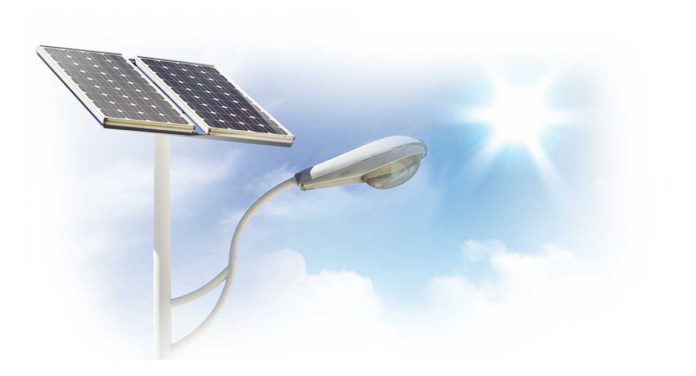

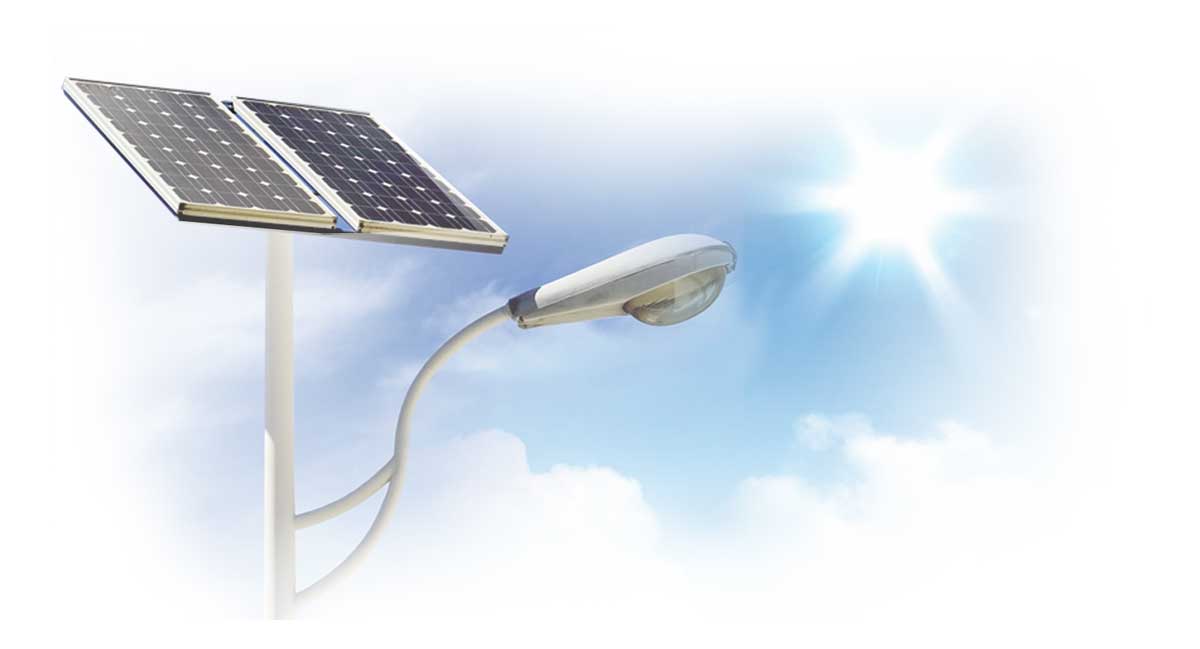
 In areas where cabling and grid power maintenance might be a challenge, investing in solar streetlights is a good option.
By Paromik Chakraborty
The call for energy-efficiency has been stronger than ever, and states like Delhi are steering the drive right from the streets. AC mains-driven LED streetlights are great as low-cost power savers. On the other hand, those who intend to move away from drawing grid power altogether, should consider investing in solar LED streetlights. There are options to ensure optimal returns from streetlighting setups, some of which we explore here.
AC mains-driven LED streetlights: Quick returns
The initial investment in LED technology is higher but it guarantees at least 50 per cent more energy savings than conventional fluorescent lights that dominated the market until recently.
A single LED streetlight setup costs between ₹ 2000 and ₹ 5000 depending on a number of factors, including the LED lumen output, wattage, component quality and cabling. Luminaires of the LED setup generally cost ₹ 30-40 per watt, so power requirements of the user play a major role in determining the end product’s cost. For example, while a 12W system may cost around ₹ 850, a 40W luminaire can cost up to ₹ 2500. Additional expenses include cables for AC mains connection, pole for installing the luminaire and installation charges. If the luminaire can be mounted on a wall, there is no need for the pole.
In areas with stable power availability, state governments can expect a quick return on their investment in AC mains-driven streetlights. An executive from Electropower, a Faridabad-based LED streetlight manufacturer, explains, “An 80W fluorescent light with a choke and other components will consume around 120 watts. This fluorescent light can be easily replaced with a 40W LED streetlight producing equal or brighter light. The replacement creates an offset energy of 120-40=80W, that is, each replaced LED streetlight can save 80W energy per day with no other running expenses throughout the life of LED streetlights.”
Dr Kushant Uppal, founder and CEO, Intelizon Energy, believes that the investment in AC mains-driven LED streetlights can be recovered in two years.
Ankit Bajpai, executive director, EPC, Trisun Sant India, shares the example of 50W AC LED streetlights installed by them. These streetlights cost them ₹ 2500 per unit with additional expense of the poles and cables. They were able to recover the investment cost in one year through electricity bill savings.
 What are the benefits?
LED streetlights save a massive amount of energy while greatly reducing carbon emission. For example, the Indian government’s Streetlight National Programme (SLNP) for installing LED streetlights throughout the country has already resulted in a total of 1172-tonne carbon dioxide emission reduction and 1.4 million kilowatt-hour energy savings annually.
LED streetlights can run up to 50,000 hours, which ensures a life expectancy of at least ten years. Moreover, there are no maintenance problems. LED drivers, if properly manufactured with correct quality control, will run their full life without glitches. As no batteries or extra accessories are required, operational cost is nil throughout the LED streetlight’s lifetime. No ultraviolet emission is another benefit.
Challenges
Dependence on AC mains power is the main challenge. Ankit says, “AC streetlights draw electricity from the utility grid. Therefore, while these reduce electricity consumption, they never nullify the expense.”
While investing in AC mains-driven LED streetlights, a few things need to be kept in mind. An AC LED device designed without a proper heat-sink can lead to overheating of the light, causing it to malfunction. Moreover, LED streetlights emit unidirectionally, so 360-degree coverage of an area will require adjustment of the luminaire’s distance from the ground, proper beam angle, and installation of reflectors or diffusers.
| Expert’s view: Are integrated solar panels a good choice? Streetlights with solar panels embedded on top of the luminaire are the newest options in the market. Sharing his experience of streetlights with integrated solar panels, Ankit says, “We installed an integrated panel system, investing ₹ 6500 a unit. Not being able to tilt the panel, the product could not capture optimal solar energy. So the purpose of the solar panel was not served.” While embedded panel setups come across as a comparatively cheaper and more compact option, many users like Ankit (from Trisun Sant India) believe that these are not optimal for solar generation. |
Solar setup requires expertise in solar panel positioning; in order to capture sufficient amount of solar energy, panels need to be tilted at a certain angle. Moreover, solar streetlights require periodic maintenance for optimal performance. This includes panel cleaning, battery replacement and so on.
Batteries run for an average of 3 to 4 years, requiring replacement. Moreover, external batteries can get stolen. So manufacturers are providing an arrangement to clamp batteries at a suitable height on the pole. Some of the latest streetlighting systems have internal battery systems.
| AC mains-driven LED vs solar LED streetlights | ||
| AC mains-driven LED streetlights | Solar LED streetlights | |
| Cost | Estimated ₹ 2000 to ₹ 5000 and additional costs depending on luminaire wattage, cabling, pole requirement, etc |
₹ 10,000 and above, including additional costs depending on wattage, panel power, battery, cabling, pole requirement, etc |
| ROI | 1 to 2 years | 2-5 years based on usage |
| Optimal application | Energy-efficient lighting option with minimal maintenance at lower cost with quicker ROI. Suited for areas with a comparatively better grid electricity availability | Long-term benefits in terms of financial savings and environmental safe-keeping by minimising grid dependency in lieu of a higher investment. Recommended for remote areas where consistent electricity availability and grid cabling might be a challenge |
Solar LED streetlights: Keep the grid at bay
Solar setups greatly reduce the dependency on grid electricity. Grid-connected solar streetlights are preferred over off-grid systems, as complete isolation from grid electricity may pose problems on foggy days or days with no sunlight.
According to a spokesperson from Gautam Solar, a setup comprising a 12W luminaire, a 75W solar panel and a 40Ah battery costs around ₹ 12,000, while a 43W LED streetlight with 300W solar panel, set of two 75Ah batteries and extension pole costs around ₹ 35,000.
Considering the much higher initial cost and running expenses on the battery, solar LED streetlight gives slower ROI, which can take up to five years of usage. Usually, the battery needs replacement every 3 to 3.5 years. Separately, it costs between ₹ 3000 and ₹ 5000, which adds to the operational expenses.
The benefits of going solar
The major USP of solar streetlights is the cut in grid electricity usage. The electricity thus saved can be distributed to higher-demand areas. This leads to carbon footprint reduction also.
The expected lifetime of a solar setup is 12 years for LED luminaires, 25 years for solar panels and 3-4 years for batteries. All in all, an LED streetlight coupled with solar panels can be a great energy and money saver.
Choice of battery
Currently, two types of batteries are available for solar streetlighting.
Lead-acid batteries are the conventional options in the market. These batteries require constant maintenance and cannot be drained out completely while in use. These allow a discharge of up to 80 per cent. However, while lead-acid batteries require regular manual maintenance, these tend to have a longer life if maintained properly.
Lithium-ion and lithium-ferro phosphate batteries are the latest on the market. These batteries are much lighter (one-third that of lead-acid batteries), allow complete discharge during use and require almost no maintenance. However, their life is limited to nearly 3.5 years. Also, they cost 20-25 per cent more.
Dr Uppal suggests, “Lead-acid batteries are heavy and large in size, requiring them to be installed on the pole externally. These also need regular maintenance. So users need to install them at an accessible height on the pole, which makes them vulnerable to theft. Lithium-ion batteries have a high energy density and are maintenance-free.”
What to buy?
Many buyers opt for AC LED streetlights owing to their lower investment cost and quicker ROI.
Dr Uppal shares, “Solar-based systems are ideal for greenfield projects and remote locations where cabling cost savings, power savings and uninterrupted power (independent of grid) can provide a comparatively quicker ROI within 6 to 24 months, depending on the location.”
Sambid Mohanty, AGM-Solar, Havells Lighting, explains benefits of solar streetlighting with an example: “If you notice AC-driven LED lightings across Noida-Greater Noida roads, a good number of them malfunction, the reason being poor maintenance and frequent power cuts. In areas like these, where cabling and grid power maintenance might be a challenge, investing in solar streetlights would be a better option.”