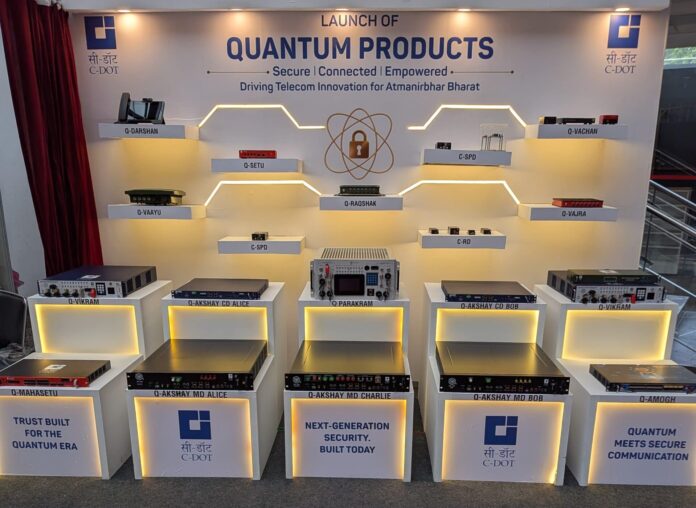

The products have a broad range of applications including, but not limited to Telecom, Defence, BFSI and Government Utilities. According to C-DOT the aim is to lead India into the ‘Quantum Era’ by 2029.
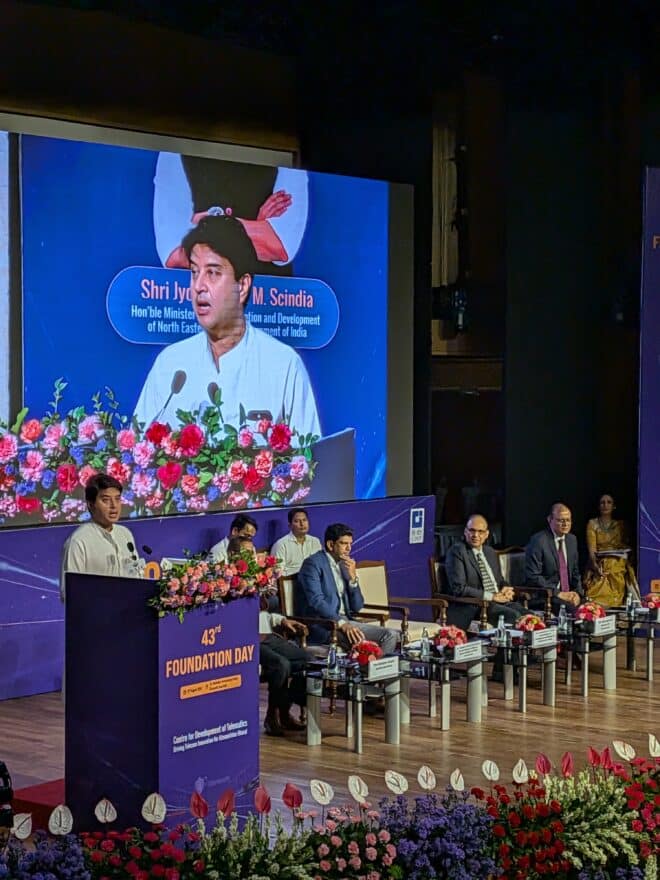
“We were behind the world in 4G, we walked with the world in 5G and it is due to organisations like C-DOT(Centre for Development of Telematics), that we can say that India will lead the world in 6G”, said Union Minister for Communications and Development of North Eastern region, Jyotiraditya Scindia as he unveiled fourteen new Quantum products developed by C-DOT on its 43rd Foundation day.
The products are expected to protect core infrastructure for industries ranging from Telecom and Core networks, Defence, BFSI, and Government Utilities. The aim is a quantum-safe transition through a dual-track security architecture, that is physics-based Quantum key distribution (QKD) for critical communications, alongside algorithmic Post Quantum Cryptography (PQC) across enterprise networks and end-user environments.
“As the world advances towards the Quantum era, C-DOT has emerged as one of the key contributors to India’s secure communication network”, Dr. Rajkumar Upadhyay, Chief Executive Officer of C-DOT said at the event.
The fourteen products launched were classified into two security architectures: physics-based and Maths/algorithmic-based
Physics-Based Quantum Key Distribution (QKD)
Two physics-based Quantum key distribution products namely Q-AKSHAY CD and Q-AKSHAY MD were launched.
Q-AKSHAY CD uses COW (Coherent One-way) and DPS (Differential Phase Shift) protocols over Optical fibre. While Q-AKSHAY MD employs time-bin MDI (Measurement Device Independent) QKD protocol to eliminate detector vulnerabilities. It supports muti-topology deployments over single-mode fibre. Both the products are ETSI (European Telecommunication Standard Institute) compliant.
Other than that two physics-based Quantum Hardware Products were launched: Single Photon Detector, which is a near-infrared single photon detector (900-1700 nm) with up to 30 per cent photon detection efficiency. As well as a Wideband RF Driver covering DC to 15 Ghz with up to *Vpp output voltage and 30 dB gain.
Algorithmic Post Quantum Cryptography (PQC) Solutions
Apart from physics-based distribution products there were nine Maths or Algorithmic based Post Quantum Cryptography (PQC) products launched:
- Q-SETU: Compact PQC encryptor with 80 Mbps IPSec throughput using NIST (National Institute of Standards and Technology) ML-KEM (Module Lattice Based Key Encapsulation Mechanism ) and ML-DSA (Digital Signature Algorithm).
- Q-MAHASETU: High-throughput, tamper-proof core network encryptor offering line-rate payload encryption up to 40 Gbps. Fully supports NIST-standardized ML-KEM and ML-DSA algorithms
- Q-VIKRAM: Defence-grade FPGA (Field-Programmable Gate Array) encryptor delivering 1 Gbps line-rate protection for L2/L3 networks.
- Q-DARSHAN: PQC secured end-to-end video and voice IP phone featuring a 7” touchscreen, camera shutter, and biometric password.
- Q-VACHAN: Plug-and-Play external inline node securing legacyVoIP (Voice over Internet Protocol) calls end-to-end.
- Q-RAQSHAK: Enterprise network client-gateway solution securing campus and remote access channels. Supports Android, Windows, and Linux clients.
- Q-VAAYU: Wireless point-to-point node designed for difficult terrains
- Q-VAJRA-1000: Secure access node for Wi-Fi, GPON, or wireless radio endpoints. Features hardware based secure boot and full-disk encryption.
- Q-PARAKRAM: Military-grade, high-assurance inline network encryptor offering 1 Gbps line-rate payload encryption
Hybrid Security Innovations
Apart from the above, a product with a hybrid security architecture, that is both Maths plus Physics based architecture, in the PQC category was also launched named Q-AMOGH. It is India’s first quantum safe Layer-1 Optical Encryptor, delivering wire-rate encryption up to 200 Gbps with minimum Latency.
National Migration Timeline
India has laid out a phase PQC migration timeline with accelerated timelines for Critical Information Infrastructure (CII). CII for short-term actions or build foundations is to be achieved by 2027. CII for medium term or migrate high-priority systems is to be achieved by 2028 and CII for long-term full PQC adoption is to be achieved by 2029.
C-DOT’s Legacy and Strategic Impact
Centre for Development of Telematics (C-DOT) was India’s premier R&D institution for telecommunications, established under the Ministry of Telecommunications, Government of India in August 1984. It has worked across cybersecurity, 4G/5G technologies, fraud management and disaster relief.
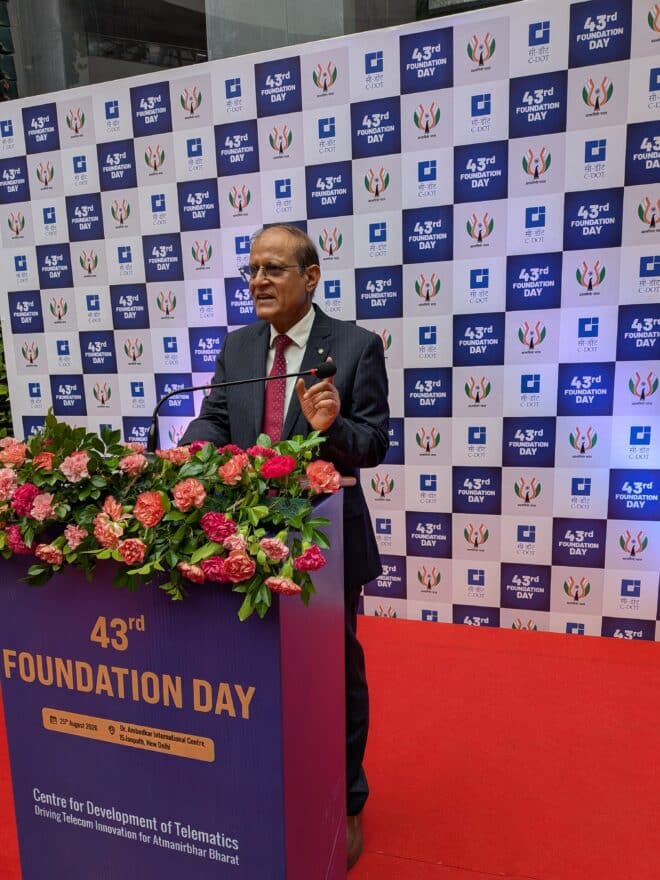
According to CEO Rajkumar Upadhyay,C-DOT is providing emergency service and cell-broadcasting for disaster management across 36 states. C-DOT’s equipment serves 4G/5G services to 2.2 crore citizens through BSNL network of 1,75,000 base stations, placed at 100,000 sites in India. Speaking to EFY, he said that C-DOT expects to be a profitable venture in the next two years. Moreover, he added that C-DOT’s disaster management technologies are already deployed in four other countries, highlighting its export potential.