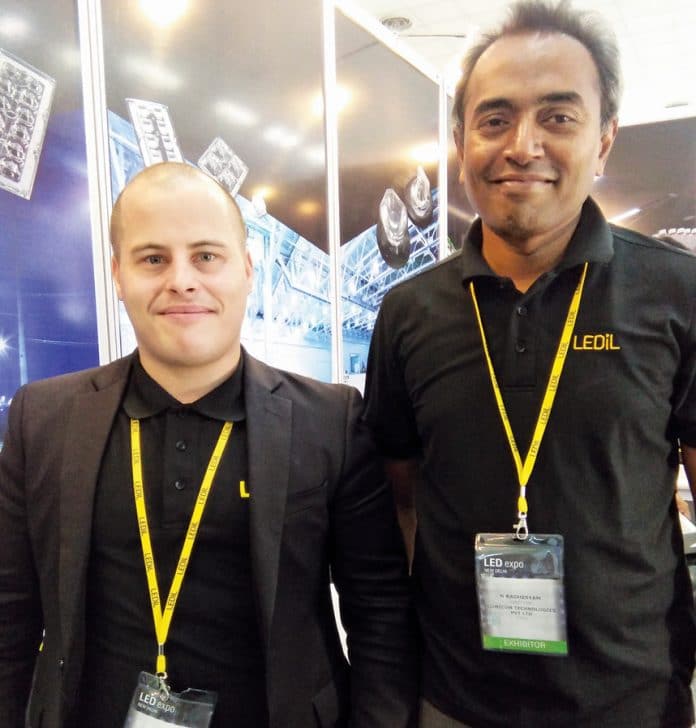

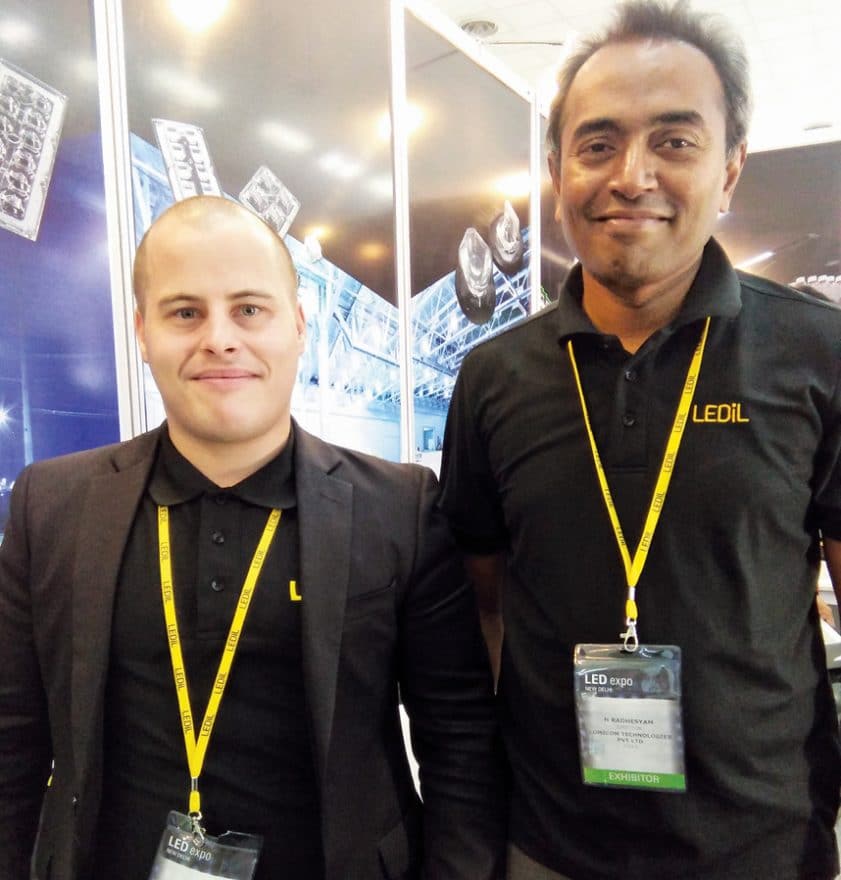
For the seventh consecutive year, LEDiL Oy, an LED optics company from Finland, participated in LED Expo 2017, New Delhi, showcasing its stellar line of optical solutions. Joni Maki, global sales director and Radhesyam N., sales representative, feel that the growing consumer base and bulk government tenders are enough to attract large investments into the LED sector. In conversation with Shruti Mishra, business journalist at Electronics Bazaar, they both share their thoughts on the firm’s expansion plans.
EB: Where does LEDiL Oy operate globally and what made you choose India?
We are a world leading LED lens and reflector manufacturer, currently offering more than 4000 standard optical solutions. We have our R&D headquarters plus three factories in Finland, three plants in China, and have recently opened another one in the USA.
Talking about India, this country has both the high population density and immense market potential. We have been present in India since the last seven years and street lighting is currently our main business here. The Indian government, along with EESL, is replacing all the streetlights with LEDs, which presents an immense investment opportunity for us. Beyond this, we are also present in the high bay and industrial lighting applications space, where customers are switching from conventional lights towards more robust, maintenance-free and longer lasting LEDs.
EB: How do you conduct your business in India?
As we don’t have any registered office in India as yet, we do our business with the help of sales representatives and distributors. In addition, we actively interact with customers directly from Finland. At LEDiL, the most important thing for us is to understand the product requirements and then tailor new solutions accordingly.
EB: So, what are your expansion plans here?
Within six months, we plan to start manufacturing in Hyderabad. Work on this is currently going on in full swing since we have a very distinguished business partner there, and Hyderabad is a practical choice for us from a logistics point of view, too.
EB: Apart from street lighting, are there any other segments that you are planning to target?
The big trend in Europe is retail lighting, which is not yet popular in India, but will eventually come here within a couple of years. Seeing the number of possibilities in LED lighting, especially in the Indian retail sector, we are ready to start redesigning our large product range for this segment here. Also, presently, we have filed an innovative patent for one of our products in the automotive sector, which is also quite an interesting, high volume segment in India.
EB: What modifications have you made in your product line to make it more suitable for the Indian market?
India is a very price driven market with high volumes. To match customer expectations, we needed to develop a totally new product range for this market, with high capacity. All the products that we sell here have been modified according to Indian lighting requirements and standards. We aim to focus on offering the right products at the right price. Even our product names sound familiar for the local market. As an example, our street lighting lens family is called ‘Sitara’ and that actually is our winning range, right now. Customers are happy with the performance (and the names), and they not only tend to buy more but are encouraging us also to make more.
EB: Are you in touch with the government or EESL for any of the lighting tenders?
We don’t directly supply to EESL. Our customers are the customers of EESL. However, we are closely following the tenders, specifications and requirements of EESL. We take care to comply with EESL guidelines, so our products have been altered from both the light distribution and price angles. We already have tailored lenses for the different global markets as per European, Asian and American standards but, in India, we have modified the lenses as per EESL requirements. We have street lighting solutions for 18W, 25W, 32W and 60W tenders.
EB: How much does India contribute to your global revenue?
This year, our turnover is going to be around US$ 54.6 million. India still accounts for only a very small portion of our global revenue, but each year we are growing by 50 per cent. Industrial and linear lighting is booming in Europe, and we are certain that it will definitely hit the market in India too very soon. That will help in increasing the overall market share of our company.
EB: What promotion strategy do you follow in India?
LEDiL is a technology company, so obviously, our priority will be to provide technological advantages for our customers by offering the right solution for a particular application at the right price. We keep our customers updated about the new products through newsletters, frequent visits and interactions. Our customers are not operating in very generic domains, but in very targeted, niche spaces. LEDiL is a known brand in India now. Whenever customers have optical requirements, they remember LEDiL since we have been present here for a long time. We give a local touch to our products’ names, unlike other companies that follow very difficult ordering codes. Easy, catchy names are an important promotion strategy for us.
EB: Did anything change in your business execution plans after the GST rollout?
GST has affected us a little bit, but not much. During July and August 2017, our business dropped by 20-30 per cent. But we are again back on track.
EB: Are there any recommendations that you would like to give to the Indian government?
Our only suggestion is that the Indian government should not go just by price but look at quality as well. Suppliers are already making more and more compromises by providing low quality components, which in the long term will affect the overall projects and reduce the benefits expected from LEDs. So, our intention is to reduce the emphasis on price and try to educate people on how important the quality of the product is; only then will it last for the time guaranteed and the return on the investment will be good.