Global Telecom Equipment Market Rebounds Driven by Cloud

Cloud providers account for over half of H1 2026 revenue growth as spending shifts towards optical transport and high-end routing.

The positive momentum that characterised the global telecommunications equipment market throughout 2025 has carried through into the first half of 2026. Preliminary data from market research firm Dell’Oro Group indicates that aggregate worldwide revenues across six key segments—Broadband Access, Microwave & Optical Transport, Mobile Core Network (MCN), Radio Access Network (RAN), and High-End Routing & Aggregation—grew by 5 per cent year-on-year in 1H26, marking a sixth consecutive quarter of growth.

This sustained expansion follows a 4 per cent revenue increase in 2025, which saw the market recover from a steep 14 per cent decline recorded between 2022 and 2024. While the initial 2025 recovery was driven by inventory normalisation and improving carrier demand, growth in 1H26 shifted markedly towards technologies with direct exposure to artificial intelligence and data centre infrastructure.

Telecom equipment revenue and the contribution of cloud in it. Source: Dell’Oro Group

Although traditional communication service providers (CSPs) still generate over 90 per cent of total telecom equipment revenues, hyper-scale cloud providers are driving incremental expansion. Cloud operators contributed an estimated 55 per cent of total market growth in 1H26, reflecting aggressive capital deployment into AI data centres and associated high-capacity connectivity.

The surge in cloud investment resulted in distinct sectoral performance variations across product categories. Optical Transport and High-End Routing served as the primary growth engines, with Optical Transport recording double-digit revenue expansion on strong demand for data centre interconnects, while High-End Routing & Aggregation benefited from robust purchasing by both cloud firms and traditional telcos. In contrast, aggregate revenues across Radio Access Networks, Mobile Core Networks, Broadband Access, and Microwave Transmission remained largely flat over the same period.

- Advertisement -

Geographically, growth was broad-based across North America, EMEA, Latin America, and Asia-Pacific excluding China. North America benefited significantly from AI-driven demand for optical transport, routing, and fibre access gear. Conversely, the market in China contracted as domestic operators reallocated capital from traditional telecom networks to compute infrastructure; China’s top three CSPs are targeting a 40 per cent increase in computing capital expenditure in 2026, alongside a 24 per cent cut in traditional connectivity spending.
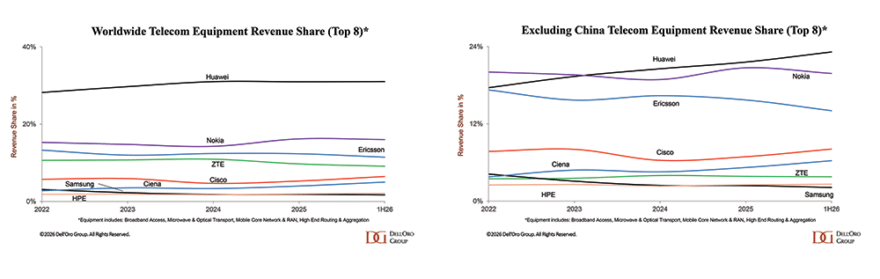
Revenue Share of Major Telecom Equipment Manufacturers. Source: Dell’Oro Group

Vendor market shares outside China experienced notable shifts. Huawei maintained its position as the world’s largest overall equipment supplier, followed by Nokia and Ericsson. However, in non-Chinese markets, Huawei and Cisco gained market share relative to 2025, whereas Ericsson and Nokia saw their combined revenue share drop by approximately three percentage points. This divergence reflects varying vendor exposure to the fast-growing optical and routing segments versus flatter mobile infrastructure markets.

Dell’Oro Group has upgraded its full-year 2026 revenue forecast, projecting global market growth of 3 to 5 per cent (up from earlier estimates of 2 to 4 per cent). While ongoing cloud infrastructure investments provide strong tailwinds, the sector faces potential headwinds in the second half of the year from weakening Chinese spending and rising costs for memory and underlying components.


- Advertisement -
Loading form…
Jaydeep Gadhavi
Jaydeep Gadhavi
Jaydeep Gadhavi is a journalist with EFY business focusing on EV as well as Semiconductor business news.

Industry's Buzz

Samsung Launches 2026 Innovation Campus in Karnataka to Train 2,000 Youth in AI

0
Tech giant collaborates with state government and local university to build future-ready artificial intelligence talent. Samsung India has launched the 2026 edition of its Samsung...

ESSCI and NIELIT Partner to Advance UK-Standard Semiconductor Skilling in India

0
Strategic alliance aims to build a high-tech talent pipeline across semiconductors, AI, and emerging technologies. The Electronics Sector Skills Council of India (ESSCI) and the...

ASML Begins India Operations to Support Tata’s Flagship Semiconductor Fab

0
Dutch lithography giant establishes local presence, tying workforce expansion to India’s long-term semiconductor ambitions. Dutch semiconductor equipment leader ASML has officially commenced operations in India,...

Nandini B takes charge as Chairperson of ELCIA

0
ELCIA has more than 140 member companies and represents businesses across the Electronics City ecosystem. Nandini B, Director at Tescom Private Limited, has taken charge...
CXMT

China’s CXMT Prepares Expansion into NAND Flash Memory

0
DRAM specialist plans Beijing pilot line, crossing into flash storage as global memory shortages intensify.  Chinese semiconductor manufacturer ChangXin Memory Technologies (CXMT) is preparing to...

Learn From Leaders

Ronak Kumar Samantray, Founder, TM2Space Technologies Pvt Ltd.

“Our goal is to build data centres in space.” – Ronak Kumar Samantray, TM2Space

0
A space startup aims to build orbital data centres, letting users run AI models and store data on satellites while also supplying satellite hardware...

India’s Photonics Puzzle Is Finally Coming Together 

0
Can India turn its scattered photonics capabilities into a stronger industry? A new association aims to connect the ecosystem and strengthen the domestic value...
Jin Bains, CEO, Mini-Circuits

Mini-Circuits CEO Jin Bains on Navigating High-Frequency Component SWaP-C Constraints, Emerging Markets, and Career...

0
In this exclusive, Jin Bains, Chief Executive Officer (CEO) of Mini-Circuits, explains in a conversation with Dilin Anand of EFY about areas of emerging...

India Needs Not a Hundred, But Thousands of Chip Diversified Companies 

0
Can India build a semiconductor ecosystem beyond fabs? Indiesemic believes thousands of diversified chip companies are needed to make that possible. India’s semiconductor push is...
L Venkata Subramaniam, CEO, Qbit Force, Andhra Pradesh

“We Aim To Make Quantum Computing More Visible, Understandable, And Open To Build On”...

0
From building India’s first open quantum hardware ecosystem to assembling a working quantum computer in just four months, Qbit Force is redefining how deep...

Startups

Mohit Gupta, Founder and CEO, TYLsemi

“We are democratising custom silicon with reusable chiplets, enabling more companies to build their...

0
In an exclusive interview,Mohit Gupta from TYLsemi explains to Saba Aafreen from Electronics For You as to why the future of AI infrastructure will...
Venkata Simhadri, Managing Director and CEO of ASIP

“Running A Semiconductor Manufacturing Facility Requires A High Level Of Discipline, Consistency, And Attention”-...

0
Prime Minister Narendra Modi recently laid the foundation stone for ASIP Technologies’ semiconductor facility in Tarluvada, Visakhapatnam. In an interaction with EFY’s Nitisha Dubey,...
Sarah Osentoski is the Chief Technology Officer of Vinci

A Startup Building An AI Copilot For Physics 

0
What if engineers could solve complex design problems in minutes instead of hours? An AI startup is building a system that uses physics-based AI...
Ronak Kumar Samantray, Founder, TM2Space Technologies Pvt Ltd.

“Our goal is to build data centres in space.” – Ronak Kumar Samantray, TM2Space

0
A space startup aims to build orbital data centres, letting users run AI models and store data on satellites while also supplying satellite hardware...
Manivannan Subramaniam, Director R&D, CIYES Systems

“We Want to Build Globally Competitive Deep-Tech Products from India” –  Manivannan Subramaniam, CIYES...

0
Can India build globally competitive deep-tech products? Manivannan Subramaniam of CIYES Systems believes it can. In this interview with EFY's Nitisha Dubey, he discusses...