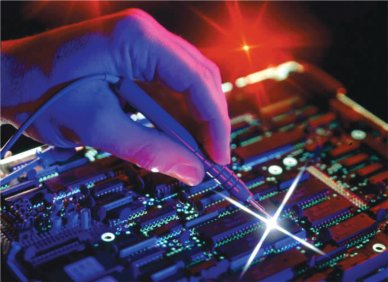

The PCB industry is not only facing stiff competition from imports, but is also struggling under an unfavourable tax structure, and the drawbacks of the dated technology used in domestic PCB manufacturing
By Nitasha Chawla
 Unlike in other countries, the PCB industry in India is yet to take off, and faces stiff competition from imports. Despite India manufacturing a wide range of single-sided, double-sided, flexible, rigid-flex and multi-layer PCBs, there is a stark difference between their volumes of production vis-a-vis other countries. Hence, India’s demand is mainly met by imports from China, Taiwan, Hong Kong, Korea and the US. In fact, imports from China and Taiwan are cheaper by about 5 per cent than locally produced PCBs. However, India exports 30 per cent of its production.
Indian manufacturers can supply products in small quantities, and this is one of the biggest advantages the country has over China, which can only supply in bulk. According to an industry expert, and Anurag Dhoot, CEO, Epitome Components Limited, the PCB market in India grew at a CAGR of around 15 per cent in 2012. Anurag Dhoot says that there is an increase in demand every year but it isn’t necessarily catered to by the domestic industry.
Demand and potential of the market
An Indian Printed Circuit Association (IPCA) report states that in 2009-2010, the demand for PCBs in India was US$ 920 million and by 2014-2015, it is expected to be US$ 1700 million, registering a 15 per cent growth.
Durga Rao, managing director, Sulakshana Circuits, believes that the proposed government initiatives to improve the domestic manufacturing sector will also expand the PCB market in the areas of defence, space, nuclear power and other related industries, raising the demand for hi-tech PCBs. “In order to cater to this increased demand, we are planning to upgrade our technology for high-end PCB manufacturing,” she says.
Since the increased demand isn’t being met by the domestic manufacturers as PCBs are imported in large volumes, the Indian industry is worried. Shares Rajneesh Garg, managing director, Garg Electronics, “The total volume of PCBs may not be shrinking, but domestic manufacturing is suffering since more and more PCBs are being imported.” According to Garg, the demand for PCBs in the power conditioning equipment was less last year and hence, manufacturers who cater to this segment suffered.
Considering that PCBs are the backbone of the electronics industry, the government has taken steps to boost the PCB industry by making the use of locally-made bare PCBs mandatory under the Preferential Market Access (PMA) scheme. However, the industry is not sure if this policy will be beneficial for them. Says the industry expert, “We are yet to see any significant impact on PCB demand due to this policy. However, if it goes as per the plan of the government, there will be some respite for domestic manufacturers.”
But since the PMA policy focuses on boosting bare PCBs, those making PCB sub-assemblies do not see the policy benefiting them. Says Rajneesh Garg, “I don’t see the PCB industry benefiting much from the PMA policy because bare PCBs are used only in a few equipment. We basically provide PCB sub-assemblies.”
Current technology trends


PCBs designed and assembled in India are more in line with global standard technology. Shares the industry expert, “PCBs come in completely knocked down (CKD) and semi-knocked down (SKD) kits, which are mixed in technology, like standard, HDI, micro-via, etc.”
Informs Vinit Lal, managing director, Vintek Circuits, “Earlier, the CRT TV industry was the biggest consumer for single-sided PCBs. However, now the trend is shifting to LCD and LED TVs, for which only multi-layered PCBs are used. And most Indian manufacturers are importing the assembled panels from China. Now, the only major application of single-sided PCBs is in the lighting industry.”
According to Durga Rao, new materials like nano-materials have helped to manufacture reliable boards at lower costs. “The use of improved coating processes not only reduces the cost of production but also helps to lower costs when moving into higher volume products,” she says.
PCB players feel that miniaturisation of electronic devices is a trend that is here to stay. Since semiconductors are getting tinier, PCBs are also getting smaller. As a result, manufacturers are producing double-sided and multi-layer PCBs. This requires micro-via technology, which use small holes or vias, created with lasers, through which multi-layered PCB traces interconnect components. These vias are less than or equal to 50 um in diameter.
Another trend is the increased use of aluminium boards. At present, boards are made of polyester and polyimide materials, but since aluminium has excellent heat and electrical conductivity (it has a perfect base for PCBs used in LED manufacture, for dissipation of heat devoid of extra heat sinks), its demand is slowly picking up. Moreover, aluminium-based PCBs are also lighter and more durable. These are mostly used in the lighting industry, and slowly local demand is also picking up.
Challenges faced


The PCB industry in India is facing several challenges which are restricting its growth and making it difficult for manufacturers to survive. According to the industry expert, imports of PCBs must be curbed immediately as the industry is suffering from the growing competition from China, which sells at a lower price than Indian manufacturers.
Durga Rao cites three main challenges which the PCB industry is currently facing — the rupee’s devaluation, competition from China and the slow progress in implementing the government’s new electronics policy.
For an industry that is heavily dependent on imports for raw materials and machines, the rupee’s devaluation has been a major setback. Shares Vinit Lal, “The basic raw material used for making PCBs, like the copper-clad laminate, is completely imported. Besides, a lot of other elements play a role in raising the cost of Indian-made PCBs like exchange rate fluctuations, and the inverted duty structure which makes up 75 per cent of the total PCB price. Also, it is not possible to keep increasing the price of PCBs due to fluctuations in exchange rates since the buyers expect us to absorb the increase in costs.”
Besides, 90 per cent of the PCBs developed locally are of very low technology. If India needs to compete in the global market, it will have to adopt and invest in world class PCB fabrication capabilities to support hi-tech applications in sectors like defence and aerospace, automotive, etc.
Adding to the above problems are the infrastructure related issues like the high cost of power, chronic power outages, poor connectivity of the industrial hubs with ports and markets, lack of PCB testing facilities, etc.
Solutions to boost industry
Industry experts believe that immediate government involvement is required to boost the domestic PCB industry. Shares Vinit Lal, “We are competing with China in both the double-sided and single-sided PCB markets. There is no duty on the import of PCBs from China. IPCA has urged the government to impose an anti-dumping duty on PCBs but nothing has happened so far. The government has not done anything to check this.”
Anurag Dhoot thinks that only when the imports come down, will the PCB market be able to expand and re-invest its profits in the business. “As of now, the industry has not been able to scale its technology and business models to serve a larger number of customers due to the inherent lack of technical and delivery capabilities, for which it needs to make large investments in the business,” he says.
The industry experts suggests that the government should take a strong step (like the current gold import policy) for PCBs as well. “The electronics industry starts with components and one has to build on that foundation, unlike the present situation in India where there is no clear direction and goal. We need to have a system that works from the bottom, upwards, for electronics manufacturing.”
While building a strong manufacturing base is a long process, some immediate reforms on the tax and incentives front may help the PCB industry to perform better. Shares Rajneesh Garg,“We need to go through a tremendous amount of government regulations to get excise tax exemption. Also, the documentation and procedure for the import of raw materials is very tedious; even for a small quantity, one has to go through a long process of documentation. We also need support from the government in improving the infrastructure, which is very necessary to encourage manufacturing.”
Electronics Bazaar, South Asia’s No.1 Electronics B2B magazine