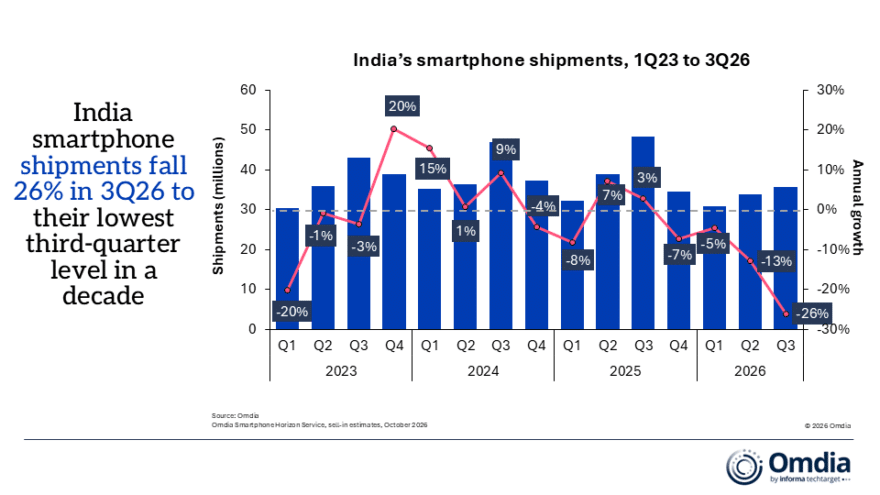
The festive season fails to spark demand as rising prices and cautious spending push quarterly volumes to a ten-year low.
Smartphone shipments in India fell by 26 per cent year-on-year to 35.8 million units in the third quarter of 2026, marking the lowest third-quarter volume recorded since 2016. Despite the arrival of the festive season, higher device prices and muted consumer spending severely dampened replacement demand, leading manufacturers to scale back inventory. The quarterly slump was further exacerbated by a quieter online shopping period and a late Diwali, which pushed much of the traditional offline inventory build-up from September into October.
Vendor Landscape
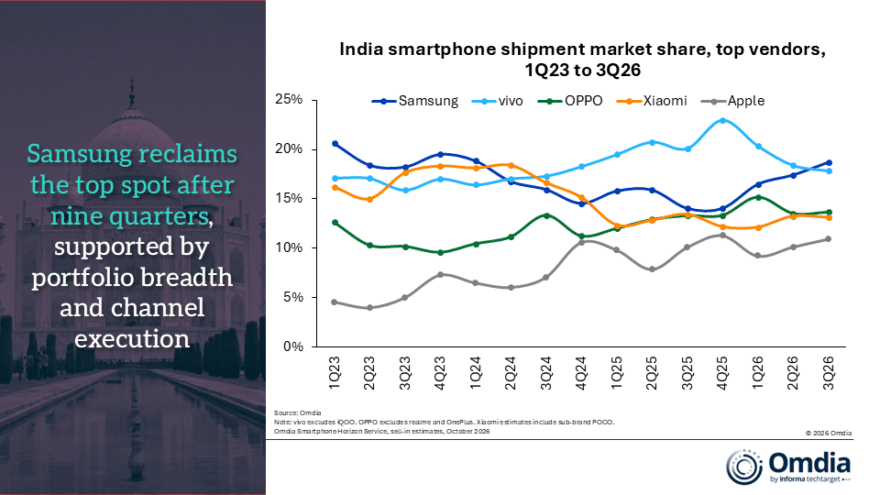
- Samsung reclaimed the top spot for the first time since the first quarter of 2024, shipping 6.7 million units. Performance was anchored by mass-market models including the Galaxy A07, A17, and A27, whilst the Galaxy S26 series, new Z foldables, and the S26 FE bolstered its premium line-up. Extended financing schemes, trade-in allowances, and bank cashback offers helped drive upgrades across various price bands.
- vivo dropped to second position as shipments fell 34 per cent year-on-year to 6.4 million units—the steepest decline among the top five vendors. Successive price increases disrupted retailer inventory planning, whilst supply constraints at the entry level hurt competitiveness. Volumes were primarily driven by the Y11 5G and Y21 5G, alongside the re-introduced S-series.
- OPPO secured third place with 4.9 million units shipped, down 24 per cent year-on-year. Higher prices and hesitant retailer ordering impacted its core A-series, though the camera-focused Reno16 series and targeted financing supported demand in higher price segments.
- Xiaomi placed fourth, shipping 4.7 million units—a 28 per cent year-on-year decline. Rising component costs forced the brand to compromise on pricing and hardware configurations, weakening its traditional value proposition. Entry-level models like the Redmi 15A and A7 anchored volumes, while the Redmi Note 17 series and POCO X8 range supported the upper tier.
- Apple finished fifth with 3.9 million units shipped, buoyed by retailer stocking ahead of expected price hikes and sustained interest in the base iPhone 17 and 16 models. Late-quarter momentum for the newly launched iPhone 18 Pro and Pro Max was further bolstered by zero-cost monthly instalment plans and trade-in incentives.
Market Shift and Future Outlook
“India’s smartphone market is shifting from online-led shipment expansion during the festive period to more selective, channel-driven growth, challenging vendors’ traditional volume strategies,” noted Sanyam Chaurasia, Principal Analyst at Omdia.
Chaurasia highlighted that September—typically a key period for stocking up ahead of major online sales—saw sluggish momentum. A lack of exclusive launches, fewer budget options, and less aggressive discounting diminished the online channel’s usual festive pull. This trend hit Chinese manufacturers particularly hard, with their combined market share shrinking from 75 per cent in the third quarter of 2025 to roughly 68 per cent in the same period of 2026. Conversely, Samsung and Apple expanded their footprint through premium offerings, established retail networks, and structured trade-in initiatives.
Looking ahead, Omdia projects a further low-single-digit decline for the Indian smartphone market in 2027 following a difficult 2026, as longer device replacement cycles and elevated prices persist. Pricing pressure is expected to continue through at least the first half of 2027.
To reignite consumer interest, analysts suggest that brands will need to look beyond minor hardware updates and focus on meaningful artificial intelligence features. According to Omdia’s research, nearly 40 per cent of consumers in India indicated a willingness to pay extra for genuine AI capabilities, making flexible financing, trade-in programmes, and software innovation crucial to driving future upgrades.