
India’s EMS Market Set To Cross ₹12.68 Trillion By FY30

India’s electronics manufacturing services (EMS) sector is entering a new phase as rising exports, government incentives and the China+1 strategy drive manufacturing investments.

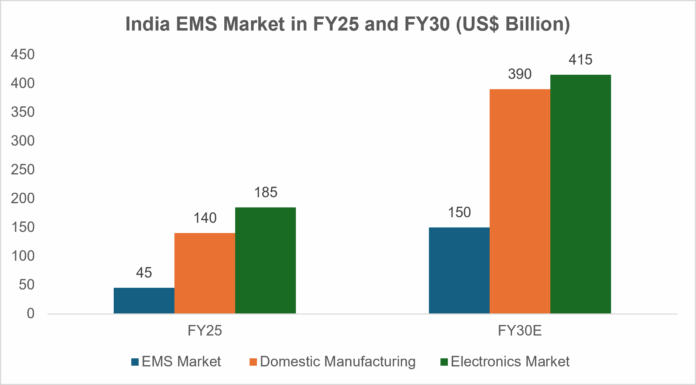
India’s electronics manufacturing services (EMS) market is expected to grow sharply as global electronics companies diversify their supply chains and manufacturers expand capacity in the country. According to KPMG, the Indian EMS market reached approximately ₹3.38–3.81 trillion in FY25 and is projected to cross ₹12.68 trillion by FY30.

India has emerged as the world’s second-largest mobile phone manufacturer by volume and an increasingly important production base for global technology companies. Smartphone exports are also rising, with Apple and other global electronics companies and their suppliers increasingly using Indian plants as export hubs.

The EMS sector recorded a revenue compound annual growth rate (CAGR) of around 24 per cent between FY19 and FY24 and is estimated to grow at around 27 per cent between FY24 and FY29, supported by supply-chain diversification and the China+1 strategy.

Government programmes including the Production-Linked Incentive (PLI) scheme, SPECS, EMC 2.0, India Semiconductor Mission (ISM) and Electronics Components Manufacturing Scheme (ECMS) have helped attract investments and expand India’s electronics ecosystem.

- Advertisement -

The broader electronics manufacturing sector has also expanded significantly, with production rising from around ₹1.9 trillion in FY15 to ₹11.3 trillion in FY25. Electronics have consequently moved from the seventh-largest export segment in FY22 to one of India’s leading export categories.

Components remain a challenge

Despite this growth, India accounts for only around 5–6 per cent of global EMS manufacturing output. The country has developed strong capabilities in smartphone assembly and PCBA manufacturing, but remains dependent on imported components, particularly from China and Hong Kong.

The next phase of growth is therefore expected to focus on increasing domestic value addition through component manufacturing, semiconductor fabrication, packaging and design.

India is targeting a ₹42.28 trillion electronics ecosystem by 2030, including ₹33.82 trillion in manufactured electronics and ₹8.46 trillion in components.

Achieving this target will require India to move beyond assembly-led manufacturing and diversify into semiconductor design and packaging, IT hardware, telecommunications, automotive and medical electronics. As global supply chains continue to diversify, strengthening domestic components and higher-value manufacturing will be key to India capturing a larger share of the global electronics value chain.


- Advertisement -
Loading form…
Nikita Kumari
Nikita Kumari
Nikita Kumari is a Journalist at EFY. She decodes deals, investments, and policy shifts, redefining the semiconductor and tech landscape.

Industry's Buzz

EV (Representational Image)

Solterra Technologies Partners With Sinpro for EV Powertrain Components in India

0
The partnership is expected to support the adoption of EV powertrain technologies in India Ghaziabad-based EV charging and power electronics startup Solterra Technologies has partnered...

FCC Clarifies Equipment Rules, Sparing Chinese Optical Transceiver Makers

0
US communications watchdog leaves data-centre components off blacklist, easing market fears as the AI optical interconnect sector booms. The US Federal Communications Commission (FCC) has...
Samsung

Samsung Starts AI Data Centre Cooling Equipment Production In Pune

0
Samsung has started mass production of specialised AI data-centre cooling systems at its new Pune facility, adding India-made AHUs, FWUs, and CRAHs to its...
Image for representation purpose

VoltaXplore Shifts 21700 Battery Cells From EVs To Defence

0
Canadian battery maker VoltaXplore is shifting its 21700 lithium-ion cells from mass-market EVs to defence drones, UGVs, and portable electronics to pursue specialised demand...
Image for representation purpose

DRDO Opens Defence Electronics Source Codes to Industry

0
Private defence manufacturers can now access DRDO weapon-system source codes to manage electronics obsolescence, software upgrades, and capability enhancements with less laboratory dependence. Private defence...

Learn From Leaders

Ronak Kumar Samantray, Founder, TM2Space Technologies Pvt Ltd.

“Our goal is to build data centres in space.” – Ronak Kumar Samantray, TM2Space

0
A space startup aims to build orbital data centres, letting users run AI models and store data on satellites while also supplying satellite hardware...

India’s Photonics Puzzle Is Finally Coming Together 

0
Can India turn its scattered photonics capabilities into a stronger industry? A new association aims to connect the ecosystem and strengthen the domestic value...
Jin Bains, CEO, Mini-Circuits

Mini-Circuits CEO Jin Bains on Navigating High-Frequency Component SWaP-C Constraints, Emerging Markets, and Career...

0
In this exclusive, Jin Bains, Chief Executive Officer (CEO) of Mini-Circuits, explains in a conversation with Dilin Anand of EFY about areas of emerging...

India Needs Not a Hundred, But Thousands of Chip Diversified Companies 

0
Can India build a semiconductor ecosystem beyond fabs? Indiesemic believes thousands of diversified chip companies are needed to make that possible. India’s semiconductor push is...
L Venkata Subramaniam, CEO, Qbit Force, Andhra Pradesh

“We Aim To Make Quantum Computing More Visible, Understandable, And Open To Build On”...

0
From building India’s first open quantum hardware ecosystem to assembling a working quantum computer in just four months, Qbit Force is redefining how deep...

Startups

Sarah Osentoski is the Chief Technology Officer of Vinci

A Startup Building An AI Copilot For Physics 

0
What if engineers could solve complex design problems in minutes instead of hours? An AI startup is building a system that uses physics-based AI...
Ronak Kumar Samantray, Founder, TM2Space Technologies Pvt Ltd.

“Our goal is to build data centres in space.” – Ronak Kumar Samantray, TM2Space

0
A space startup aims to build orbital data centres, letting users run AI models and store data on satellites while also supplying satellite hardware...
Manivannan Subramaniam, Director R&D, CIYES Systems

“We Want to Build Globally Competitive Deep-Tech Products from India” –  Manivannan Subramaniam, CIYES...

0
Can India build globally competitive deep-tech products? Manivannan Subramaniam of CIYES Systems believes it can. In this interview with EFY's Nitisha Dubey, he discusses...

Raptee.HV, Rajalakshmi Engineering College Launch EV Centre of Excellence

0
The facility is among the first initiatives under Raptee.HV Academy Raptee.HV has launched a Centre of Excellence for Electric Mobility at Rajalakshmi Engineering College (REC),...

Agnikul Cosmos Opens New Facilities to Advance Reusable Rocket Development

0
STIF has been designed and fabricated in-house to test complete reusable rocket stages under flight-like conditions Indian space-tech company Agnikul Cosmos has inaugurated two new...