Surging AI infrastructure demand generates diverse roles across engineering, management, and healthcare, boosting formal sector employment.
India is preparing for substantial capital deployment in data centre capacity, driven by the rapid adoption of artificial intelligence services that require larger and more advanced computing infrastructure. According to recent data from Indeed Hiring Lab, 1.3 per cent of Indian job listings mentioned data centres in August, marking an increase from 1.0 per cent a year earlier and nearly doubling the rate recorded two years prior. Financial advisory firm KPMG estimates that the data centre sector represents a $90 billion market opportunity for India by 2035.
While public debate around AI frequently focuses on workplace automation and the potential disruption of existing occupations, the technology’s most immediate economic impact is materialising through the physical infrastructure required to operate AI at scale. Callam Pickering, Senior Economist for APAC at Indeed, noted that expanding national data centre capacity is generating a distinct layer of employment demand as companies build out support systems for AI and digital services. He highlighted that constructing and maintaining these complex operations extends far beyond technical software roles, creating steady recruitment across engineering, project management, facilities oversight, and general business operations.

During the 2025–26 financial year, software development comprised 28 per cent of Indian data centre job listings, while IT infrastructure and systems roles accounted for an additional 22.7 per cent. However, non-technology occupations represented a substantial portion of overall recruitment, highlighting that building and maintaining data facilities requires a diverse workforce beyond traditional IT software roles.
Management positions led to non-technical hiring at 9.9 per cent of total postings, followed by key roles in industrial engineering (5.8 per cent), sales (5.2 per cent), electrical engineering (3.6 per cent), and project management (3.5 per cent). This distribution reflects the multidisciplinary operational demands involved in scaling up large-scale data infrastructure.

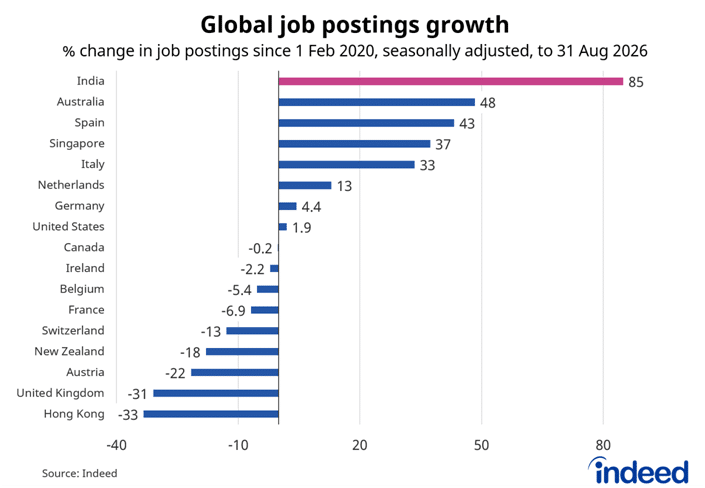
Overall hiring activity across India strengthened in August, with job postings on recruitment platform Indeed edging up by 0.2 per cent. This modest rise consolidated previous monthly gains to stand 7.4 per cent higher year-on-year. Despite recent fluctuations in posting volumes, recruitment intensity across the country remains exceptionally elevated, running 85 per cent above pre-pandemic benchmarks.
Because Indeed tracks recruitment within the formal economy—skewing towards corporate, technology, and sales roles—the data highlights India’s steady transition away from informal employment structures. As job creation in the formal sector continues to outpace broader national employment growth, India’s posting trajectory has significantly outperformed other global markets monitored by Indeed.

This shift toward formalisation represents a structural benefit for the Indian workforce, as formal roles typically provide higher remuneration, greater job security, and clearer pathways for career progression. The sustained resilience in recruitment postings underscores ongoing economic modernization and expanding professional opportunities nationwide.
Job postings grew across nearly 80 per cent of occupations over the past three months, driven primarily by sharp increases in healthcare and caregiving roles. Childcare listings led the expansion with a 27 per cent surge, followed closely by nursing at 23 per cent, pharmacy at 20 per cent, and physicians and surgeons at 17 per cent, alongside solid gains in dental and medical technician roles.

This expansion was partially tempered by continued softness in the technology sector over the same period. Listings for IT infrastructure and support dropped by 20 per cent, while software development fell 19 per cent, data analytics declined 14 per cent, and IT systems roles slipped 7.6 per cent. Nevertheless, overall tech recruitment volumes remain historically healthy and well above pre-pandemic benchmarks despite underperforming the wider market.
Pickering noted: “The strongest recent hiring growth is coming from healthcare and other people-intensive occupations. The gains in nursing, pharmacy, childcare and medical roles point to sustained demand for services that rely on human expertise and cannot be easily substituted by technology.”