
Most innovations that are happening in UPS for offices are focused on increasing efficiency. This helps in saving power and the environment as well. With technology advancing in a fast pace, customers are demanding UPS solutions with advanced technology and desiring the most feature packed products, doubling the competition in the market. In such a scenario, a company’s ability to successfully identify and launch new, innovative products has become one of the most essential criteria for success. In this process, improving upon existing technologies has become imperative and many enterprises have established strong R&D units, into which they pump a fair amount of money every year to innovate and create new and unique products.
By Srabani Sen
Sunday, February 21, 2010: UPS with two new technologies are being evolved—hybrid topology and fuel cell based UPS systems. Explains Gaurav Burman, director, transaction business, American Power Conversion (APC), “Quite evidently, online technology is not an efficient one while line interactive is not the best mode as it lacks the capability to take care of small fluctuations. A hybrid technology is, therefore, being evolved. In this system, the UPS remains in standby mode till the voltage fluctuations are in acceptable preset limits and comes online when needed making it more efficient. Fuel cell based UPS systems are also being developed by some high end research organisations which will use hydrogen as fuel to offer longer backup time. However, it is yet to be declared as a commercial technology.”
According to Deepak Sharma, country business head, UPS, Delta, “Scalable and modular UPS will be more popular in future as it reduces the initial investment for the customer. Rack based UPS solutions are a necessity in most IT environment to minimise the space requirement.”
UPS needs to be equipped with network management capability for remote management and control. They are now expected with large chargers (internal or external) and capabilities to manage, diagnose and optimise large banks of batteries. Energy efficiency will be a crucial consideration in all future buys of UPS because of increased awareness among customers to opt for green products. Conventionally, UPS in small offices offer efficiency up to 85 per cent. But today, UPS are much sophisticated with LCD displays, producing clean sine wave output. “These systems offer efficiency as high as 94 per cent in sub 10 kVA range. We have introduced systems that offer 94 per cent efficiency and KW at 0.9 o/P pf. These systems can offer higher power density and can connect more work stations,” says Venkat Rao, country manager, medium and large UPS systems, Emerson Network Power (India) Pvt Ltd.
According to Sharma, the trend today is moving more and more towards compact systems and rack based solutions to minimise the space required. “As networks are becoming more complex, far flung and being managed from remote control sites, UPS needs to be equipped with multiple network management protocols and flexible enough to incorporate diagnostics and predictive failure analysis,” explains Sharma.
UPS are now coming with higher capacity chargers, add-on chargers and accessories that provide the user the capability to manage, diagnose and optimise medium to large battery bank installations. “The challenges of flexible capacity enhancements and lowest mean time to recovery (MTTR) demands are best addressed by modular and scalable UPS like Delta NH Plus series,” he adds.
Other latest trends are UPS with LCD panels for user friendly information, IGBT with digital signal processing (DSP), modular UPS and UPS with solar charger. “Microtek develops innovated products from time to time. Customers save money by using our products as we use transformers with less core watt loss,” says Sunil Jain, vice president, public relations, Microtek International.
The current trend is the usage of online UPS and preference is being given to centralised UPS rather than distributed configurations. Customers expect customised solutions rather than standard UPS. Vendors are expected to integrate UPS with batteries, alternate source like DG sets and static/automatic transfer switch to provide for complete power protection. According to Arun Ghosh, MD, Hita Technology, space and cost are the main issues now, hence offices are going for modular UPS. “Solar powered UPS can also reduce the recurring cost,” he adds.
upsINVERTER.com has come up with numerous innovative features for its products, including multistage charging, auto adjustments in batteries (resulting in enhanced battery life), accentuated battery backup, improved power generation and higher efficiency. “Necessity is the mother of invention and the fierce competition and picky customers drive us to constantly excel through innovation. Also, we believe that innovation of product technology is the true and most effective advertisement for products. One doesn’t need to rely on heavy marketing if his products have features that customers desire,” says Yogesh Dua, MD, upsINVERTER.com.
“upsINVERTER.com has come up with a combo UPS system, which is a cross between a UPS and an inverter. It is a high frequency device, which allows multistage charging. It also has battery level display and can be configured to run IT products as well as household ones. “It takes time to innovate new products, but new products always translate into new business,” comments Dua.
Power-One Micro Systems has developed a gamut of unique products including transistorised UPS systems, 80kVA UPS systems, 2×40 kVA parallel redundant online UPS systems, passive filters for UPS systems to reduce input current harmonics and improve input power factor and solar power systems. “Through R&D, we continuously ameliorate our products and launch new, innovative ones, due to which, we are able to retain our customers and foray into new areas of business. We also innovate in the pursuit of concocting cheaper products with great quality,” says M R Rajesh, director, Power-One. The company’s UPS systems possess the paralleling feature. If a customer wishes to increase the load, he can add another UPS parallel to it and connect it to the same electrical wiring. Power-One’s digital design makes it possible to avoid the usage of analogue circuits.
The active harmonic filter static synchronous compensator can reduce the current harmonics generated by load. Reduction of harmonics is advantageous to the customer as it decreases the chances of machine failures, cable heating and tripping of switch gears and also leads to overall improvement of power generation.
Green solutions demanded
Consumers are now more aware and demand cost effective and green solutions. Emerson has launched various new technologies with energy saving functions like energy optimiser and intelligent paralleling. The energy optimiser works on a multi-module UPS system. This function measures the load and monitors the UPS capacity. Depending on the threshold points set, redundant UPS will be switched off/on as load varies, ensuring the UPS are always loaded at their maximum efficiency range. “In 1+N system, if the load is less than the connected modules, one or more module would be idle. But intelligent paralleling function improves efficiency without compromising on the availability load profiling. It monitors the off peak times of modules and adaptively schedule modules to be offline to distribute the operating hours to all modules,” explains Rao.
APC offers green technology based on power saving features that can power down the loads in a situation of ‘no activity’ for some time. Delta’s E-Series has high AC to AC efficiency resulting in lower running cost, quieter operation and lesser load. “It is a truly green UPS, with widest input voltage range to help users to maximise the mains utilisation, thus saving on battery life and replacement costs. These UPS operate on mains mode at voltages as low as 80 V. It has input power factor correction up to unity to reduce input current resulting in lower electricity bills and minimising harmonics,” states Burman.
Luminous UPS are fast charging with near unity input power factor. Its units also have inbuilt input power factor corrector. upsINVERTER.com UPS—with brand name UTL—have single card facility that minimises circuit loss, mechanical loss, stray loss and improves efficiency of the system. It also saves power. Microtek uses high-grade-low-watt loss silicon steel core in transformers with a watt loss of <4W, “whereas other manufacturers use core with a minimum watt loss of 6W which consumes more power. Our products help to save on watt loss, leading to a saving of Rs 30-70 per month on 600VA to 1500VA units. The higher the capacity the more the savings. Our double sided PCBs with PTH also gives better performance and ensures reliability,” says Jain.
Delta claims to be “future ready” to face any challenges and situations. “We believe in making green power protection for real. All Delta product lines have green features like wide input voltage range, which helps to extend the life of the batteries; high energy efficiency, which results in lower wastage of electrical energy and saving of electricity bills; advance battery management, which extends the life of the battery and reduces its consumption,” points out Sharma.
Epower finds out some of the innovations that have taken place and the changes technologies are going through.
UPS with double conversion technology
Delta has introduced a new range of 1-3 kVA UPS systems—E-Series—a single phase, online UPS system with double conversion technology to provide high performance and reliability for mission critical applications. It is suitable for SMEs and corporate segments. E-Series is built on plug-n-play style, has intelligent self diagnostic functions, light weight and provides freedom to choose extended runtime options. This microprocessor controlled, high frequency PWM technology based double conversion UPS system has IGBTs at inverter stage and provides pure sine wave output. Its cold start allows the UPS to start on mains supply without batteries or on batteries without mains supply. It also has widest input voltage range to help users’ maximise the utilisation of mains, thus saving on battery life and replacement costs.
Delta R-Series UPS system comes in a futuristic design using online double conversion topology. This system comes with high power density and adjustable LCD display for easy rack or tower convertibility. Its input power factor correction up to unity results in lower electricity bills and minimises harmonics making it generator compatible and environment friendly.
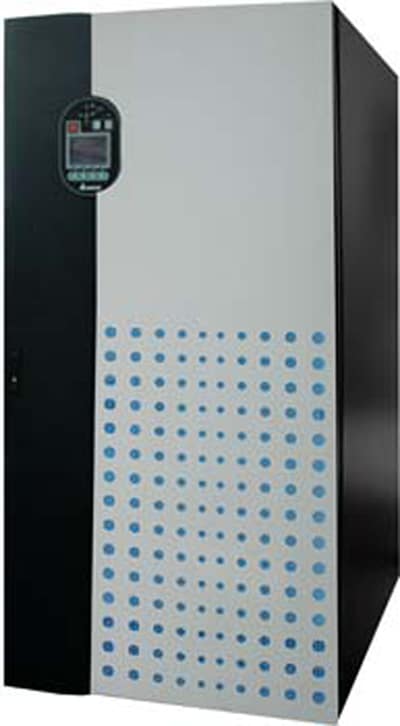
With high efficiency and modular structure, NH Plus Series maintains 94 per cent efficiency even under 25 per cent loading conditions. Due to its extreme power efficiency, it can save electricity bills considerably. Another remarkable cost reduction feature of the series is its hot, swappable modular structure. Each power module delivers 20 kVA high power density in a 3U height chassis. This UPS system allows IT managers to protect their data from power fluctuations in a flexible and scalable way, resulting in lower initial acquisition costs as well as minimised MTTR and system downtime.
UPS with intelligent power distribution system
Emerson’s Liebert ITA intelligent power system is an integrated IT equipment room UPS with environment friendly and energy efficient features. The UPS and battery system adopts the IT style rack and is designed to match aesthetics of server or network racks and can be kept in the same lineup. This reduces the wiring cost as compared to the conventional systems because of its integrated intelligent power distribution system. The system has an inbuilt 30kVA rack mounted UPS and its hot swappable power modules reduce MTTR, maintaining power to the load while faulty units are being replaced online.
Liebert NXr is an efficient, space saving and flexible solution with a standard efficiency rate of up to 96 per cent in a compact, low footprint UPS. It keeps the office network protected while saving on cost and space. It has double conversion technology, which provides 100 per cent protection with complete input to output isolation and totally regenerated power. The system also has redundancy options and flexible battery configurations. It is sized to minimise capital equipment expenses and designed for optimum efficiency. It provides 100 per cent usable real power with high generator compatibility because of low input. It has configurable battery and standard top cable entry and allows easy configuration of different system architecture like dual bus and parallel ability.
Sine wave combo with inbuilt AVR facility
UTL’s Hi-Lite is a high frequency sine wave combo, which can run on inverter as well as UPS mode and has an inbuilt AVR facility. This is absolutely safe from smoke or sound pollution and is suitable for any kind of load like computer, tubelight, fan, cooler, motors, etc. The user can get backup of his own choice, that is, as much load is put on the battery, it will discharge accordingly. This combo has the facility of SMS charging and its power consumption is very less. It also contains no load current less than 1.2 Amp and has input voltage range from as low as 100 V. It is found in the range of 600 VA to 3 kVA. Keeping in view the problems of increased power consumption and non-availability of desirable AC power in small cities, the charging range of Hi-Lite is as low as 90V. It is also loaded with desirable features of selectable fast/normal charging, auto restartable, no load shut down with 15 per cent more backup.
UPS with solar charger
HiTA has developed UPS with solar charger for SOHO and SME markets. The product is designed to provide green, interruptible power in tier I, II and III cities. This UPS is available from 600 VA to 5 kVA. HiTA has also developed hybrid solar systems, which can generate 200 W to 1 KW to provide green, uninterruptible electricity.
UPS with zero impact on mains power supply
PCI’s Flexus range of UPS system is ideal for protection of critical information in an office network and telecommunications. The Flexus series is available from 10-120 kVA three phase input and output models, with double conversion online technology and is compliance as per international standard. Flexus has been designed and manufactured using state-of-the-art technologies in order to deliver maximum protection for critical users, a zero impact on the mains power supply and a high operating efficiency. The high level of flexibility at the design stage means that there is full compatibility both with three phase and single phase sources, thus eliminating any critical factors in the connection between UPS and system.
High frequency online UPS with APFC
Su-Kam has launched two high frequency online UPS—Sinclair Series and Sinclair-I Series. This range of UPS is made of the latest technology considering the most critical factors of the industry like active power factor correction (APFC), power factor, size, running cost, etc. The system comes with DSP based triple conversion technology with IGBT; APFC with input power factor 0.98 to 1 for 10-100 per cent load; and SMPS based charger with field settable charging current. This UPS is a transformer less design, available with internal battery option to provide 10-15 minutes backup as well as external battery option with a heavy duty charger which enables an extended backup of 10 minutes to a few hours. This series is presently available in 3 kVA 96 volt internal battery option only, which will be upgraded to 10 kVA. The unit is user friendly with big LCD screen as a front panel and plug and play facility, which does not require external wirings.
Electronics Bazaar, South Asia’s No.1 Electronics B2B magazine