
Market shifts towards mainstream enterprise adoption as satellite providers scale hybrid connectivity and standards-based networks.
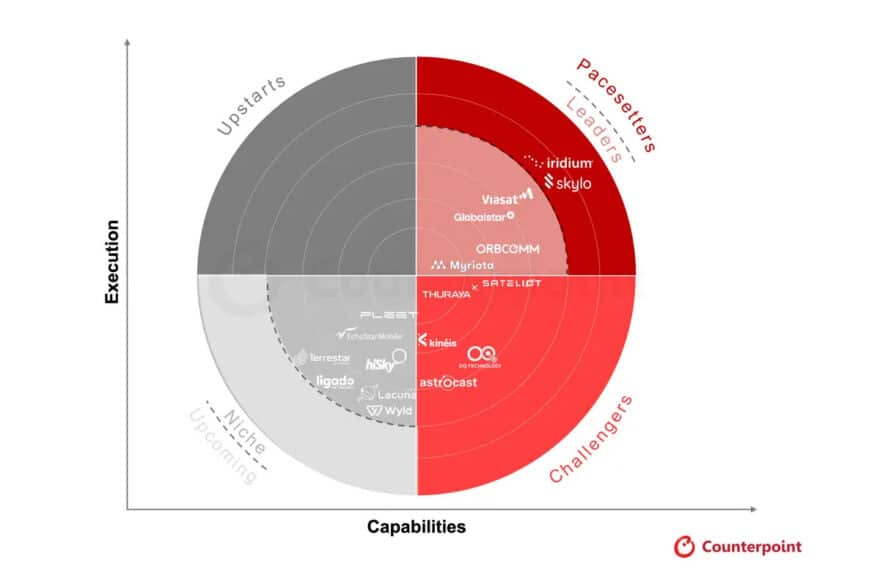
Iridium and Skylo have been named ‘Pacesetters’ in Counterpoint Research’s Satellite IoT Connectivity CORE Rankings for 2026, reflecting their robust network capabilities, technological innovation, ecosystem development, and commercial execution. The recognition comes as satellite IoT transitions from niche applications toward widespread enterprise adoption, driven by hybrid satellite-cellular solutions and 3GPP (3rd Generation Partnership Project) non-terrestrial network (NTN) standards that integrate satellite capabilities directly into the broader cellular landscape.
Commenting on the shifting sector dynamics, Counterpoint Research Senior Analyst Subhadip Roy said: “Satellite IoT is moving beyond niche connectivity as 3GPP NTN and hybrid satellite-cellular connectivity bring satellites closer to the cellular ecosystem. The provisioning of satellite-based connectivity solutions is becoming a focus for MNOs, MVNOs, chipset and module vendors, device makers and IoT platforms, in addition to traditional satellite players.”
Roy added, “While proprietary satellite networks remain important for established remote IoT applications, standards-based NTN and hybrid architectures are creating new routes for satellite connectivity across applications such as logistics, agriculture, maritime, energy and utilities.”
Security, compliance, reliability, and network availability have become baseline requirements across the satellite IoT market. As these core capabilities align across providers, competitive differentiation is shifting toward seamless device integration, broader interoperability, and commercial execution speed.
Counterpoint Research Director Mohit Agrawal noted: “Iridium and Skylo have emerged as ‘Pacesetters’, although their strengths come from different positions in the market. Iridium combines a mature global LEO network, an established IoT base and broad partner ecosystem with continued investment in hybrid and standards-based connectivity. Meanwhile, Skylo is pushing the market toward standards-based NTN through deep integration with mobile operator, chipset and device ecosystems.”
Meanwhile, Viasat, Globalstar, ORBCOMM, and Myriota secured ‘Leader’ status, backed by established satellite infrastructure and industrial IoT footprints. Viasat benefits from the scale of its merged Viasat and Inmarsat portfolio, driving broader enterprise reach across international markets.
At the same time, ORBCOMM and Globalstar are expanding their traditional industrial tracking and telematics services, while Myriota is adapting its low-power satellite architecture to support emerging hybrid network models.
Sateliot, Thuraya, Kinéis, OQ Technology, and Astrocast have been ranked as ‘Challengers’, each taking distinct approaches to satellite IoT connectivity. Sateliot and OQ Technology are focusing on standards-based NB-IoT NTN solutions and tighter cellular integration, whereas Thuraya-4 is pursuing 3GPP-compliant NTN capabilities through a partnership with Skylo. Conversely, Kinéis and Astrocast continue to rely on proprietary, non-3GPP technologies.
While these providers showcase strong network capabilities, their long-term market position will increasingly depend on commercial execution, operational scale, and deployment reach. Meanwhile, players in the ‘Niche’ category remain focused on specialised or regional opportunities, leveraging targeted expertise to serve specific connectivity requirements within the evolving market.
Counterpoint Research Director Mohit Agrawal noted: “Satellite IoT is still at a nascent stage, leaving significant room for competitive positions to evolve. As adoption expands, providers will have opportunities to build on their existing strengths, with deployment scale, market reach and the ability to expand across applications increasingly shaping competitive positioning.”
As satellite IoT matures, success across all tiers will hinge on converting early technical capabilities into scalable, multi-industry enterprise deployments.
The Satellite IoT Connectivity CORE Rankings survey represents one of the most thorough assessments of the sector to date, incorporating insights from 18 market participants gathered through extensive interviews and research over a six-month period.
Key players across the satellite IoT ecosystem were evaluated using Counterpoint Research’s proprietary CORE framework, which assesses companies based on their technical capabilities and commercial execution.
The complete Satellite IoT Rankings report is available to purchase directly from Counterpoint Research.