
 Victor Component Systems Pvt Ltd set up its business with an investment of just ₹5000. Yet, it has kept pace with the changing requirements of the market for over two decades. Emerging unscathed from a competitive Indian market which has embraced Chinese imports, the company has recently achieved a turnover of over one billion. In an interaction with Samonway Duttagupta of Electronics Bazaar, Pawan Sharma, managing director, Victor Component Systems Pvt Ltd, talks about the company’s success and its journey through the early years
The beginning
We had a very modest beginning. We started our business in 1987 with just ₹5000. Initially, we manufactured wound magnetic transformers for black and white TVs. But with the advent of colour TVs, we shifted our manufacturing focus to components for colour TVs including choke coils and line filters, among others. Besides, the competition was high in the black and white segment and as a small start-up we could hardly make a mark. On the other hand, there were only a few Indian players making transformers for colour TVs at that time.
Even though these components were of hardly any value as compared to the bigger products in the market, at that time, our main aim was to make some profits and roll the money further into the business, and we were successful in doing so. So, while our investment was low, the profits were comparatively high.
The secret behind the firm’s name
When it comes to professional life, I am an aggressive person. I believe in being victorious in whatever I do. Hence the name Victor Components came up.

Entering the market
We got our first major break in 1992. During that period, India and Russia were on good bilateral terms. Russia used to supply arms and ammunition to India while we used to export goods like hosiery, tea, tobacco, etc. Interestingly, we got contracts from two renowned Russian companies for making picture tubes that would be used in colour TVs. This happened at a time when picture tubes were not manufactured in India. That was our first opportunity to make good money from our business.
Gatecrashing the market
After manufacturing components for TVs, we started moving to other areas of manufacturing. In 1997, the Indian government introduced electronic energy meters in order to prevent electricity theft. We got huge orders for these energy meters and that proved to be the starting point of doing business in bigger volumes.
At that time, we were one of the very few companies that had begun manufacturing these meters. The machines used to make these meters were a lot more expensive than those used to manufacture any other electronic product in India. So the investment we had to make in procuring these machines for our business was a lot more than what several other electronics companies had to make. But that did not hurt us much as we were getting good returns from this line of business. Over time, our company became the biggest supplier of electronic energy meters in India until we stopped this manufacturing line in 2003.
Riding the waves of change
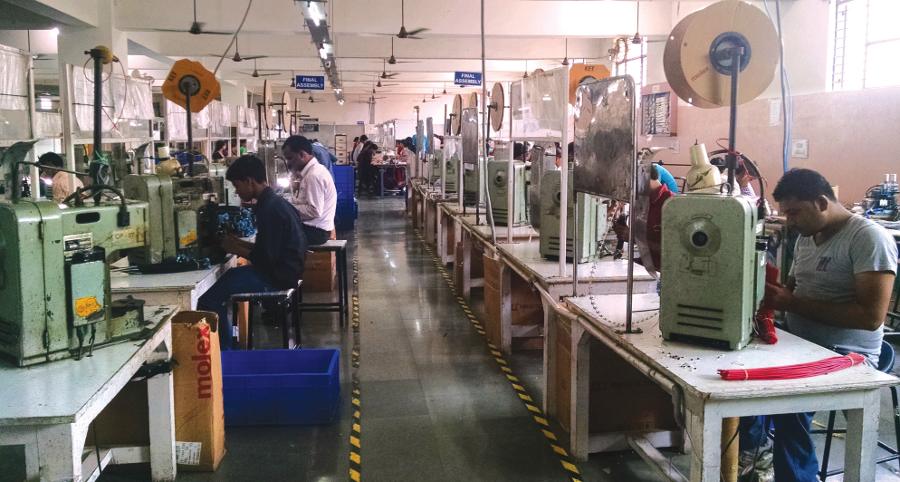
In 1999-2000, renowned MNCs like Sony, Panasonic, LG and others started coming to India and we began doing business with them. We were the biggest suppliers of TV components, including degaussing coils and switched mode power supply (SMPS) transformers. Soon, we also added wire harnesses to our product portfolio. Moving on, we opened our subsidiary, Victor Pushin Cords Pvt Ltd, which manufactures cables and power cords. In fact, we have the biggest facility for these products in India.
Till 2013, we were getting big orders for colour TVs. Today, LCD and LED TVs are in demand and most companies have stopped manufacturing the old cathode ray tube television sets. We had a tough time during that phase, as 60 to 70 per cent of our revenues were coming from this line of business. So we shifted our focus towards the LED lighting industry. We started manufacturing LED components and supplied them to the leading lighting brands. But from last year, we have also started manufacturing LED lights and are looking to invest more in this line of business.
Manufacturing capacity
Right now, we are supplying components in large volumes to the lighting and set-top box industries. We are manufacturing about six to seven million units in a month and are planning to double this capacity. We have a wide range of world class machines that we use to manufacture our different products. Our factory is spread across an area of 9290.03sqm.
The final numbers
Right now, our group turnover is ₹1.25 billion and, if things go the way we want them to, we can cross five billion in the next two years.
Key to success
As I mentioned, we started modestly; but the best thing we did was that we never took out any money from our business—we always rolled the profits. We spent all the money in developing our manufacturing facility. The key to our growth and success has been our ability to adapt ourselves with the changing needs of the times.
Benefits of making in India
The prime minister has done a great job by launching the ‘Make in India’ campaign. The biggest benefit being given under this is the MSIPS, even though we have not been able to apply for the same. Talking about the overall experience of making in India, there have not been too many benefits in all the years that we have manufactured in India. But in recent times, the benefits have been a lot more since Chinese imports are getting costlier because of their rising labour costs. Besides, our population is our biggest strength as it provides a great working force for manufacturing in a country that has rising demands.

Strategies for making in India
We are focusing on increasing the production of components in India. This will help us in competing with China. Besides, companies have already started accepting and trusting Indian component manufacturers. We are simply encashing this acceptance and using it to manufacture products of world class standards.
Challenges faced
Being in the Indian manufacturing game for such a long time, we are not expecting any further benefits from the government. But, at the same time, working with the government departments and going through the bureaucratic procedures can be complicated and cumbersome.
Besides, talking about the manufacturing ecosystem as a whole, something that the government can do to make a huge difference is to change the interest costs. Right now, we are paying 12-13 per cent interest as compared to three to four per cent paid by the Chinese companies. That alone makes them eight per cent cheaper than us.
The practicalities of the ‘Make in India’ campaign
It is a highly practical campaign and will surely give results but the government needs to make things much less complicated for starting a business in India. The formal procedures should be simplified and a better land bill should be in place.
What the government can do
Talking about the Electronic System Design & Manufacturing (ESDM) industry in particular, the government should focus a lot more on investments in components like semiconductors, integrated chips (ICs) and fabs. Besides, land should be sold at a cheaper price for manufacturers to set-up their facilities.