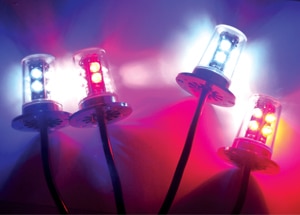

 January 30, 2015: The constant pressure to reduce chip sizes and increase lumens per watt has forced manufacturers to come up with modified drivers equipped with the latest technologies. These drivers are high on efficiency and come with in-built protection
By Richa Chakravarty
Light emitting diodes (LEDs) are low voltage light sources that require a constant DC voltage or current to operate optimally. Since the LEDs operate on a low voltage DC power supply, they easily adapt to different power supplies, have longer standby power and are safer. Hence, it is important that the light source is protected from line-voltage fluctuations while in operation. Changes in voltage can produce a disproportionate change in current, which in turn can cause light output to vary. If the current exceeds the manufacturer’s recommendations, the LEDs can become brighter, but the increased heat can degrade their light output at a faster rate and shorten their useful life.
Hence, without an LED driver, the lamp would be vulnerable to voltage changes, and could get dim or go out if the voltage drops too low. Besides, the life span of the lamp will be reduced if the voltage goes too high. An LED driver is a self-contained power supply that controls the amount of current and voltage supplied to an LED light. The drivers respond to the changing input voltage while maintaining a constant current supply to the LED. They are commonly used for blinking, dimming and colour mixing of LEDs in various applications.
The latest in the market
As LEDs are available with different power ratings, the drivers must produce different constant currents to operate them. Single-watt LEDs require a constant current of 350mA, while 2W LEDs need 700mA. The maximum output voltage of a driver, thus, determines the number of LEDs that can be operated in series. When the voltage is high enough to supply the desired number of LEDs, buck drivers are used. But when the voltage is too low, boost drivers are required. However, in some cases, a combined driver type is needed.
Some LED lamps have inbuilt rectifiers and therefore can be used with iron-core transformers. If there is no inbuilt rectifier, the LED light needs to be used in conjunction with an LED-specific driver, as these have standard rectifiers. Some LED drivers use pulse width modulation (PWM) in conjunction to enable the LED light to become dimmable.
Dimming and colour changing: Drivers can enable dimming, colour changing or sequencing of LEDs based on either preset commands, the presence of someone in a room or manual commands. Most LED drivers are compatible with commercially available 0V to 10V control devices and systems like occupancy sensors, photocells, wall box dimmers, remote controls, architectural and theatrical controls, and building and lighting automation systems. They can also work with devices governed by the DMX and digital addressable lighting interface (DALI) protocols and, in the future, may include wireless controls as an option.
According to the Lighting Research Center, dimming causes LEDs to experience a shift in spectral power distribution similar to what happens in an incandescent lamp. However, if coloured LEDs in an array are used to produce white light, the amount of shift, particularly with red and yellow LEDs, may produce an undesirable effect on the white light that is produced by the system. Drivers with dimming capability can dim the LED light output over the full range from 100 to 0 per cent. They do so by reducing the forward current or by using PWM via digital controls. More sophisticated methods exist, but most dimming drivers use PWM. With this method, the frequency could range from 100 modulations per second to hundreds of thousands of modulations per second. With that many modulations, the LED appears to be continuously lit without any flickering. A benefit of the PWM method is that it enables dimming with minimal colour shift in the LED output.
GlacialPower has introduced a new range of constant current and constant voltage drivers. Its GP-LP060P LED drivers cover the entire DC output range of 12V to 57V DC and deliver up to 60W of power to the LED. The step dimming functions for constant current and constant voltage can be conveniently controlled through the AC power switch. The company has also introduced its dual-mode GP-LC7028 LED driver that powers LED lighting ranging from 7W to 20W. Featuring constant current or constant voltage operation, the LED driver mode and power output can be adjusted to fit a variety of lighting and signage applications. Power input and output lines are connected via robust and easy to use clips. “We offer a wide range of options for indoor LED lighting needs. The output voltage of the two LED drivers ranges from 9V DC to 57V DC,” explains Nikhil Malhotra, country manager, Glacial Light.
Flicker-free TRIAC dimmers: TRIAC dimmers provide a phase-cut sine wave that deteriorates to current pulse if the device is dimmed too much. The two circuits interfere with each other. As there are many TRIAC dimmers installed in homes and offices, and nobody wants to spend a lot of money replacing them when shifting over to LED lighting, engineers have solved this problem by developing a driver that is tailor-made for existing lighting control systems. With such a driver, it is now possible to dim LEDs continuously and without flickering to zero.
Moxie Devices Pvt Ltd offers a series of solar charge controllers in low wattages (up to 5W), which are microcontroller-based. These offer high efficiency, easy customisation as per customer requirements and strict constant current regulation. They are used in LED/solar lanterns, LED torches and LED home lighting systems. “The products offered in this series are the best option for compact, standalone solar and LED products. The centrepiece in these products is a microprocessor that controls charging functions and guarantees optimal charge control. The housing can be installed directly onto a wall,” says P K Jain, director, Moxie Devices Pvt Ltd.
High voltage drivers: Today’s high voltage drivers can supply up to 17 LEDs in series with constant currents between 350mA and 1200mA. One of the most common mistakes is to connect too many LED strings in series. Doing so may result in too low a voltage being available to the last string(s) in the chain. A prudent practice is to check the voltage rating of the LED load being used against the rated output voltage of the driver. For example, using a 12V driver on a 10V LED load could result in a significantly shorter life of the module. However, the drivers available today are capable of meeting high voltage demands even when attached in strings.
ON Semiconductor’s LV5026MC is a high voltage LED drive controller which drives LED current up to 3A with an external MOSFET. It corresponds to various wide dimming controls including the TRIAC dimming control. The LV5026MC has been designed and developed for general use or in consumer appliances.
Making a purchase decision
While making a purchase decision, the one key factor to be kept in mind is whether the product is the constant current or constant voltage type. It is very important to also consider Indian climatic conditions. If used in India, this driver must be designed for universal input, since the high voltage fluctuations can result in malfunctioning of the instrument. The higher the efficiency, the lower power consumption will be. If there is a huge gap between the output wattage of the driver and input of power consumption, then the instrument is not very efficient. Other factors that one should look for are low voltage and high voltage protection, and isolated and non-isolated technology. If one buys an instrument based on one’s requirements, it can help in cutting down power consumption.
Boxes
ON Semiconductor’s LV5026MC
-
Simplicity of design; small solution size and low in cost
-
Soft start function; protection against rush current
-
Integrated TRIAC stabilised function
-
Flicker prevention
-
Integrated over-voltage protection
-
Prevention of IC destruction
-
Selectable switching frequency (50 or 70 kHz)
-
Reduction of the EMI
Philips’ Advance XITANIUM
-
Compact form factor
-
UL Class 2 output with adjustable output current (AOC)
-
Leading edge (LE) and training edge (TE) dimming at 120V input
-
Enables design of low profile and compact fixtures
-
Flexibility via adjustable drive current
-
Helps to maximise energy savings and allows application-specific light levels
RECOM’s RACD100A series
-
Offers constant output currents of 1400mA or 700mA at voltages from 50V up to 142V.
-
Supports dimming via PWM or 1-10V signals, and is fully IP67 sealed for outdoor as well as indoor applications
-
Wide input voltage range of 90V to 305V AC
-
Converters operate with full load efficiencies of more than 93 per cent
-
Features low THD (15 per cent) and active PFC with power factors exceeding 0.98, and is fully protected against short circuits, overload and over temperature conditions
GlacialPower’s GP-LC7028
-
Two LED drivers in one
-
Comes with a DIP switch for either constant current or constant voltage mode, for enhanced functionality
-
Can be customised to specific LED lighting needs with eight modes of constant current (from 250mA to 700mA) and constant voltage (from 12V, 24V and 28V) operation
-
For constant current mode, 1V to 10V dimming and push dimming can also be enabled with a dimmer
Moxie Devices’ HP series
-
Input current: 0.15A (max), input wattage: 16.25W (max)
-
Efficiency: > 81 per cent (full range 90V-270V AC)
-
Power factor: > .94
-
THD < 20 per cent, isolation: 2.5KV
-
Output DC voltage: 45-48V (can be customised)
-
Output current: 270 mA (can be customised)