
Make In India 2.0 To Focus On Electronics – Drones, Robotics, EVs

Notably, Indian government’s PLI scheme’s most notable success is in electronics manufacturing. The government reported a 20% value addition in mobile manufacturing within three years.

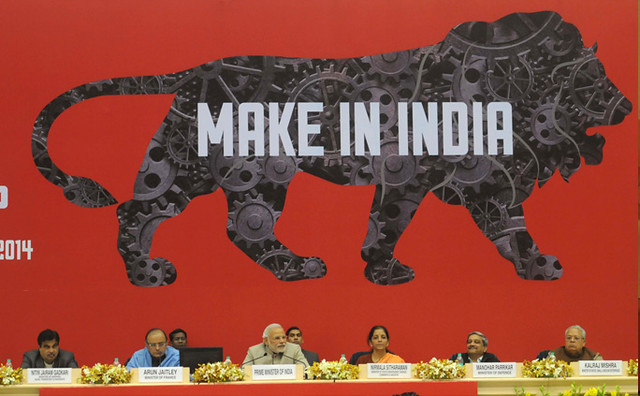
The Ministry of Commerce & Industry’s second phase of the ‘Make-in-India’ initiative is emphasising sectors like drones, toys, robotics, electric vehicle components, and electronics due to their export potential and job creation capabilities. The Department for Promotion of Industry and Internal Trade (DPIIT) is actively engaging with 24 sub-sectors to enhance manufacturing in India.

The chosen sectors, which include air-conditioners,  auto components, aluminium, and other important sectors, align with Indian industries’ strengths. This will cater the need for reducing imports, export potential, and job creation.

The ministry highlighted a significant increase in foreign direct investment (FDI) in manufacturing. Over the past nine financial years (2014-23), the sector received $149 billion in FDI equity inflow, a 55% rise compared to the $96 billion during the previous nine years (2005-14). Overall, FDI inflow from FY 2014 to 2023 reached $596 billion, almost double the amount of the preceding period. This surge in FDI reflects India’s growing appeal as a global investment destination.

A key element of this growth is the Production-Linked Incentive (PLI) scheme, which has drawn investments over Rs 95,000 crore until September of the current year. The scheme resulted in production/sales worth Rs 7.80 lakh crore, created 6.4 lakh jobs, and boosted exports by Rs 3.20 lakh crore. Initially applied to three sectors, the PLI scheme now encompasses 14 sectors with a budget of Rs 1.97 lakh crore. In FY 2022-23, around Rs 2,900 crore in incentives were distributed to qualified manufacturers.

- Advertisement -

The PLI scheme’s most notable success is in electronics manufacturing. The government reported a 20% value addition in mobile manufacturing within three years. In the 2022-23 period, the total electronics production was $101 billion, with smartphones making up $44 billion, including $11.1 billion in exports. This performance underlines the PLI scheme’s effectiveness in enhancing production, job creation, and exports across various sectors. Selection of 27 companies under PLI 2.0 for IT hardware, recently,  has been a boon in this regard. The selected companies include big names like HP, Lenovo, Dixon, Foxconn and Dell etc.


- Advertisement -
Loading form…

Industry's Buzz

Prime Minister Modi

Modi Flags 6G And Domestic Electronics Production At IMC 2026

0
Prime Minister Narendra Modi has outlined India's next telecom priorities at India Mobile Congress 2026, linking the 5G-to-6G roadmap with semiconductor production, domestic electronics...
Fujitsu

Fujitsu-Owned 1Finity Deploys 200+ Engineers To Expand India’s Optical Networking Business

0
Japan’s Fujitsu-owned 1Finity is expanding its India networking business with more than 200 engineers as AI and data-centre growth drives demand for optical networking...
Mivi factory

Mivi Targets Indigenous Smartphone Design With In-House Electronics Engineering

0
Indian consumer electronics brand Mivi aims to develop an indigenously designed smartphone within 12 months by building in-house circuit design, PCB and software engineering...
GlobalFoundries logo

GlobalFoundries and TSMC Partner on US Interposer Production for CoWoS

0
Five-year agreement expands Malta, New York fab to create domestic supply chain for high-performance AI chips. GlobalFoundries (GF) has reached an agreement with TSMC to...

Vietnam Plans US$136.3 Billion Investment in Power Generation and Grids by 2030

0
The revised plan also targets 10,000–16,300 MW of battery energy storage capacity by 2030 Vietnam is planning investments of approximately US$136.3 billion in power generation...

Learn From Leaders

Does India’s Chip Packaging Growth Need Local Materials At Scale?

0
What will it take for specialised semiconductor materials manufacturing to grow in India? Packaging volumes will be a key factor as OSAT facilities move...
Ronak Kumar Samantray, Founder, TM2Space Technologies Pvt Ltd.

“Our goal is to build data centres in space.” – Ronak Kumar Samantray, TM2Space

0
A space startup aims to build orbital data centres, letting users run AI models and store data on satellites while also supplying satellite hardware...

India’s Photonics Puzzle Is Finally Coming Together 

0
Can India turn its scattered photonics capabilities into a stronger industry? A new association aims to connect the ecosystem and strengthen the domestic value...
Jin Bains, CEO, Mini-Circuits

Mini-Circuits CEO Jin Bains on Navigating High-Frequency Component SWaP-C Constraints, Emerging Markets, and Career...

0
In this exclusive, Jin Bains, Chief Executive Officer (CEO) of Mini-Circuits, explains in a conversation with Dilin Anand of EFY about areas of emerging...

India Needs Not a Hundred, But Thousands of Chip Diversified Companies 

0
Can India build a semiconductor ecosystem beyond fabs? Indiesemic believes thousands of diversified chip companies are needed to make that possible. India’s semiconductor push is...

Startups

PowerMon

Aquaexchange Brings Monitoring And Automation To Shrimp Farming

0
The startup has developed an AI- and IoT-enabled platform that helps shrimp farmers manage farms, access financing, monitor operations, and connect with markets. The startup...

Drone-Like Aircraft For Logistics From BluJ Aerospace

0
Hyderabad-based BluJ Aerospace is developing indigenous electric and hydrogen-powered vertical take-off and landing (VTOL) aircraft for remote cargo transport. BluJ Aerospace, a Hyderabad-based aerospace startup...
Jash Jetly, Co-founder and CEO of EVE

“The cloud isn’t the only way to run AI. We’re proving it can happen...

0
A startup is building a decentralised AI and communication network that runs across everyday devices instead of centralised cloud servers. In an interview, Jash...
Mohit Gupta, founder and CEO, TYLsemi

Building AI Chips, One Block at a Time 

0
What if building an AI chip became as simple as assembling reusable blocks? The startup is working to make custom silicon accessible beyond the...
Seema Johar, Co-Founder and Product Director, Compcarta Solutions Pvt Ltd

“We Let Designers Focus on Innovation, Not Infrastructure.”- Seema Johar, Compcarta Solutions

0
In an exclusive interview, Seema Johar of Compcarta speaks with EFY’s Akanksha Sondhi Gaur about why setting up an EDA environment can be harder...