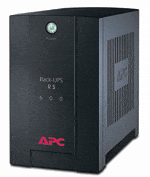

The UPS and inverter market is making a strong comeback following the growth of the information technology (IT) and telecom markets. According to a Frost & Sullivan report, the UPS market will grow at a compound annual growth rate (CAGR) of 14 per cent till 2014, largely due to the growth in the small and medium business (SMB) segment. Growth will be equally satisfactory in the inverter and battery markets, owing to the country’s uncertain power situation. The present size of the inverter market in India constitutes about 1.5 million units a year and is growing steadily at a CAGR of 12-14 per cent.
By Srabani Sen
Wednesday, August 19, 2009: Presently, the UPS and inverter market is abuzz with interesting trends as everyone, from major manufacturing facilities to home owners, is recognising the need and value of UPS and inverter systems. Industry analysts opine that manufacturers who move with the market trends and upgrade themselves accordingly will survive and emerge successful.
Competition and pricing
The market continues to reel under the twin challenges of competition and pricing. “Competition has always been high but of late, its intensity has increased as customers are more price consciousness now,” says Venkat Rajaraman, chief executive officer, Su-Kam. “UPS and inverter manufacturers are not only facing a high level of competition but are also dealing with an influx of cheaper products,” adds Vivek Jain, director, marketing, Microtek International.
“The challenge of competitive pricing is being faced not only by the small and medium players but also by the big players. It’s a common challenge for all. This pushes us to improve the quality of the products even better, while still maintaining a good price,” says S K Ray Chaudhuri, managing director, G P Tronics Pvt Ltd. Established in 1978 in Kolkata, G P Tronics manufactures inverters, solar inverters, UPS, etc.
Strong product range
To combat competition, the trend today, is to offer a strong product range along with excellent after sales services, which helps manufacturers to attain a strong advantage in the market. “Possessing a strong product range can prove to be crucial to your success. Also, by improving product awareness, one can expand the base of competent UPS and inverter users,” says Jain. “Manufacturers are making high frequency products with more capacity, more backup and more features,” explains Vijay Chacko, managing director, Ammini Electronic Pvt Ltd, Tamil Nadu. The company, which also operates in Karnataka and Kerala, engages in continuous upgradation of its products and services to meet customer expectations.
SMB, SOHO: Large drivers
The growth in the UPS and inverter market comes from the enhanced awareness of the need for proper backup solutions. SMBs and SOHOs have been for quite some time, the largest drivers of growth in the industry. “This trend will continue,” predicts N K Verma, chairman, Parker Power. “The growth of the SMB and SOHO segments has helped in evolving their business requirements, leading to the need for IT and power conditioning solutions,” he adds.
Brand consciousness
With the changing times, customer are also becoming increasingly brand conscious and their purchases are driven by quality, reliability and strong after sales services. “It is quite clear that the customer is moving towards branded products. Nowadays, almost all small manufacturers are producing low frequency UPS and inverters but when it comes to quality and reliability, customers
are more inclined to look towards brands. They are not only hunting for better features but also reliable and sophisticated products,” explains Rajaraman. Ray Chaudhuri, however, begs to differ. “Whether a product is branded or local made, customers demand quality, competitive price and back by prompt after sales services.”
Demand in B & C class cities
A key factor, leading the growth of the Indian UPS market is the spreading vertical penetration in B and C class cities. Until recently, the market growth was chiefly contributed by major cities like Delhi, Mumbai, Kolkata and Bengaluru. However, now, the trend seems to have changed course. After capitalising on the metropolitan cities, power electronics players are now moving on to the tier II and III cities that are still untapped. “There has been a distinct shift towards B and C class cities such as Chandigarh, Pune, Lucknow and Jaipur,” states Ray Chaudhuri.
“Manufacturers are increasingly concentrating on B and C class cities to counter their eroding market share in metros and big cities,” says Umesh, managing director, Mayatronix, Karnataka. An ISO 9001:2000 certified company, Mayatronix was established in 1990. “In these cities, the sale of desktops are still stable and the power situation is worse than in the large cities, hence, they are considered untapped gold mines,” adds Umesh.
Importance of R&D
Today, customers are more aware of technology and demand innovative and technologically advanced products. Manufacturers are, therefore, establishing their own R&D units. “After taking market feedback, products are often modified and upgraded and a new product is born. That is what sells. Customers always seek innovative features and new technology,” points out Chacko.
Online UPS much in demand
The offline and line interactive UPS market is gradually shrinking, while the online UPS market has been expanding progressively across all key business verticals. “Of late, the market has seen an increase in the demand for online UPS for mission critical applications and a shift from offline and line interactive UPS towards online UPS has been noticed.
Notebook may harm UPS
The sub-5KVA UPS market has seen dipping volumes, mainly due to the soaring sales of notebooks over the last few years. In response, UPS manufacturers are trying to counter the market trend by engendering innovative product designs, venturing into the retail segment and increasingly focusing on B and C class cities.
“The consumer UPS market is mobilised by desktop sales. It is not good for the 600VA UPS market when consumers opt for notebooks,” explains Umesh. “However, since the SMB and SOHO segments have a mixed demand for notebooks and desktops, we expect that the growth in this segment will remain stable,” he adds.
The chances of home consumers or SOHOs purchasing a UPS are less if they possess notebooks. However, if a customer has a server in his network, then he will certainly buy a UPS. All communication equipment such as servers, routers and switches require a UPS system. Adds Rajaraman, “No doubt, notebook usage is increasing. PC penetration is also growing by 15 per cent and this will give way to more demand for UPS.”
Retail and channel
Manufacturers are also trying to woo customer through large retail chain. “Only high volume, non-critical products can move through retail. Large configurations require technical support and it’s advisable to sell them through channels,” says Ray Chaudhuri. Manufacturers are also investing in adequate training of channel partners to ensure that they are able to sell smoothly and offer support to customers.
The aesthetics factor
UPS and inverter makers are also improving the aesthetics of their products, specifically for consumers. A UPS or inverter is an important part of the overall look of a workstation or home. Users desire neat, compact and clean inverters or UPS to enhance the look of their living environments. Many manufacturers believe that design and aesthetics are important factors for consumers in the sub-5kVA segment. They are of the opinion that in the coming months, manufacturers will try to improve on both design and power density to attract more customers.
However, Chacko disagrees. “The demand for UPS and inverters is driven more by quality and after sales service support. These rank higher than aesthetics because in most places, the UPS or inverter is not displayed but tucked away in some remote corner.”
Electronics Bazaar, South Asia’s No.1 Electronics B2B magazine