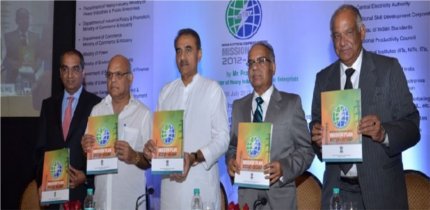

 Thursday, July 25, 2013: Praful Patel, union minister for Heavy Industries & Public Enterprises, today launched the ‘Indian Electrical Equipment Industry Mission Plan 2022’ for the rapid development of the domestic electrical equipment industry and to enhance its competitiveness. The mission plan seeks to steer, coordinate and synergise the efforts of all stakeholders to accelerate and sustain the growth of the domestic electrical equipment industry and reach an output of $ 100 billion by balancing exports and imports.
Terming India’s dependence on imports of electrical equipments as the major impediment, Praful Patel said at the launch ceremony that there is nothing wrong in putting control measures on imports and it is the norm all over the world. ‘There is a reckless debate going on in India on this issue.United States, Europeon Union, Australia etc put in place controls over imports. India too should not shy away. A country as big as us should have its own technological base. We have a larger responsibility of nation building that should be paramount’ said Patel emphatically.
‘The government’s positive intervention is required to give domestic industry the needed boost, specifying that the government would protect its own industry. India is the biggest consumer of everything it can produce and this advantage must be leveraged.’ he added. This statement is significant in light of the recent decision of the government to keep the execution of PMA (Preferential Market Access) policy in abeyance till further review.
The minister, while talking to reporters after the launch of the mission plan, informed that his ministry has written to the finance ministry seeking 5 per cent more import duty on power gear, which is currently 21 per cent. Cheaper imports from China coupled with overall economic slowdown has made it difficult for local power equipment makers to stay competitive.
“We have sought 5 per cent additional customs duty on imported power equipment from the Finance Ministry to protect the interest of domestic industry,” Patel said. While agreeing that India’s electrical exports currently stood at a rather modest $5 billion and much more needs to be done on this front for realization of the Mission Plan output, the minister struck an optimistic note saying that even this export figure is a sign of our presence in global market and growing acceptability of country’s products. He said that it is imperative to build our own industry to make it competitive for its global growth and we should also look at ways and means to draw in more investment. The size of the sector is growing, and companies can pool their resources for investing in R&D for moving ahead.
Launching the mission plan, Praful Patel said that the Indian electrical industry has come a long way, with both big and small companies having contributed to its growth. He said that while making plans was the easier part, industry and the government needed to work in synergy to translate them into reality.
Talking at length about other handicaps, the minister pointed towards what he termed as ‘lack of using opportunities’. “Even by conservative assessment, coal is going to be a redundant source of energy in next 30 to 40 years, while India sits over coal reserves that will last up to 100 years. Why are we not using this as an opportunity?,’ asserted Praful Patel. Talking in the same breadth, he added on the issue of skill development that creating engineers is not as much a problem but employers must also invest in harnessing their skill set after hiring and train them in a tailor-made way for the industry.
“There are 40,000 engineering seats vacant only in Maharashtra, let alone the whole of India. Filling the vacant seats only would take care of HRD issue,” said he. On the same issue of skill development, Sutanu Behuria, Secretary in Department of Heavy Industry, also said that aspirational wage must match the market wage, otherwise the manpower would not yield qualitative product. He said enough steps have been recommended in the Mission Plan in this regard.
Need for a mission plan
The electrical equipment industry in India has a long and chequered history. Today, it covers over 1,500 units of varying sizes, amounting for an annual turnover of about Rs.1,10,000 crores. It amounts for about Rs. 20,000 crores of annual exports and about Rs. 32,000 crores of annual imports; it has a negative trade balance which has been increasing in recent times.
Because of its heterogeneous character, the domestic electrical equipment industry, despite its critical role in the economy, had not been able to received focussed attention of the policy makers so far.
The mission plan identifies five key areas for action: (i) Industry competitiveness; (ii) Upgrading technology; (iii) Skill development; (iv) Promotion of exports; and (v) Conversion of latent demand. Detailed recommendations have been formulated for strategic and policy interventions in these five critical areas that need to be addressed by the industry, with support from the government. The Mission Plan envisages to make India the country of choice for the production of electrical equipment and reach an output of US $100 billion by balancing imports and exports. It has been evolved by the Department of Heavy industry through an elaborate exercise involving all stakeholders and with the support of the Indian Electrical and Electronics Manufacturers’ Association (IEEMA). Dr. Sutanu Behuria, Secretary, Department of Heavy Industry and Shri Raj H. Easwaran, President-Elect, IEEMA, were also present on the occasion.
Ranjan Srivastava, Investinelectronics.com, An initiative of www.electronicsforyou.biz to promote investment in electronics industry of India