
Thailand will further strengthen its position in the global electronics industry by hosting the 17th Electronic Circuits World Convention (ECWC17) in August 2027
Thailand’s electronics sector has attracted more than $30.5 billion (1 trillion baht) in investments since 2023, with around one-third of the capital directed toward printed circuit boards (PCBs) and electronic components.
According to the Thailand Board of Investment (BOI), investments exceeding $10.1 billion (331 billion baht) have been committed across 224 PCB and electronic component projects, driven by global manufacturers expanding their presence in AI hardware and advanced semiconductor packaging across Southeast Asia.
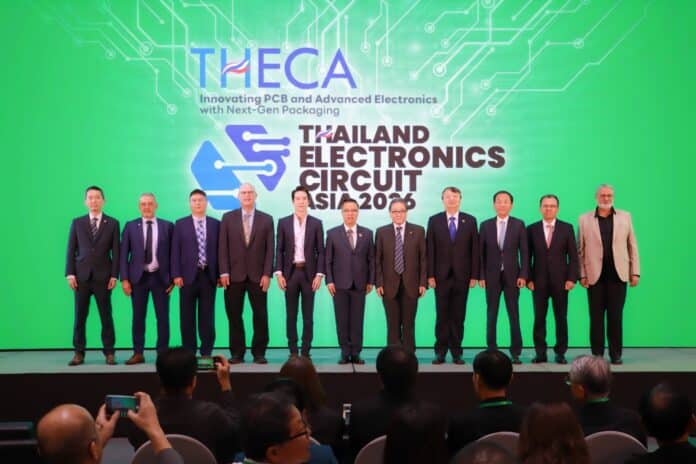
The investment surge is being highlighted at the Thailand Electronics Circuit Asia (THECA) 2026 summit, being held at the Bangkok International Trade & Exhibition Centre (BITEC). The event has brought together more than 300 global technology companies and 7,000 delegates from 40 countries.
THECA 2026 features more than 60 conference sessions covering AI infrastructure, semiconductors, photonics, advanced packaging, PCBs and electronics manufacturing services (EMS). The event comes amid an ongoing shift in global electronics supply chains toward Southeast Asia as manufacturers diversify production locations.
Thailand’s government is also pursuing structural reforms to strengthen the country’s competitiveness and move beyond the middle-income trap. With electronics identified as a key economic growth driver, the BOI is shifting its investment strategy toward attracting higher-value activities and building domestic capabilities.
The BOI’s framework focuses on four areas: promoting high-value and high-potential industries, improving Thailand’s readiness for multinational companies, strengthening domestic supply chains and workforce skills, and expanding international cooperation to connect Thai companies with global production networks.
“The investments flowing into Thailand’s electronics sector today are fundamentally different from those of three decades ago,” said Narit Therdsteerasukdi, Secretary General, Thailand Board of Investment. “They are driven by frontier technologies, proprietary knowledge, and highly skilled labor.”
Industry leaders said growing demand for AI, edge computing and smart mobility is reshaping electronics manufacturing in the region. Canice Chung, Chairman of the Hong Kong Printed Circuit Association (HKPCA), said competitive advantage increasingly depends on international knowledge transfer, cross-border research and specialized technical talent.
THECA 2026 is also promoting regional cooperation through initiatives including Power2Motion, focused on power electronics and future mobility, and the ASEAN+ Technology Pavilion, bringing together 15 robotics, AI and IoT industry alliances from Thailand, Malaysia, Singapore and Vietnam.
Thailand will further strengthen its position in the global electronics industry by hosting the 17th Electronic Circuits World Convention (ECWC17) in August 2027. The event is held every three years and rotates among major electronics manufacturing economies.
Pithan Ongkosit, President of the Thai Printed Circuit Association (THPCA), said bringing together different levels of the electronics supply chain—from raw substrates and automated machinery to semiconductors and advanced packaging—could help create greater commercial scale and accelerate technology adoption.
The BOI said Thailand is focusing on combining foreign direct investment with domestic manufacturers, academic institutions and engineering talent to establish the country as a regional hub for smart electronics manufacturing, while creating high-value employment and supporting long-term economic growth.