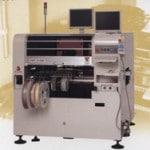

Developed in the 1960s, surface mount technology (SMT) became widely popular in the late 1980s. In the industry, it has largely replaced the through-hole technology construction method of fitting components with wire leads into holes in the circuit board. SMT equipment is now integral to any printer circuit board (PCB) assembly process. Worldwide companies engaged in manufacturing or contract manufacturing of PCB assemblies have embraced this facility. Countries like the US, Germany, Japan, China, Brazil, Turkey and Korea are using this technology extensively after rejecting the leaded components in their manufacturing units.
By Rutaksha Rawat
 Wednesday, March 18, 2009: SMT was introduced in India in 1990 and its accession within the country has been impressive in the last couple of years. With an increasing number of vendors starting manufacturing units in India, the demand for SMT-based equipment has seen an ascent. However, even now, only 10 per cent of the manufacturing in India is being done through SMT. The concept, however, has not flourished in the small scale industry and remains limited to the big players only.
Deterring factors
Tritronics (India) Pvt Ltd does not use SMT in manufacturing UPS systems and has instead opted for plated hole technology (PTH). “Most of our PCBs are outsourced. We purchase them as completely loaded PCBs and not as individual bare PCBs with various components for it. Since the activity is outsourced, most of our suppliers are comfortable with the concept of PTH and a majority of them do not possess insertion facilities for SMT components. A few of them do have SMT insertion lines, but only to meet limited and minimal requirements,” says A K Sharma, director, technical division, Tritronics (India).
Earlier, Tritronics had bought a wave-soldering machine along with two manual insertion lines for its in-house activity, but is presently not using any in-house equipment for PCB fabrication. However, it does plan to use SMT boards in future provided professional manufacturers fabricate them.
“The making of UPS systems and inverters needs power components because they are adequate for fulfilling large power requirements catering to necessary connected load. These large power components are not available in SMT packages, causing manufacturers to employ a mix and match of topology of PCB fabrication. They can only use SMT components in the controls’ section, whereas they have to use power components in PTH configuration. As a consequence, most suppliers prefer treading the convenient path by using discrete components. This is one of the driving factors for the limited involvement of SMT components in India,” he elaborates.
Another deterring factor for the sectional growth of SMT in India proves to be the cost involved in installing SMT equipment. The smallest SMT line required for board fabrication usually costs Rs 15-20 lakh per insertion line and escalates in accordance with increment in size of boards and population density of the components. Additionally, one has to also invest in reflow ovens and other support gadgets. Equipment manufacturers do not find it practical to invest a quantum for such limited activity. They desire the maximum amount possible in terms of output in return for the least amount of investment possible, which PTH is plying them with at the moment.
Kirloskar Electric Company Ltd, Powerone Micro Systems Pvt Ltd, HITA Technology Pvt Ltd and Convergence Power Systems Pvt Ltd also abstain from using SMT equipment. Since Kirloskar’s printed circuit boards are designed for through-hole components, it is not practicable for it to use SMT in its manufacturing practices. Powerone has also refrained from using SMT as it manufactures a high capacity of online UPS systems whereas the total quantity of PCBs used is lower in juxtaposition.
Arun Ghosh, MD and CEO, HITA, cites low volume demands as a contributing factor in HITA’s decision to forgo employment of SMT equipment in its manufacturing facilities.
“In power electronics, you cannot use SMT equipment. It has its own power-carrying capacity limitations,” opines Sri Kumar, director, marketing, Convergence Power Systems. According to Kumar, SMT is yet to fully evolve for all kinds of applications. “We wanted to use SMT, but we would have to use hybrid technology along with it as well. Thus, we are adhering to the latter exclusively, which is more suitable for the types of applications we use,” he adds.
N K Verma, chairman, Parker Power Systems Ltd feels that the cost of SMT assembly equipment along with the cost of SMT components is making people chary of investing in it. R Viswanathan, vice president, Genus Power Infrastructure Ltd, enumerates, “Relatively higher capital costs and lack of awareness about its advantages as the reasons that are keeping people away from incorporating SMT equipment into their manufactural structures.”
Premal Patwa, vice president, technical division, Hi-Rel Electronics Ltd, says, “The want of special skills requisite for repairing and designing is holding people back from trying out this technology.”
Advantages abound
A slew of manufacturing firms, however, lauds the advantages of SMT. Verma acknowledges using SMT equipment in Parker Power’s PCB assembly unit since the last three years. “Due to the descending costs of components, it is becoming more affordable. We have the entire SMT line for the installment of miniature chip components and ICs. For installment through hole components, we employ auto insertion machines and manual insertion processes,” Verma explains. On the operational front, Verma doesn’t find SMT too different from other manufacturing processes. “Care has to be taken in terms of work planning, workers’ training and maintenance like with any other process. Yet, SMT yields different results in its output. Since its operation is automated, it is less prone to manual errors, is spontaneously repetitive and accurate.”
Shedding light on the costs involved in ensconcing an SMT line, Verma comments, “There are many variants, but as a generic benchmark one can start at Rs 175 lakh for the basic minimum line, inclusive of a glue dispenser, a screen printer, a chip shooter, a fine pitch components placer and a reflow oven. The disbursement could be Rs 50 lakh for a second-hand basic refurbished line.”
The cost of installing SMT equipment when Parker Power purchased it was approximately Rs 20 lakh. Rates have fallen since then by at least 25 per cent. As for the returns, Verma says they are plentiful. “SMT contributes at least 40 per cent in revenue generation to our electronics manufacturing services business. SMT users can expect a 20 per cent return on investment (ROI) on an annual basis,” he reveals. The ROI and total cost of ownership (TCO) can be expected within three to four years of incorporating SMT equipment into one’s manufactural structure.
Genus Power has been relying on SMT since the inception of its commercial production in 1996. “We employ SMT equipment in our Jaipur and Haridwar plants. Our sister concern, Genus Electrotech has also installed SMT equipment in its Gandhidham plant. We have installed the entire SMT line, which basically comprises a PCB loader, a solder paste printer, SMT placement equipment, a reflow soldering machine, a PCB unloader and an optical inspection system,” says R Viswanathan.
Many others like Luminous Power Technologies Pvt Ltd and Hi-Rel are reaping the fruits of purchasing SMT equipment for their manufacturing plants. Luminous has the complete SMT line of Panasonic at its Baddi unit and has been depending on this technology since the past three years. Hi-Rel has installed next generation UPS systems with SMT-based cards. “We get it assembled from outside and have a repair centre with adequate tools for the handling of SMT boards. We have been using it since the last one year,” reveals Premal Patwa.
Enormous potential
According to Sharma, SMT will be viable in India when suppliers of PCB boards upgrade their infrastructure and SMT lines for fabrication and facilities in order to provide competent support to equipment manufacturers. “It will be viable only when the volume of demand is there,” says Arun Ghosh, commenting on the prospects of SMT in India.
Verma is of the opinion that the scope of SMT in India depends on the utilisation of machines. Underutilisation of machinery (not running it for an optimum amount of time daily) could result in poor ROI or long-term losses. “Although SMT usage is seeing a rise in certain sectors like telecom, mobile phones, high-end consumer electronics, it has not given sufficient loading of lines to many manufacturers,” he adds.
Viswanathan feels that the potential for SMT usage in India is enormous. “Presently, the trend entails smaller electronic systems, which can only be made with the use of SMD components. It is virtually impossible to mount SMD components manually and even if attempted, would spawn a spew of human errors. The use of SMT equipment greatly accelerates the mounting process and provides unerring results,” he says. Despite its drawbacks, the benefits of SMT are multifold—it increases reliability, owing to its perfect soldering of components and is less prone to defections arising from dust and moisture. It shields equipment from spurious components and reduces greatly defects arising from improper insertion, dry soldering, manual soldering, bridging of solders, etc. Furthermore, SMT usage expedites production by reducing repair time and decreasing production flaws. The overall cost of SMT equipment is lesser than the expenses incurred in PTH production, even though the initial investments are higher in the former.
SMT has sowed its seed in India and has and will continue to impact myriads of manufacturers across India. As of now only the large-scale manufacturers are employing it and the medium and small-scale manufacturers are shying away from it due to various reasons, chief among them, the costs involved and lack of demand. Yet, as the gaps between the large-scale and the medium-sized manufacturers are bridged by degrees, SMT will surely be seen more frequently in manufacturing units around India. For once manufacturers use SMT they find it difficult to part with its error-free and voluminous production. Viswanathan exemplifies an accustomed SMT patron when he admits, “SMT is indispensable to our kind of PCB assemblies and activities.”
Electronics Bazaar, South Asia’s No. 1 electronics B2B sourcing magazine