Omdia says higher component costs and supply constraints are reshaping vendor strategies, with budget smartphones facing the greatest pressure.
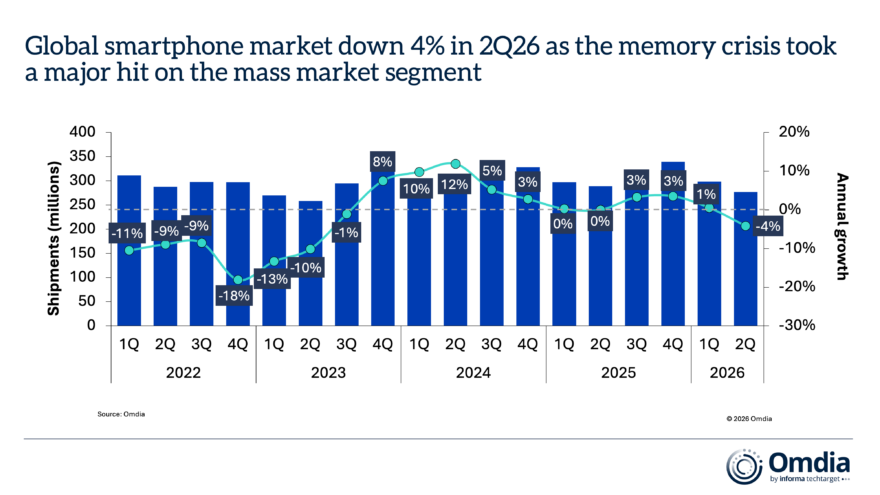
Global smartphone shipments declined 4 per cent year-on-year (YoY) in the second quarter of 2026 as soaring memory prices and supply shortages disrupted production and increased component costs, according to Omdia’s latest smartphone market research.
The research firm said the memory crisis has created a sharply polarised market, with vendors adopting different strategies based on their scale, target price segments and customer base. While the broader market contracted, Samsung and Apple outperformed rivals by expanding shipments and increasing market share.
Samsung retained its position as the world’s largest smartphone vendor with a 22 per cent market share in Q2 2026. Omdia attributed the performance to resilient consumer demand, stable component availability and delayed purchases of the Galaxy S26 series following its postponed launch. Samsung also strengthened its presence in the budget segment as several Chinese competitors reduced product portfolios and increased device prices.
Apple recorded its strongest-ever second-quarter performance, capturing a record 20 per cent market share during what is traditionally its weakest quarter. Omdia said robust demand for the iPhone 17 series drove one of Apple’s strongest upgrade cycles, while stable iPhone pricing gave the company an advantage as most rivals raised handset prices. However, the research firm noted that Apple’s price increases across other product categories towards the end of the quarter could eventually extend to iPhones.
Among Chinese vendors, Xiaomi retained third place with an 11 per cent market share, followed by OPPO at 10 per cent and vivo at 8 per cent.
According to Omdia, the greatest pressure was felt in the sub-US$400 smartphone segment, where supply constraints, narrow profit margins and price-sensitive consumers have forced manufacturers to shift their focus from shipment volumes to profitability. Vendors are streamlining product portfolios, adjusting retail prices and prioritising higher-value devices as memory costs continue to surge.
The research firm noted that memory and storage now account for more than 60 per cent of the bill of materials for budget smartphones and over 30 per cent for premium devices. In addition to memory shortages, semiconductor foundry constraints are adding further cost pressures across the supply chain.
Omdia expects memory prices to begin easing no earlier than the second half of 2027, although prices are unlikely to return to pre-2025 levels. The firm forecasts the steepest shipment declines over the next two quarters as seasonal demand from flagship launches, holidays and shopping festivals coincides with constrained memory supply.
As a result, smartphone brands are expected to increasingly focus on premium devices to protect margins. However, Omdia cautioned that higher prices will leave budget-conscious consumers with fewer affordable choices, leading many to delay purchases, opt for lower-specification models, finance new devices or turn to the refurbished smartphone market.