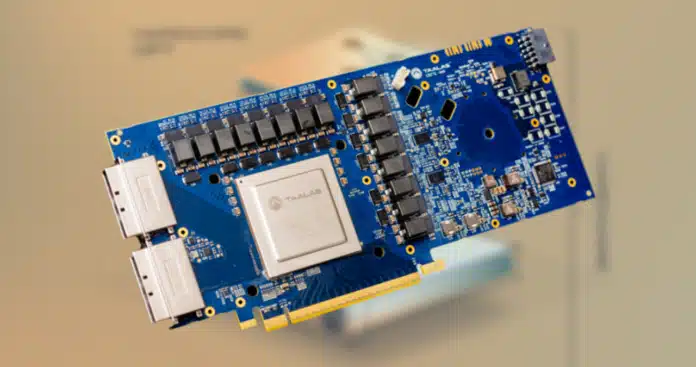

AMD’s acquisition of Taalas adds model-specific silicon to its AI portfolio, targeting the memory bottleneck that limits inference speed, efficiency, and deployment economics.
Advanced Micro Devices (AMD) is acquiring Toronto-based artificial intelligence (AI) chip startup Taalas in a move that could reshape how specialised electronics handle AI inference. The deal brings AMD technology designed to hardwire AI model weights directly into silicon, reducing the repeated movement of data between compute and memory that constrains conventional graphics processing unit (GPU)-based inference. Financial terms were not disclosed.
The significance lies in Taalas’ architectural approach. Modern AI accelerators repeatedly fetch model weights from memory during inference, making memory bandwidth and data movement major bottlenecks. Taalas instead converts a trained model into specialised hardware, effectively embedding its weights into the chip. This allows computation to take place with far less external memory traffic.
The result is a fundamentally different trade-off from the flexibility of a GPU. A conventional accelerator can run many models through software, whereas Taalas’ approach is optimised around a particular model architecture. That fixed-function character can deliver substantially higher throughput and efficiency when the workload is stable enough to justify dedicated silicon. Forbes reports that Taalas’ technology has demonstrated inference performance significantly beyond GPU-based approaches.
For AMD, the acquisition strengthens an AI hardware strategy increasingly focused beyond training. Inference—generating responses from already-trained models—is becoming a major computing workload as AI moves into production applications, where latency, power consumption and cost per token matter as much as raw compute capacity.
AMD plans to integrate Taalas’ technology into its accelerator roadmap alongside its Instinct GPUs, rather than positioning the technology as a replacement for GPUs. The broader objective is to assemble different compute architectures around different AI workloads.
Taalas, founded in 2023, had raised about $219 million, including a $169 million financing round earlier this year. Its acquisition gives AMD both specialised inference technology and an engineering team as competition in AI silicon expands beyond general-purpose accelerators.
The larger question is scalability. Model-specific silicon can offer compelling performance and efficiency, but AI models evolve rapidly. AMD will therefore need to balance Taalas’ hardware efficiency against the flexibility enterprises expect from programmable accelerators—a trade-off that could define the next phase of AI inference hardware.