
LG plans to use the technology to augment and synthesise data for robot learning
LG Electronics is accelerating its robotics collaboration with NVIDIA as the two companies explore ways to strengthen their capabilities in physical AI and speed up the commercialisation of robotics technologies.
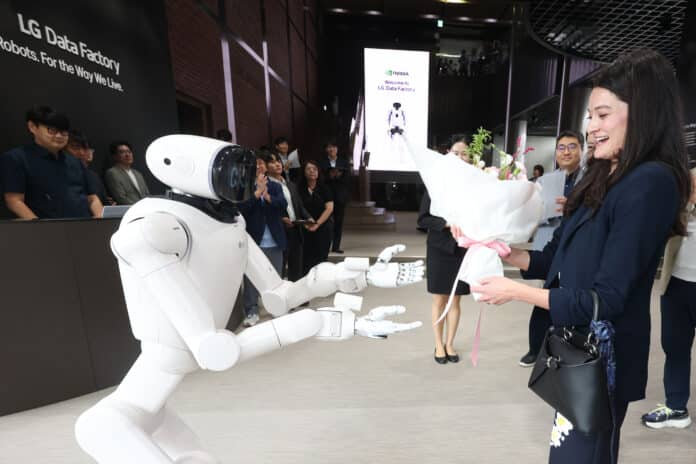
LG recently hosted senior NVIDIA officials at its Data Factory, currently under construction at the company’s Yangjae R&D Campus in Seoul. The meeting came just four days after LG Group and NVIDIA signed a memorandum of understanding (MoU) for strategic collaboration on future business initiatives at NVIDIA’s headquarters in Santa Clara, California.
During the visit, executives reviewed the progress of LG’s Data Factory and discussed opportunities to combine LG’s robotics and manufacturing expertise with NVIDIA’s robotics technologies. The facility is scheduled to become fully operational by the end of 2026.
The Data Factory is designed to collect, train, validate, and refine large volumes of data for robot learning. LG has deployed its self-developed CLOiD home robots at the facility, where they perform tasks in replicated home environments and simulated manufacturing settings. Robots are also being deployed in logistics automation and robotic-hand training environments.
Data gathered from these environments will be integrated with NVIDIA’s robotics stack, including NVIDIA Omniverse libraries, Cosmos open world models, and the Isaac robotics development platform. LG plans to use the technology to augment and synthesise data for robot learning.
The four-floor Data Factory spans around 10,000 square metres and is expected to house several hundred robots by the end of the year. LG expects the facility to generate around 100,000 hours of training data by the end of 2026, including data collected directly at the facility and synthetically generated using NVIDIA Cosmos.
LG intends to use this data to advance its Robot Foundation Model (RFM), which forms a key part of the company’s strategy for developing humanoid and other advanced robots.
The company has identified 2026 as a starting point for its expanded robotics business and recently established a Robotics Business Centre reporting directly to the CEO. LG is targeting growth across industrial, commercial, and home robotics, building on its expertise in manufacturing, actuators, and other robotic components.
“Through the synergy built on ‘One LG’ – bringing together core capabilities across the Group – and strategic collaboration with global partners, we will secure our competitiveness in physical AI and become a comprehensive robotics solutions provider,” said Lyu Jae-cheol, CEO of LG Electronics.