
The Open Challenge Programme of STPI Electropreneur Park seeks to identify and support innovative startups in the ESDM domain.
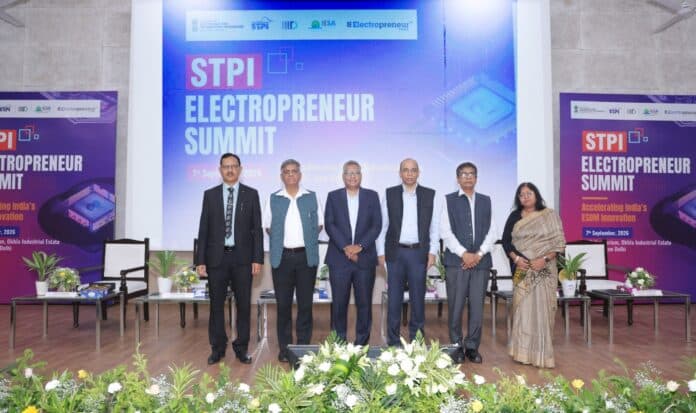
Software Technology Parks of India (STPI), an autonomous society under the ministry of electronics and information technology (MeitY), organised the Electropreneur Park Summit, 2026 at Indraprastha Institute of Information and Technology-Delhi (IIIT-Delhi). The Electropreneur Park (EP) 2.0 at the IIIT-Delhi is a follow up to EP 1.0 established at University of Delhi, south campus in August 2016.
EP 1.0 delivered 129 products, 27 trademarks, 66 patent filings and approximately $16 million in cumulative revenue. With EP 2.0 the target is to nurture 500 startups to build a strong and interconnected electronics system design and manufacturing (ESDM) innovation ecosystem across North India.
The summit was attended by representatives from the government, academic dignitaries, as well as the top brass of STPI. Many startups supported by EP 1.0 were also present. The key highlight of the summit was the launch of the ‘Open Challenge Programme’ which seeks to identify and support innovative startups in the ESDM domain.
Delivering the keynote address, K.K. Singh, joint secretary, MeitY spoke about the initiatives being undertaken by the ministry to support the ESDM sector. He added that the true benchmark for success of Electropreneur Park (EP) will be converting the talent into commercialised intellectual property and then further on into globally competitive products.
Arvind Kumar, director general, STPI, noted three developing trends in the startup ecosystem in India. Firstly, from the initial phase of aggregator startups, young entrepreneurs are moving towards deep-tech companies. Secondly, a lot of ideas are coming in from Tier-II and Tier-III cities. And lastly, there is a renewed interest in electronic design startups rather than just manufacturing services.
The summit provided an opportunity for venture capitalists and young entrepreneurs to interact and funds to flow through academic institutions. Along with IIIT-D, 11 partner institutions, termed as spoke centres attended the summit. Along with them Indian Angel Network services Private Limited and Solara VC also participated.
The 11 spoke centres that provide access to incubation, across the region include:
- ACIC RISE Association Chandigarh Engineering College
- CGC Landran
- NSUT Incubation and Innovation Foundation (NSUT IIF)
- KR Mangalam Incubation and Entrepreneurship Centre (KEIC Foundation)
- Manav Rachna University, Faridabad
- IIT Mandi Catalyst
- NewGen IEDC-Business and Innovation Centre, University of Kashmir
- MNIT Innovation and Incubation Centre (MIIC), MNIT Jaipur
- AKGEC Skills Foundation, Ghaziabad, Uttar Pradesh
- Sharda Launchpad Federation, (Sharda University), Greater Noida
- Runway Incubator, UPES Council for Innovation and Entrepreneurship (UCIE)
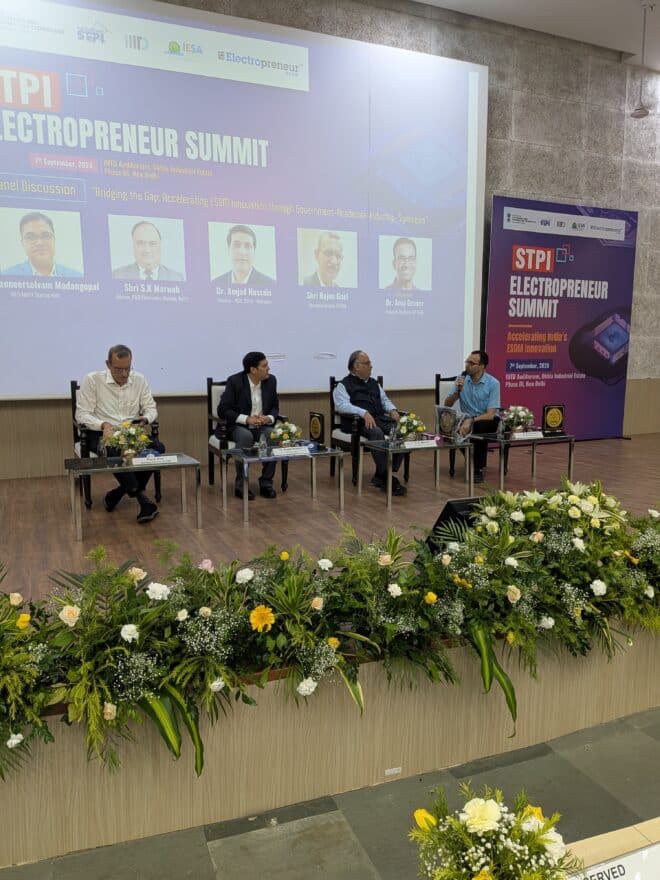
The event included a panel discussion on synergies needed to be established between the industry and academia which was led by ministry representatives, industry leaders and IIIT-Delhi faculty.
“If India has to become a product nation it has to become on the basis of innovation and risk-taking. That is where the synergy between academia and industry is inevitable.” said Dr Anuj Grover, associate professor at IIIT-Delhi, in reply to a question by Electronics For You, at the panel discussion.
S.K. Marwah, advisor, R&D electronics division, MeitY, said that the government has decided that at least 10 per cent of global standard essential patents (SEPs), for the upcoming 6G infrastructure has to be filed by India. Coordination between the industry and academia for the same is important.
Rajoo Goel, secretary general, Electronics Industrial Association of India, said that commercialization of R&D output is important from an industrial standpoint. Being a product nation essentially means being a step ahead of a manufacturing nation, and setting up globally recognised brands.
Many startups with national and international reach which began with EP described their journey and future prospects. These included Electrifuel which produces smart batteries for electric vehicles (EVs), and EVI technologies producing EV chargers. Apart from these there were companies working in the medical sector like GenElek Technologies producing artificial intelligence (AI)-powered robotic exoskeletons for people with mobility impairments, as well as Univlabs which produces laparoscopy equipment and surgical camera systems.

Marwah, in a closing address, said that the real question is can India move from being a large electronic manufacturing base to a globally competitive product technology base. This could only be done if we build a complete ecosystem moving from assembly to design, from design to product and from product to globally competitive intellectual properties (IPs).