




Global conflicts are reshaping the electronics industry far beyond logistics and procurement. When a component shortage triggers engineering and compliance challenges, is your supply chain prepared to respond?
For decades, the electronics industry has relied on globally distributed supply chains to optimise costs, accelerate innovation and access specialised manufacturing capabilities. Components, materials and subassemblies routinely cross multiple countries before becoming part of a finished electronic product.
Recent global crises, geopolitical conflicts, trade measures and supply-chain disruptions have exposed the vulnerabilities of globally distributed supply chains. Major sources of disruption include:
- The COVID-19 pandemic
- The Russia-Ukraine conflict
- The Iran-Israel and US-Iran conflicts, together with threats to shipping through the Strait of Hormuz
- Renewed Houthi activity and increased disruption risks across the Red Sea shipping corridor and Bab el-Mandeb
- Export controls and technology restrictions on advanced semiconductors
- Rising tariffs, sanctions, and trade-policy realignments affecting global electronics supply chains
While these factors are often discussed in terms of shipping delays, rising logistics costs and component availability, their impact extends much further. Export restrictions and the geographic concentration of critical minerals can also disrupt semiconductor, battery, display and electronic-component supply chains. Together, these developments increasingly influence engineering decisions, product qualification, environmental compliance and supply-chain resilience across the electronics industry.
For electronics manufacturers, a supply disruption can trigger supplier changes, component substitutions, redesign, product requalification, revised material declarations and renewed regulatory assessment. What begins as a procurement issue can therefore become an engineering and compliance challenge affecting the entire product lifecycle.
Resilience now depends not only on securing alternative sources but also on maintaining accurate product data, assessing the downstream consequences of change and demonstrating continuing compliance. These activities require a coordinated response across procurement, engineering, quality and compliance.
When geopolitics becomes an engineering problem
Discussions about geopolitical disruption often focus on visible consequences such as shipping delays, higher freight costs, export restrictions and component shortages. While significant, these represent only the first stage of a much broader challenge.
In the electronics industry, every supply disruption has the potential to trigger a series of engineering, quality and compliance activities that extend well beyond procurement.
Consider a common scenario. A semiconductor supplier in a conflict-affected region is unable to fulfil demand. Procurement identifies an alternative supplier, restoring component availability. Although the immediate sourcing problem appears resolved, the real work is only beginning.
Engineering validation typically includes:
- Customer approval for regulated or safety-critical products
- Electrical compatibility assessment
- Thermal performance verification
- Mechanical fit evaluation
- Software and firmware compatibility
- Manufacturing process suitability
- Reliability, safety and application-specific qualification, where required
- Component authenticity, traceability and authorised-source verification
- Lifecycle status and obsolescence assessment
- Bill of Materials (BOM) updates
- Product validation and requalification, where required
Engineering and environmental compliance teams must then determine whether the replacement component changes material composition, Full material declarations (FMDs), supplier declarations, country of origin, reportable substances, or applicable regulatory obligations. A supplier or manufacturing-location change may also affect tariff classification, sanctions screening, export-control requirements, and customer-specific reporting obligations.
What initially appears to be a procurement decision can quickly become a multidisciplinary engineering programme involving procurement, engineering, quality, environmental compliance and trade compliance. The speed with which an organisation can evaluate, validate and document these changes increasingly determines its ability to maintain production, demonstrate regulatory compliance and preserve customer confidence.
Supply-chain resilience should therefore no longer be measured solely by inventory levels or supplier availability. It should also reflect how effectively an organisation manages the engineering, quality, and compliance consequences of change.
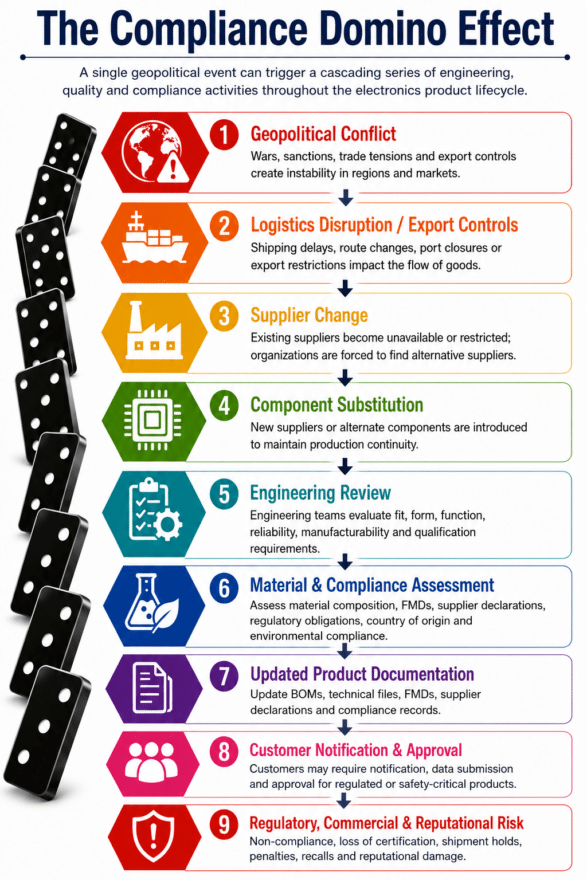
The compliance domino effect
A single geopolitical event can trigger a cascading series of engineering, quality and compliance activities throughout the electronics product lifecycle.
The new geography of electronics supply chains
Modern electronics manufacturing is one of the world’s most globally integrated industrial ecosystems. A single product may incorporate raw materials sourced from one region, semiconductor wafers manufactured in another, packaging completed elsewhere, printed circuit boards assembled in a different country, and final products delivered worldwide.
This globally distributed model has enabled manufacturers to optimise costs, leverage specialised expertise and accelerate innovation. However, it has also created significant dependence on a relatively small number of regions for critical minerals, advanced semiconductor fabrication, semiconductor packaging and testing, and printed circuit board manufacturing.

Supply-chain risk also extends upstream to critical mineral extraction, rare-earth processing, speciality metals, process gases and specialised chemicals. Export restrictions or supply disruptions affecting these upstream inputs can influence semiconductor manufacturing long before components reach electronics manufacturers.
The IEA’s Global Critical Minerals Outlook 2026 highlights several continuing concerns
- Continued concentration of refining capacity for several strategic minerals
- Expanding export restrictions affecting critical materials
- Particularly high exposure for gallium, germanium, graphite, magnet rare earths, tungsten, and yttrium
- Even limited disruption to these materials can affect semiconductor manufacturing, batteries, permanent magnets and power electronics
Unlike many industries, electronics manufacturing depends on highly specialised facilities requiring substantial investment, advanced technology and skilled workforces. Consequently, production cannot be relocated quickly when geopolitical tensions, trade restrictions, or natural disasters disrupt operations. Many organisations are therefore pursuing regionalisation, friend-shoring and ‘China+1’ sourcing strategies, although these approaches increase supplier qualification and management complexity.
Even a localised disruption can have far-reaching consequences. A shortage of a single critical component may delay production, affect multiple supplier tiers, and require manufacturers to qualify alternative sources. These changes often extend beyond procurement, requiring engineering validation, updated compliance documentation, and customer communication before products can be released.
Understanding supply-chain dependencies has therefore become as important as managing inventory. Organisations need visibility beyond direct suppliers into Tier 2 and Tier 3 suppliers, critical-material sources, and key logistics routes that influence product availability and compliance.
Beyond logistics: The six interconnected risks
Geopolitical disruption affects far more than transportation or procurement. A single event can trigger interconnected risks across engineering, compliance, trade, business continuity and product data.

1. Supply-chain and logistics risk
Factory shutdowns, transport restrictions, export controls, shortages of critical minerals, and extended lead times can reduce component availability while increasing procurement, transportation, and logistics costs.
2. Engineering and quality risk
Alternative suppliers or substitute components require validation for electrical compatibility, thermal performance, mechanical fit, software, and firmware compatibility, manufacturing suitability, reliability, and lifecycle status before production.
3. Environmental and product-compliance risk
Engineering changes may require updated full material declarations (FMDs), supplier documentation, and verification of continued compliance with regulations such as RoHS, REACH, SCIP, POPs, and other applicable product requirements.
4. Trade, sanctions, and export-control risk
Supplier or manufacturing-location changes may require export-control reviews, sanctions screening, country-of-origin verification, tariff assessment, and other trade-compliance checks before products can be supplied.
5. Business and customer risk
Production delays, compliance issues, and engineering changes can increase costs, delay deliveries, affect customer commitments, and damage business relationships and reputation.
6. Product-data and traceability risk
Without accurate Bills of Materials (BOMs), supplier declarations, and traceable product data, organisations may struggle to identify affected products, assess compliance impacts, and respond effectively during disruptions.
These risks are closely interconnected. Managing them requires timely, accurate, and traceable product data, making high-quality product information a strategic business asset rather than simply a compliance requirement
The hidden environmental cost of supply chain disruption
Supply-chain disruption affects more than production schedules and operating costs, it can also increase the environmental footprint of electronics manufacturing.
Supply-chain disruption can increase environmental impacts through:
Higher safety-stock levels, which may increase warehousing and resource use but can reduce reliance on emergency transport when carefully managed
Longer shipping routes, increasing fuel consumption, and transit times
Greater reliance on air freight, resulting in significantly higher carbon emissions
Alternative sourcing locations, which may increase transportation distances and value-chain (Scope 3) greenhouse-gas emissions
Redesign, requalification, and obsolete inventory, increasing material waste and embodied emissions
As sustainability reporting requirements continue to expand, resilience and environmental performance can no longer be managed independently. Decisions made to protect supply continuity increasingly influence carbon emissions, resource efficiency, and corporate sustainability commitments.
For electronics manufacturers, resilience is therefore measured not only by the ability to maintain production, but also by the ability to preserve product transparency, regulatory compliance, and environmental performance throughout the supply chain.
Export controls: When public policy triggers engineering change
Export controls on advanced semiconductors, manufacturing equipment, design software, and other strategic technologies demonstrate how rapidly public policy can reshape the electronics industry. Changes in licensing requirements, permitted customers or end uses can directly influence supplier availability, sourcing strategies and technology roadmaps.
When critical components become unavailable, organisations must first determine whether an alternative supplier or transaction is legally permitted before evaluating technical suitability. Export-control and trade-compliance assessments may require product classification, destination, end-user, and sanctions screening, end-use review, licence determination, and verification of ownership or control relationships.
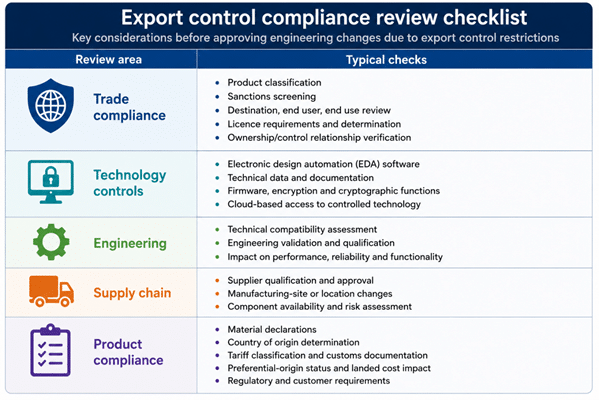
Export controls may also extend beyond physical components to technologies such as electronic design automation (EDA) software, technical data, firmware, encryption, and cloud-based access to controlled technology. Consequently, compliance decisions increasingly require close collaboration between procurement, engineering, trade compliance and legal teams. Because export controls and sanctions can change rapidly, organisations should maintain evidence of trade-compliance screening and periodically reassess affected suppliers, customers, and transactions.
Where alternative components are approved, manufacturers should then assess the impact on:
- Engineering validation and qualification
- Material declarations and environmental compliance
- Country of origin and preferential-origin status
- Tariff classification and customs documentation
- Landed cost and applicable customer or regulatory requirements
Supplier or manufacturing-site changes can influence all of these trade-compliance considerations and should therefore be evaluated alongside engineering and environmental compliance reviews.
Additional risks to evaluate
- Increased reliance on grey-market distributors may introduce counterfeit, remarked, or substandard components
- Replacement components may affect firmware, software licences, cybersecurity, cryptographic functions, and cloud-based services
- Technically compatible components may still create lifecycle-support or software compatibility challenges
- Supplier qualification, component authentication, and verification should remain integral to every engineering change
Every engineering change should therefore trigger an appropriate compliance review to ensure both technical suitability and regulatory obligations have been addressed.
Engineering change management: Integrating compliance from the ctart
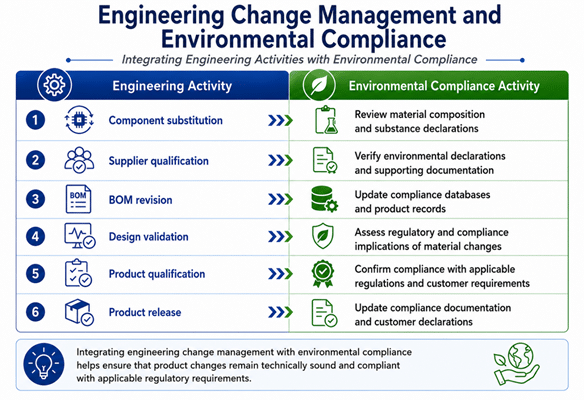
Engineering change management (ECM) has traditionally focused on maintaining product performance, reliability and manufacturability. Today, however, engineering changes must also be evaluated from an environmental and regulatory compliance perspective.
Consider an industrial controller whose primary semiconductor is replaced because of export restrictions. The alternative component passes functional testing and satisfies all performance requirements, making it technically suitable for production. From an engineering perspective, the change appears complete.
From a compliance perspective, however, several important questions remain:
- Has the material composition changed?
- Is an equivalent and current full material declaration (FMD) available?
- Have declarable or restricted substances changed?
- Does the replacement affect compliance with RoHS, REACH, SCIP, POPs, or customer-specific requirements?
- Has the manufacturing site or country of origin changed?
- Are trade-compliance reviews, such as tariff, sanctions, or export-control assessments, required?
- Is additional regulatory or customer documentation required?
- Have the BOM, engineering records, and compliance documentation been updated consistently?
An engineering change should not be considered complete until all applicable technical, quality, compliance and documentation requirements have been addressed.
By integrating engineering and compliance into a single change-management process, organisations can improve the quality and speed of engineering decisions while strengthening regulatory compliance and customer confidence.
Material transparency: From regulatory requirement to business capability
Environmental compliance was once viewed primarily as a documentation exercise. Manufacturers collected supplier declarations, maintained compliance records, and responded to customer requests as required.
That approach is no longer sufficient.
Customers increasingly expect detailed information about material composition, restricted substances, recycled content, responsible sourcing, country of origin and broader sustainability attributes. At the same time, regulators are placing greater emphasis on product traceability, digital documentation, and demonstrable due diligence throughout the product lifecycle.
The key question has therefore evolved from “Is the product compliant?” to “Can the organisation demonstrate compliance quickly using reliable, traceable and up-to-date evidence?”
This shift transforms environmental information from an administrative requirement into a strategic business capability. Organisations that maintain accurate, accessible, and well-governed product data are better positioned to respond to regulatory changes, supplier disruptions, engineering changes, and customer enquiries with confidence.
In an increasingly complex regulatory and geopolitical environment, material transparency is no longer simply a compliance obligation; it has become a foundation for supply-chain resilience, business continuity, and informed decision-making.
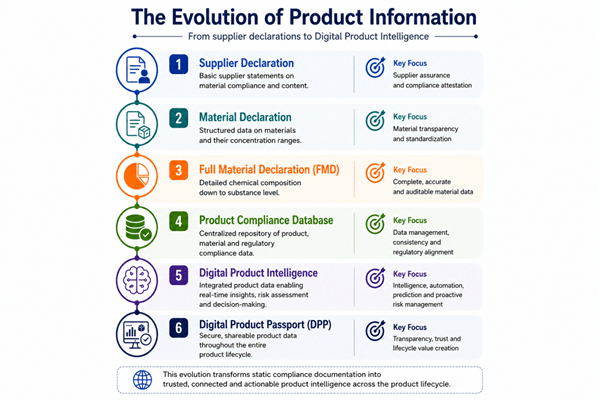
From material declarations to digital product intelligence
Traditional compliance programmes often rely on supplier declarations, spreadsheets, and disconnected databases. While these methods may support routine compliance activities, they become increasingly difficult to manage when suppliers, engineering changes, and regulatory requirements evolve simultaneously.
Digital product intelligence represents the next stage in compliance management by connecting engineering, procurement, environmental compliance, and product information into a single, continuously updated ecosystem.
Resilient supply chains depend on resilient product data.
With connected product data, organisations can rapidly identify:
- Affected products and components
- Suppliers operating in high-risk regions
- Material declarations requiring updates
- Engineering changes that trigger compliance reviews
- Customers requiring revised documentation, and
- Emerging regulations that may impact existing product portfolio
This transforms compliance from a reactive documentation exercise into a proactive data-driven business capability.
Supported by technologies such as IPC-1752 material declaration standards, product lifecycle management (PLM), enterprise resource planning (ERP), supplier collaboration portals, environmental compliance databases, and emerging digital product passport (DPP) initiatives, digital product intelligence provides the visibility needed to make faster, better-informed decisions during disruption.
Rather than reacting after disruption occurs, digital product intelligence enables manufacturers to rapidly identify affected products, evaluate engineering impacts, and support compliance decisions using connected, continuously updated product information.
Artificial intelligence: Accelerating decisions, not replacing evidence
Artificial intelligence (AI) is becoming an increasingly valuable tool for regulatory intelligence, supplier monitoring, and supply-chain risk management. By analysing large volumes of structured and unstructured data, AI can identify trends, dependencies, and potential risks far more quickly than traditional manual processes.
Within environmental compliance, AI can help organisations identify:
- Products dependent on suppliers in high-risk regions
- Components affected by geopolitical developments
- Expiring supplier declarations
- Engineering changes requiring additional review
- Emerging regulatory developments
- Potential alternative sourcing strategies
However, AI cannot replace engineering judgement or regulatory evidence. It cannot validate material composition, approve engineering changes, or compensate for incomplete supplier documentation. Its effectiveness depends entirely on the quality, accuracy, and governance of the underlying product information.
When supported by reliable Bills of Materials (BOMs), supplier declarations, and compliance data, AI becomes a powerful decision-support capability, enabling organisations to respond more quickly and confidently to supply-chain disruption.
AI is not a substitute for engineering expertise, supplier evidence or regulatory documentation. Its greatest value lies in helping organisations analyse complex product and supply-chain data more quickly, enabling faster, better-informed engineering and compliance decisions.
Building resilient and compliant electronics supply chains
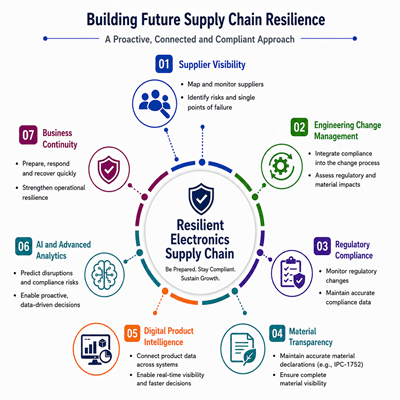
As geopolitical uncertainty becomes a permanent feature of global business, resilience must extend beyond securing component supply. Electronics manufacturers need integrated strategies that combine engineering, procurement, environmental compliance, and product information to respond effectively when disruption occurs.
Key priorities include
- Mapping critical suppliers, manufacturing locations and logistics routes
- Identifying single-source dependencies before shortages occur
- Maintaining current material declarations and supplier documentation
- Pre-qualifying alternative suppliers and components
- Integrating compliance reviews into engineering change management
- Monitoring export controls, sanctions, and critical mineral developments
- Connecting engineering, procurement, and compliance information through digital product intelligence.
- Regularly testing the organisation’s ability to demonstrate compliance using current product information
The next major geopolitical disruption is not a question of if, but when. Organisations that can rapidly evaluate engineering changes, maintain regulatory compliance, and access reliable product information will be better positioned to protect business continuity and customer confidence.
The electronics industry is entering an era in which geopolitical uncertainty is no longer an occasional disruption but an enduring business reality. Building resilient supply chains therefore requires more than diversified sourcing or larger inventories. It demands closer integration of engineering, procurement, environmental compliance and trusted product information.
Manufacturers that can rapidly assess engineering changes, demonstrate regulatory compliance and make decisions using accurate, connected product data will be better positioned to respond to future disruptions with confidence.

