


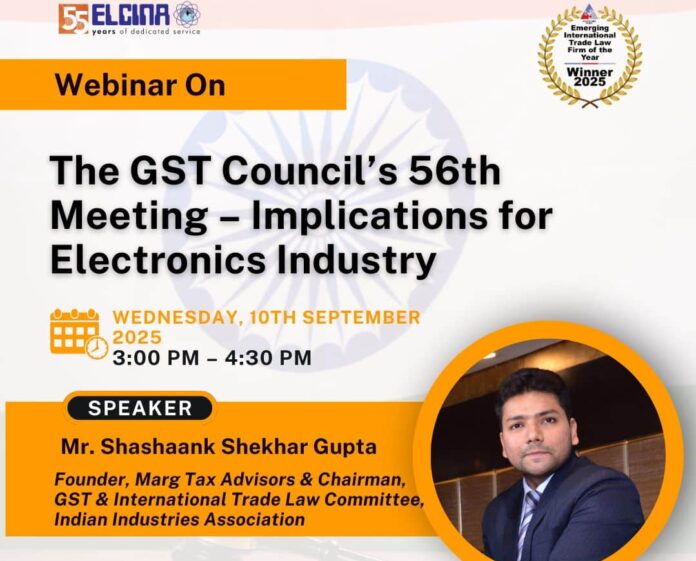

Cheaper appliances, smoother compliance, and stronger exports; an exclusive ELCINA webinar on GST 2.0 explored how the reforms could power India’s $500-billion electronics manufacturing vision.
Last Wednesday, the Goods and Services Tax (GST) Council, in its 56th meeting, announced major reforms to India’s indirect tax system. Finance Minister Nirmala Sitharaman confirmed the new framework: two primary slabs of 5% and 18%, with 40% for demerit goods, effective 22 September 2025. Welcoming these measures and looking to assess their long-term impacts, the Electronic Industries Association of India (ELCINA) organised an exclusive webinar yesterday.
Expert Shashank Shekhar Gupta, a Delhi-based chartered accountant, lawyer, and founding partner at Marg Tax Advisors, unpacked GST 2.0 reforms, covering the two-slab system, input tax credit (ITC) transitions, and practical guidance for electronics manufacturers, finance teams, and compliance professionals.

Dr Sasikumar Gendham, President of ELCINA, highlighted that the simplified structure and subsuming of compensation cess will boost India’s electronics sector, a cornerstone of the US$500 billion manufacturing vision by 2030. “Essential products like air conditioners, refrigerators, and televisions will become more affordable; washing machines may cost ₹3,000 less, televisions around ₹5,000 less, putting more cash in consumers’ hands and stimulating demand in tier-2 and tier-3 cities,” he said.
Key GST rate cuts for electronics
- Electric accumulators (excluding lithium-ion): 28% → 18%
- Select categories under 8525 60: 12% → 5%
- Electric ignition and starting equipment: 28% → 18%
- White goods such as TVs, refrigerators, and air conditioners: 28% → 18%
Lower GST = lower prices, stronger demand, and a boost for domestic electronics manufacturing.
Exploring the GST reforms
Gupta continued the session, describing the changes as “one of the most significant rationalisations since the implementation of GST,” consolidating excise, service tax, value added tax (VAT), entry tax, and central sales tax (CST) into a unified framework with two main slabs and 40% for demerit goods.
For the electronics industry, most products will fall under the 18% slab, with essentials like white goods, electric accumulators, and ignition equipment seeing cuts from 28% or 12%. Consumers could save up to ₹4500 on a ₹50,000 appliance, enhancing purchasing power and boosting festive demand.
On ITC, Gupta clarified that “once availed, ITC remains indefeasible” and can be used against outward liability, though exemptions require reversal of credits. He noted dissatisfaction over unutilised balances from inverted duty structures, as refunds for past accumulated ITC will cease once both inputs and outputs move into 18%.
On procedural reforms, Gupta welcomed steps to streamline export refunds: exporters paying tax under letter of undertaking (LUT) can claim automatic refunds through the Indian Customs Electronic Gateway (ICEGATE), and 90% of refund claims for low-risk taxpayers will be released promptly, easing liquidity pressures.
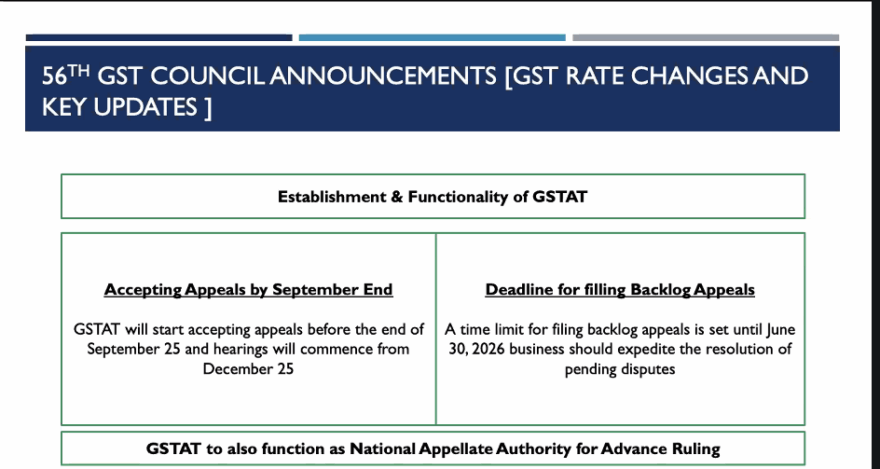
The webinar also noted the establishment of the GST Appellate Tribunal, expected to accept appeals by September 2025 and start hearings by December. The limitation period for pending cases has been extended until 30 June 2026, giving taxpayers more time. Gupta praised measures addressing disputes over intermediaries and post-supply adjustments, as well as relaxations around credit notes and compliance mechanisms, which he said will “reduce unnecessary litigation and ease industry operations.”
On registration, Aadhaar-based verification, OTP authentication, and physical inspections have curbed fraud while streamlining business-to-business (B2B) compliance. Automatic registration is proposed for taxpayers with monthly liabilities below ₹250,000.
Gupta also clarified transitional tax scenarios, explaining that the applicable rate depends on the sequence of supply, invoice, and payment: a framework that “removes ambiguity and gives businesses clarity for planning, compliance, and cash flow management.”
The session provided a few takeaways for the electronics industry:
- Clear cost benefits for consumers: Lower prices will directly stimulate demand, strengthening order books for manufacturers and suppliers.
- Alignment with global VAT practices: The two-tier structure brings India closer to European Union (EU), Gulf Cooperation Council (GCC), and Malaysian VAT models, boosting export competitiveness.
- Encouragement for domestic manufacturing: Rationalised slabs reduce costs across the value chain, encouraging localisation and scaling of supply chains.
- Clarity on transitional challenges: Businesses are planning around temporary slowdowns as buyers delay purchases until new rates apply.
- Inverted duty structure relief: Automated refunds up to 90% for products in the 5% slab will provide liquidity support.
- Streamlined compliance and refunds: Faster refunds will ease working capital pressure across the B2B chain.
- Practical industry guidance: Businesses can identify applicable rates directly through HSN (harmonised system of nomenclature) codes, reducing reliance on intermediaries.
Transitional GST rate rules (effective 22 September 2025)
When supply, invoice, and payment dates fall across old (28%) and new (18% / 12% → 5%) rates, the time of supply rules decide the applicable rate:
- supply + invoice + payment before 22 Sept → old rate applies
- supply before, invoice and payment after 22 Sept → new rate applies
- supply before, invoice before, payment after 22 Sept → old rate applies
- supply and invoice after 22 Sept → new rate applies (irrespective of payment date)
Tip: Sequence of supply, invoice, and payment determines whether the old or new GST rate applies.
Gupta also answered some essential questions from the audience and ELCINA:
How will GST reforms benefit the middle class?
Electronics will see up to a 10% GST cut, making goods more affordable. Moving many items from 28% to 18% is “bolder than expected” and will directly ease costs for middle-class consumers.
What is the monetary impact, and will benefits be passed on?
Prices will fall substantially, leaving more disposable income. With anti-profiteering provisions phasing out, competition will ensure the benefit reaches buyers.
What about business operations and compliance?
Companies are updating HSN registers and purchase records, while planning refunds where inverted duty applies. A short-term dip in transactions is expected as buyers wait for lower rates, followed by a surge in demand.
What are the implications for international trade?
The two-tier structure aligns India with global VAT models. Exporters will see limited credit accumulation, and imports will be realigned, improving competitiveness.
Will new inverted duty structures arise?
Yes, items moving into 5% may face accumulation of credits. However, automated refunds up to 90% for low-risk businesses will ease pressures.
Closing the session, Gupta advised companies to rely on HSN codes and official rate notifications, which resolve most queries, while noting that the Council may issue further clarifications. He reassured industry players of continued support through the transition.
The session concluded that GST 2.0 marks a decisive step toward a simpler, more transparent tax regime; one that will reduce litigation, boost consumption, and reinforce the electronics sector’s role in India’s US$500 billion manufacturing vision by 2030. ELCINA emphasised the need for quick resolution of residual anomalies such as inverted duty structures, while affirming that the reforms will strengthen domestic demand, improve affordability, enhance export competitiveness, and accelerate industry growth.

