


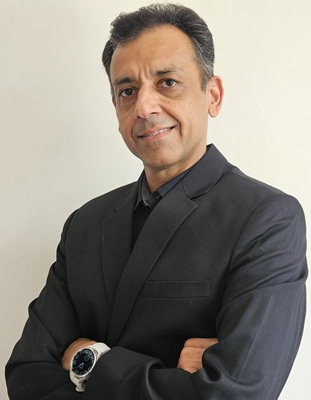

From connected vehicles to ADAS, Greencore Electronics is helping Indian OEMs accelerate innovation through faster development and local manufacturing. Pavan Puri from Greencore speaks to Pratyush Kumar and Saba Aafreen from EFY about the company’s journey and vision.
Q. In simple analogy, what does Greencore Electronics do?
A. It is an innovative automotive electronics company focused on sensors, advanced driver assistance systems (ADAS), and camera-based sensor systems. We specialise in two large fields: the connected automobile and ADAS for passenger vehicles and commercial vehicles. We are pursuing global tie-ups and collaborations to expand further and sell our products to the Indian automotive segment.
Q. Would you consider Greencore a startup or a full-fledged company?
A. We were a startup three years ago, but we are now on the path to becoming a full-fledged electronics manufacturer specialising in automotive electronics within the next two years.
Q. When Greencore started, what gap was it trying to fill?
A. You see, connected cars and connected trucks were coming in, and a lot of telematics mandates were emerging. The gap was that only one or two really large players existed, and they had high costs and very long development times. We came in with shorter development times, mid-level costs, and faster time-to-market. That is the best way to describe it.
Q. Can you break down your business into key segments: automotive accessories, smart electronics, ADAS, and connected systems?
A. Right now, about 15 to 18% of the business comes from accessories, and the balance comes from smart electronics, connected devices, and ADAS sensor systems. The ADAS and connected category is very large. We currently sell mostly audio systems and reverse-camera systems, but if you put artificial intelligence (AI) in a camera system, it becomes an ADAS camera. For instance, we are working on a driver-monitoring or driver-drowsiness system. It is the same camera, but with AI behind it. When the driver is drowsy, it alerts immediately. Connect it through a telematics module, and it alerts the fleet owner. That is a perfect example of how connected systems and ADAS overlap.
Q. Are you focusing only on ADAS in general or also on ADAS for two-wheelers?
A. Right now, we are focusing on wider vehicle segments for ADAS and connected solutions, such as passenger vehicles, commercial vehicles, and construction equipment. For two-wheelers, we plan to introduce similar, very innovative products starting next year.
Q. What role will ADAS and sensor-based systems play in improving road safety?
A. ADAS is already present, but I see a major impact in the commercial vehicle and truck segment. Most truck drivers drive for many hours, and a lot of accidents happen due to drowsiness. Driver-drowsiness detection systems will improve road safety significantly. For passenger cars, more refinement and more cost-effective ADAS systems are needed. Today, ADAS features are typically offered only on top variants. I would like to see them become standard across all variants. Even the base model should come with some low-cost ADAS features. Blind-spot detection, for example, does not require too much money. Commercial vehicle ADAS will definitely improve road safety, and ADAS should be offered across all car variants.
Q. What were the key challenges in developing ADAS and smart systems for Indian road conditions?
A. Indian road conditions are incredibly dynamic. The technology for autonomous driving exists and can be implemented in India, but the primary challenge is the environment. You have animals on the road, pedestrians, cyclists, and people suddenly crossing. The lane system is poor, often not painted well. If there are no clear markings, a camera cannot keep you in lane, which prevents the lane-departure warning system from functioning properly. That is why in India, we are only doing basic Level 1 and Level 2 ADAS, and even Level 2 sometimes works and sometimes does not. Beyond that, the challenge is finding reliable partners to put the hardware together in India and sell it to different customers.
Q. How are these challenges addressed from your end?
A. We have to validate our product extensively, conduct road tests under different conditions, and perform tests such as electromagnetic interference (EMI) and electromagnetic compatibility (EMC). We must ensure our electronics do not interfere with other vehicle electronics. For example, a camera system should not interfere with the instrument cluster or even a simple light. Nothing should malfunction.
Q. How do you ensure reliability and automotive-grade safety in your products?
A. Two ways. First, we only tie up with companies that already sell to reputable automotive original equipment manufacturers (OEMs) worldwide, like Hyundai, Mercedes, and BMW. They have the certifications and reference customers. Second, we have hired experienced engineers from the industry. I personally oversee every single test to make sure safety is met. Then the customer also validates everything.
Q. From an electronics perspective, what core technologies power your products today?
A. For any electronics, especially ADAS, there are two main categories: hardware and software. We look for very good, reliable partners because, in the automotive field, there are many reliability tests and factors at play. People’s safety is involved, and the government has put many mandates in place. Our OEM customers, like Tata Motors and Ashok Leyland, also have strict norms. We are pursuing technical collaborations with Korean, Taiwanese, and, to an extent, Chinese companies for technology transfer.
We take their AI algorithms or software, assemble the hardware in India, do extensive validation and testing locally, and then sell to different customers. AI is mostly controller- and software-driven.
For example, a camera at the front of a car, combined with AI and linked to the braking system, becomes a forward-collision warning ADAS feature. If the vehicle in front stops and the driver does not, the camera senses it and applies the brakes.
Q. Are you just assembling the technologies you get from Korea and Taiwan, or are you the original designer as well?
A. We are assembling. We depend on our technology partners for the technology. They transfer knowledge and some machines and show us how to assemble everything. They send their engineers here for about a month to train our engineers and workers. We have a factory in Manesar, near Gurugram.
Q. Can you talk about your manufacturing facility in Manesar and the production process?
A. Most processes are assembly-line and end-of-line testing, all linked together. There is a lot of traceability at the end of the line. Every data point is recorded, and we keep it for up to four years. The lines are not fully automated; they are semi-automatic. A lot of assembly takes place, and a lot of end-of-line testing runs through a computerised system.
Q. Is all manufacturing done at the Manesar plant? Do you have other plants?
A. Only from Manesar right now. I would also highlight one product: we make a puncture repair kit, or tyre repair kit, which we sell as an Original Equipment Manufacturer (OEM) product to electric vehicle (EV) makers like Tata, Škoda, Volkswagen, and Mahindra. We are one of the largest suppliers. We hold a patent for the inflator design, which we manufacture from scratch in India at Manesar.
Q. How do repeat orders look from your clients?
A. The beauty of our products is that once a camera system, for example, is validated and enters the OEM’s bill of materials, it becomes a standard part. Every time that model is produced, we automatically get a repeat order. The product life cycle is typically four to five years. Even when models change, we have been fortunate that our quality and cost have been so good that clients have continued with our system in the updated model. Essentially, 99% of our business is repeat business.
Q. Can you detail your facility’s capacity, equipment, and output?
A. The area is around 2508 square metres (27,000 square feet). It is divided across three and a half floors. One floor is entirely the store, one floor is dedicated to assembly lines, and the third floor is office space. We have about six assembly lines today for different products: audio systems, puncture kits, and reverse-camera systems. We also have some unused space within the facility, giving us considerable scope for expansion.
Q. What machinery do you have at your facility, and how much have you invested in it?
A. They are the usual assembly-line machines, jigs, and fixtures, along with automatic, programmable logic controller (PLC)-controlled testing jigs. We have currently invested close to about ₹20 million. However, the breakthroughs we are expecting will require quite a large investment. We are working on it.
Q. Who are the founders, what is the current team size, and what is the scale of operations?
A. I started the company with my wife Prerna, who is the president. We began by selling automotive electronic accessories to OEMs like Maruti and Toyota, and then Prerna suggested we shift to factory-fitted OEM products, which is how we entered core products. We changed our strategy within the first year, and in years two and three we expanded. Also, Akshay Kashyap, director of Green Fuel Energy, played a very important role as a shareholder and strategist. Our current team size is around 110 people: 50 on-roll and 60 off-roll.
Q. Is there a story behind the name Greencore?
A. We were part of Green Fuel, which is Akshay’s company. That is where the ‘Green’ came from. Prerna suggested we focus on core products, so ‘Core’ came from that.
Q. What does your core engineering and product development team look like?
A. We have about 12 Research and Development (R&D) engineers and about 14 quality engineers because we place greater emphasis on quality. We also have two in-house designers and use design software such as AutoCAD and UniGraphics. Even though the core electronic printed circuit board assembly (PCBA) or software may come from our partner, many of the plastic and metal components are sourced and designed locally.
Q. What is the approximate revenue contribution of each segment?
A. Accessories contribute about 18%. Audio systems and infotainment account for around 40%. The remaining roughly 42% comes from other smart electronics, such as reverse-camera systems, universal serial bus (USB) charging ports, and reverse parking sensors that we supply across cars and trucks. Going forward, we plan to grow further in connected audio systems, infotainment, and clusters.
Q. Which segments are driving the highest growth and margins for you?
A. Passenger vehicles adapted to connected features three or four years ago, so that is a slightly more mature but still growing market. However, the commercial vehicle segment is undergoing very rapid change right now.
Next year, a government mandate for driver-drowsiness detection, blind-spot detection, and forward-collision warning systems may arrive for commercial vehicles. For passenger vehicles, the opportunity lies more in the e-cockpit, where the cluster links with the infotainment system and further with the telematics module to deliver a completely connected automobile.
Q. Any other segment that contributes significantly to your revenue?
A. Our construction equipment segment is growing strongly because the government’s infrastructure push is driving sales of JCB, Escorts, Kubota, and similar equipment. That is also helping us grow.
Q. How do you position Greencore against the competition in this sector?
A. Our biggest unique selling proposition (USP) is shorter development time and much more competitive pricing compared to players like Harman or Continental. They are very large, of course. Our smaller team allows faster development and competitive costs. We are getting there and should be able to match them very soon.
Q. What is your biggest bottleneck while scaling your business?
A. Supply chain. The biggest challenge is finding good suppliers in North India, quality suppliers willing to work with us even on slightly lower volumes. We are growing, so volumes are sometimes not in the millions per month. We want to tie up with partners who can support medium-sized volumes while maintaining the same high quality as larger volumes.
Q. Are you looking for suppliers in North India to keep logistics costs lower?
A. Most of our suppliers are from North India. Only one or two are from South India. It is better for logistics because you want faster supplies and just-in-time delivery. It simply makes more sense to tie up with nearby suppliers.
Q. Are there any other major challenges in your scale-up process?
A.The only challenge is supplier selection, which we are now addressing aggressively. Regarding finance and investment, surprisingly, it has not been a major issue. Banks are ready to finance lucrative projects. So, the key issue is supplier selection.
Q. Do you have any plans for further fundraising, a small and medium enterprise (SME) initial public offering (IPO) or series funding rounds?
A. When we look at expansion in a big way, we will evaluate different options. Instead of an IPO, we could consider funding rounds. We are open to that when the time is right.
Q. How do you see smart automotive electronics evolving with EVs and connected vehicles in India?
A. EVs have played a very important role in bringing smart electronics to the country. Initially, people were not buying EVs, so manufacturers decided to make them more attractive by offering the latest technology and futuristic designs. That trend brought smart electronics into the mainstream, and gradually it was carried into petrol and other engine vehicles as well. EVs have definitely helped make smart electronics a widespread, mass-market product.
Q. With the ongoing fuel transition in the country, where do you see Greencore standing?
A. The beauty of our products is that we supply to EVs, Compressed Natural Gas (CNG) vehicles, petrol engines, diesel engines, and soon hybrids, which are coming in a big way. The electronics segment we work in caters to every fuel type. There is nothing to worry about regarding our future expansion. We are very thoughtful about the products we choose to enter.
Q. What is your long-term vision for Greencore?
A. We want to be a full-stack automotive mobility company in smart electronics, offering connected electronics and ADAS sensor systems. We will tie up with high-quality, reputable international companies and bring those offerings to the Indian automotive market.
Q. What message would you like to share with our readers?
A. The Indian automotive segment is undergoing tremendous change for the better, with increasing use of electronics in vehicles. We should embrace it, use it, and take advantage of it to improve the overall ecosystem.

