


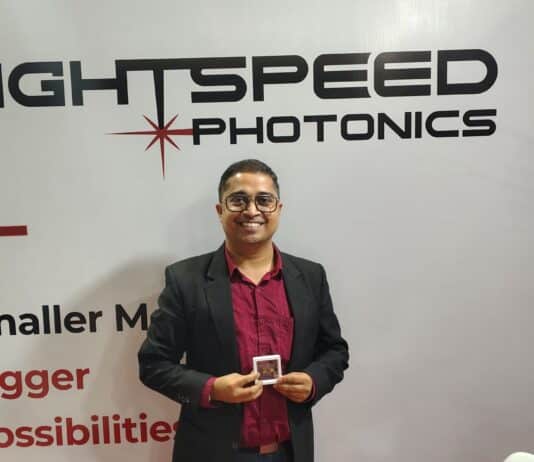

Can optical interconnects move closer to AI compute without making packaging the next bottleneck? A compact 400-Gbps component offers a glimpse of one approach.
LightSpeed Photonics has demonstrated a CPO-class optical interconnect component capable of transferring 400 Gbps at less than 2 W in a compact 9 mm × 9 mm footprint. The approach targets a key challenge in bringing optical connectivity closer to high-performance compute, making photonic integration practical to manufacture at scale.
The approach combines optical and semiconductor materials through heterogeneous integration, with the component designed to withstand surface reflow temperatures used in electronic assembly. The company is also demonstrating PCIe-over-fibre technology supporting PCIe 5.0 and PCIe 6.0. This could allow compute, storage, and memory resources to be physically separated while continuing to communicate over PCIe.
In an exclusive interaction at Semicon 2026, Rohin Y, Founder and CEO of LightSpeed Photonics, said the company has focused on bringing different materials together in a package that can withstand conventional manufacturing conditions.
“We have interdisciplinary engineering ability to integrate optics that are made in polymers to substrates that are in high-frequency substrates, to silicon germanium, or III-V materials,” Rohin said. “All these materials, they all have to come together, glue together, and make them withstand surface reflowable temperatures is the core IP that we have created over the years.”
That reflow capability could allow photonic components to fit more naturally into electronic assembly processes, bringing them closer to the way conventional components are manufactured. But according to Rohin, demonstrating that near-package or co-packaged optics work is only part of the challenge.
“The challenges that we went out to solve were manufacturability, the yield improvements, and how we can bring this to scale at large,” he said.
The company’s PCIe-over-fibre technology addresses another challenge emerging as AI systems grow: separating resources that were traditionally housed within the same server. Rohin said future data centres could use optical links to support disaggregation of storage, memory, and compute.
Moving optics closer to compute also introduces thermal and reliability considerations, as high-power compute engines can affect nearby optical components. For near-package photonics to scale, optical performance therefore has to be matched by manufacturability, yield, thermal reliability, and integration.
In a longer interaction with EFY, Rohin discussed the engineering behind LightSpeed’s photonic integration approach, its 400-Gbps component, PCIe-over-fibre technology, and the challenges of bringing optical connectivity closer to AI compute

