



India’s expanding digital economy is creating unprecedented demand for compute infrastructure
India’s data centre market is entering a structural growth phase that could make it one of the most attractive infrastructure investment opportunities in the Asia-Pacific region, according to a new report by Wood Mackenzie.
In its report, India’s Data Centre Landscape: Powering the Digital Economy, the research firm projects that India’s operational data centre capacity will rise from 2.2 GW in 2025 to 12 GW by 2030, representing a compound annual growth rate (CAGR) of about 40%.
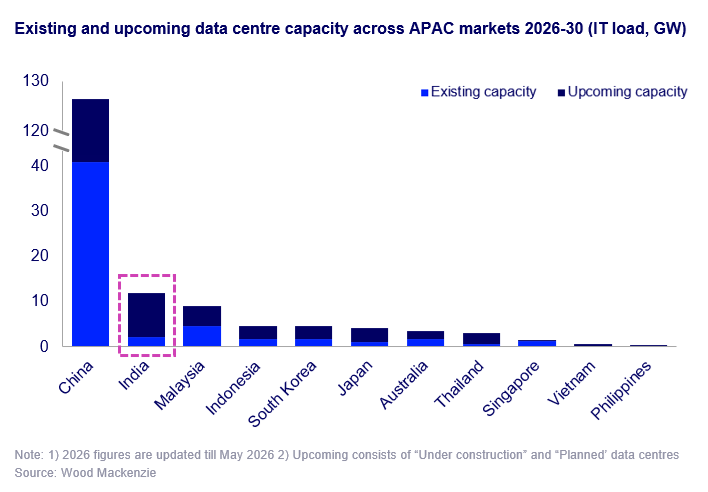
AI-dedicated capacity is expected to expand even faster, increasing nearly 24-fold from 275 MW in 2025 to 6,546 MW by 2030, driven by hyperscale cloud investments, enterprise digitalisation, and rapid adoption of artificial intelligence.
“India’s data centre market becomes a structural investment thesis,” said Souhardya Pal, Research Associate at Wood Mackenzie. “The convergence of hyperscale capital, AI workload growth and a decade of policy support have created the conditions for India to rival any market in Asia-Pacific.”
The report says India’s expanding digital economy is creating unprecedented demand for compute infrastructure. Valued at INR 32 trillion in 2025 and contributing roughly 12% of GDP, the ecosystem supports more than 1.03 billion active internet users and processes around 22 billion UPI transactions every month. India’s domestic AI market is projected to reach INR 11.7 trillion by 2032, further accelerating demand for high-performance computing infrastructure.
Wood Mackenzie also forecasts that data centre electricity consumption will increase 20-fold by 2040, rising from 10 TWh in 2025 and accounting for about 7% of India’s total electricity demand.
While Maharashtra and Tamil Nadu currently account for around 65% of installed IT load, the next phase of growth is expected to spread across Andhra Pradesh, Telangana, Uttar Pradesh, and Karnataka. These states are attracting investments from global hyperscalers such as Amazon Web Services and Google, as well as domestic operators including AdaniConnex, which has announced a 2.6 GW development pipeline.
The report includes a Hub Attractiveness Index that evaluates markets on power economics, sustainability, infrastructure ecosystem, and policy support.
According to the report, reliable and cost-competitive power has overtaken land and capital as the primary constraint in data centre development. Captive generation and long-term renewable power purchase agreements (PPAs) are emerging as the preferred procurement strategies, helping operators lower operating costs while meeting decarbonisation goals.
“Land and capital are no longer the limiting factors for data centre developers in India. What determines site selection and delivery timelines now is access to firm, round-the-clock power at the node level,” said Dr. Rashika Gupta, Vice President of Research at Wood Mackenzie. “Developers who secure their power strategy early through captive generation or long-term renewable PPAs will lock in a structural cost and sustainability advantage for the life of their assets.”
The report also identifies water availability as an underappreciated investment risk, particularly as AI workloads increase rack densities and cooling requirements. Water-stressed states such as Tamil Nadu and Karnataka may face growing pressure, prompting developers to adopt closed-loop cooling systems and zero liquid discharge technologies to reduce freshwater consumption and prepare for potential future regulation.
Wood Mackenzie concludes that India’s combination of strong digital demand, supportive policy, expanding renewable energy markets, and accelerating AI adoption is creating one of the world’s fastest-growing data centre markets. However, the firm says long-term success will increasingly depend on developers’ ability to secure reliable power, manage water resources, and choose locations that balance growth potential with infrastructure resilience.
Top of Form
Bottom of Form

