
AMD To Power Lux and Discovery Supercomputers For U.S. DOE’s Genesis Mission

The Genesis Mission brings together DOE national laboratories, industry, academia and other research organisations

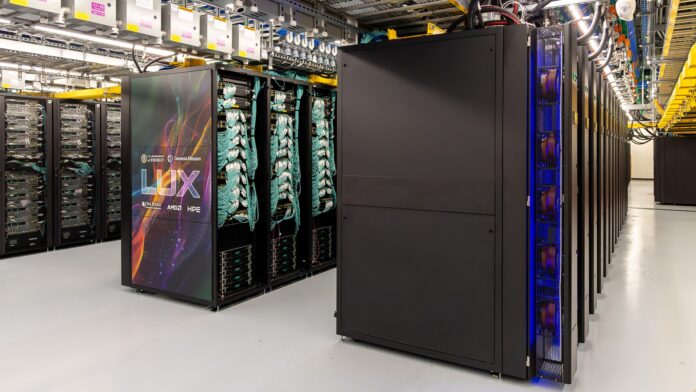
AMD has announced its role in advancing the U.S. Department of Energy’s (DOE) Genesis Mission through the next generation of AI and high-performance computing (HPC) systems, with the upcoming Lux supercomputer expected to become the mission’s first operational platform and Discovery planned as a future exascale flagship system.

Lux is scheduled to begin supporting funded research projects in October 2026. The system is designed to combine AI, simulation, data analytics and scientific computing on a single platform, helping accelerate research in energy, materials science, medicine, national security and advanced manufacturing.

The Genesis Mission brings together DOE national laboratories, industry, academia and other research organisations to use AI for scientific and engineering breakthroughs. By integrating simulation, data and AI workflows, the initiative aims to shorten the time required for discovery and improve the productivity of U.S. research programs.

According to AMD, Lux will provide researchers with an open and interoperable computing environment capable of supporting traditional HPC applications alongside cloud-native AI tools.

- Advertisement -

Thomas Zacharia, senior vice president of Strategic Technology Partnerships and Public Policy at AMD, said the company is helping turn the Genesis Mission into a working scientific platform. He added that Lux will enable researchers to combine simulation, AI, data and emerging computing workflows on a high-performance foundation, while Discovery will extend that foundation for the next generation of American science.

The Lux architecture will include AMD Instinct MI355X GPUs, AMD EPYC CPUs, AMD Pensando networking technologies and an open software ecosystem. The system is being designed to support the entire scientific workflow, from instrument data acquisition to AI-driven insight.

AMD said Lux is also intended to support future capabilities such as the American Science Cloud, collaborative AI model development, autonomous laboratories, digital twins, persistent AI services and workflows that span CPUs, GPUs and quantum processors.

The company pointed to the existing Frontier supercomputer, also powered by AMD technology, as an example of how converged AI and HPC can accelerate scientific research. Frontier is being used for applications including rapid plant-imaging analysis and the study of materials for tritium production in future fusion reactors.

These types of workflows are expected to expand with Lux and later Discovery, with research opportunities covering critical mineral recovery, fusion energy, hydropower, flood response and electrical grid resilience.

Discovery, which is planned in collaboration with the DOE, Oak Ridge National Laboratory and HPE, is intended to become a long-term platform for converged AI and exascale computing.

The future system is expected to use 6th Gen AMD EPYC processors, AMD Instinct MI430X GPUs, AMD Pensando networking technologies and the ROCm software stack. AMD said Discovery is being designed to support large-scale simulations, scientific models and integrated discovery workflows with native FP64 precision for high-accuracy computing.

The company described Discovery as the next step beyond Frontier and Lux, providing a leadership platform for deeper convergence between AI and high-performance computing in U.S. scientific research.


- Advertisement -
Loading form…
Nitisha Dubey
Nitisha Dubey
Nitisha Dubey is a journalist at EFY. She focuses on startups and innovations with a deep interest in new technologies and business models.

Industry's Buzz

HCLTech

HCLTech and Anthropic Partner to Accelerate Safe Enterprise Agentic AI

0
Global IT provider establishes dedicated Anthropic unit to build secure, governed Claude solutions for enterprise deployment.  HCLTech has announced a Global Premier Partnership with AI...

LTTS and Nvidia Launch AI-Native Manufacturing Lab in Bengaluru

0
The new facility leverages Nvidia accelerated computing to advance digital twins, industrial AI, and autonomous factory operations.  L&T Technology Services (LTTS) has inaugurated an AI-native...

TANAKA Targets Indian Semiconductor Expansion Without Local Plant

0
The Japanese supplier engages domestic firms following the Semicon 2.0 launch, but holds off on local manufacturing plans.  TANAKA Precious Metals India is looking to...

Defence Satcom Revenues to Exceed $22.6bn by 2035

0
Commercial satellite revenues in defence surge as armed forces shift to next-generation NGSO constellations.  Global demand for defence satellite communications is forecast to exceed 7.5...
Essencore

Essencore Partners With Syrma SGS, Brings KLEVV Products to India

0
Essencore and Syrma SGS Technology have partnered to expand electronics manufacturing in India and introduce KLEVV memory and storage products to the market, supporting...

Learn From Leaders

Does India’s Chip Packaging Growth Need Local Materials At Scale?

0
What will it take for specialised semiconductor materials manufacturing to grow in India? Packaging volumes will be a key factor as OSAT facilities move...
Ronak Kumar Samantray, Founder, TM2Space Technologies Pvt Ltd.

“Our goal is to build data centres in space.” – Ronak Kumar Samantray, TM2Space

0
A space startup aims to build orbital data centres, letting users run AI models and store data on satellites while also supplying satellite hardware...

India’s Photonics Puzzle Is Finally Coming Together 

0
Can India turn its scattered photonics capabilities into a stronger industry? A new association aims to connect the ecosystem and strengthen the domestic value...
Jin Bains, CEO, Mini-Circuits

Mini-Circuits CEO Jin Bains on Navigating High-Frequency Component SWaP-C Constraints, Emerging Markets, and Career...

0
In this exclusive, Jin Bains, Chief Executive Officer (CEO) of Mini-Circuits, explains in a conversation with Dilin Anand of EFY about areas of emerging...

India Needs Not a Hundred, But Thousands of Chip Diversified Companies 

0
Can India build a semiconductor ecosystem beyond fabs? Indiesemic believes thousands of diversified chip companies are needed to make that possible. India’s semiconductor push is...

Startups

Compcarta Reduces The Cost And Complexity Of End-To-End Chip Design

0
Building a chip should not require assembling an entire design ecosystem. A Noida-based startup is developing a browser-based EDA platform that aims to reduce...
PowerMon

Aquaexchange Brings Monitoring And Automation To Shrimp Farming

0
The startup has developed an AI- and IoT-enabled platform that helps shrimp farmers manage farms, access financing, monitor operations, and connect with markets. The startup...

Drone-Like Aircraft For Logistics From BluJ Aerospace

0
Hyderabad-based BluJ Aerospace is developing indigenous electric and hydrogen-powered vertical take-off and landing (VTOL) aircraft for remote cargo transport. BluJ Aerospace, a Hyderabad-based aerospace startup...
Jash Jetly, Co-founder and CEO of EVE

“The cloud isn’t the only way to run AI. We’re proving it can happen...

0
A startup is building a decentralised AI and communication network that runs across everyday devices instead of centralised cloud servers. In an interview, Jash...
Mohit Gupta, founder and CEO, TYLsemi

Building AI Chips, One Block at a Time 

0
What if building an AI chip became as simple as assembling reusable blocks? The startup is working to make custom silicon accessible beyond the...