Memory Shortages Trigger 4 Per Cent Decline in Global Smartphone Shipments 

Omdia says higher component costs and supply constraints are reshaping vendor strategies, with budget smartphones facing the greatest pressure. 
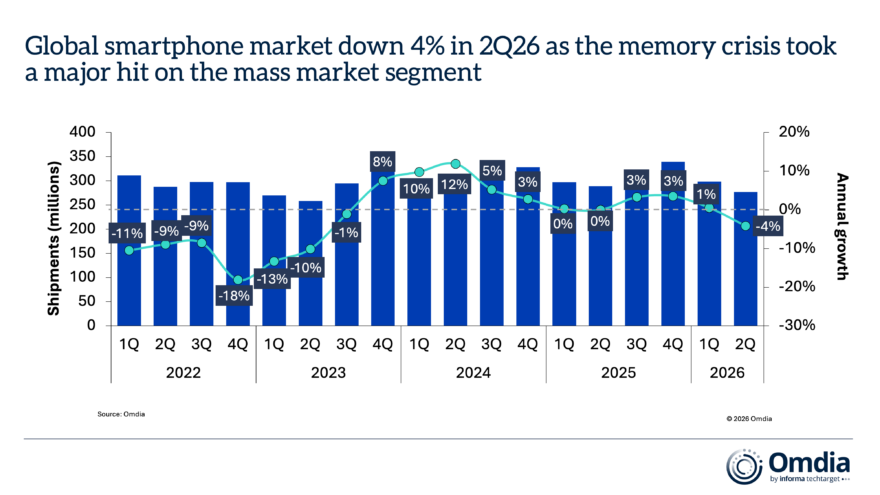
Global smartphone market down 4 percent in 2Q26

Global smartphone shipments declined 4 per cent year-on-year (YoY) in the second quarter of 2026 as soaring memory prices and supply shortages disrupted production and increased component costs, according to Omdia’s latest smartphone market research.

The research firm said the memory crisis has created a sharply polarised market, with vendors adopting different strategies based on their scale, target price segments and customer base. While the broader market contracted, Samsung and Apple outperformed rivals by expanding shipments and increasing market share.

Samsung retained its position as the world’s largest smartphone vendor with a 22 per cent market share in Q2 2026. Omdia attributed the performance to resilient consumer demand, stable component availability and delayed purchases of the Galaxy S26 series following its postponed launch. Samsung also strengthened its presence in the budget segment as several Chinese competitors reduced product portfolios and increased device prices.

Apple recorded its strongest-ever second-quarter performance, capturing a record 20 per cent market share during what is traditionally its weakest quarter. Omdia said robust demand for the iPhone 17 series drove one of Apple’s strongest upgrade cycles, while stable iPhone pricing gave the company an advantage as most rivals raised handset prices. However, the research firm noted that Apple’s price increases across other product categories towards the end of the quarter could eventually extend to iPhones.

- Advertisement -

Among Chinese vendors, Xiaomi retained third place with an 11 per cent market share, followed by OPPO at 10 per cent and vivo at 8 per cent.

According to Omdia, the greatest pressure was felt in the sub-US$400 smartphone segment, where supply constraints, narrow profit margins and price-sensitive consumers have forced manufacturers to shift their focus from shipment volumes to profitability. Vendors are streamlining product portfolios, adjusting retail prices and prioritising higher-value devices as memory costs continue to surge.

The research firm noted that memory and storage now account for more than 60 per cent of the bill of materials for budget smartphones and over 30 per cent for premium devices. In addition to memory shortages, semiconductor foundry constraints are adding further cost pressures across the supply chain.

Omdia expects memory prices to begin easing no earlier than the second half of 2027, although prices are unlikely to return to pre-2025 levels. The firm forecasts the steepest shipment declines over the next two quarters as seasonal demand from flagship launches, holidays and shopping festivals coincides with constrained memory supply.

As a result, smartphone brands are expected to increasingly focus on premium devices to protect margins. However, Omdia cautioned that higher prices will leave budget-conscious consumers with fewer affordable choices, leading many to delay purchases, opt for lower-specification models, finance new devices or turn to the refurbished smartphone market.


- Advertisement -
Loading form…
Nikita Kumari
Nikita Kumari
Nikita Kumari is a Journalist at EFY. She decodes deals, investments, and policy shifts, redefining the semiconductor and tech landscape.

Industry's Buzz

Samsung, Noida Factory

Samsung Hikes Chipmaking Prices by 15%, Due to Demand Spike

0
Chinese customers are facing the steepest price increases as US curbs on exports of advanced chipmaking equipment to China has increased reliance of local...

LG Begins Mass Production of 5G R16 Smart Telematics Solution for Vehicles

0
LG has also incorporated a scalable software platform based on its proprietary Automotive Telematics Platform (ATP) LG Electronics has started mass production of its next-generation...
Semiconductor

ECTC 2027 Calls for Papers and Courses

0
IEEE’s Electronic Component and Technology Conference (ECTC) 2027, is a premier conference for the world’s semiconductor packaging industry. It is to be held from...
IPO

Unitree Robotics Surge 629% to $66 Billion Valuation at Shanghai’s STAR Market Debut

0
Stocks surged as the first listing of the humanoid robot maker drew 9.8 million retail investors competing for just 9.7 million shares.   Shares of...
Keysight

Keysight Shares Rise 5% as AI Boom Boosts Q4 Profit Outlook 

0
Keysight expects fourth-quarter revenue of up to $1.95 billion as AI data centre expansion drives demand for electronic testing and simulation tools.  Keysight Technologies has...

Learn From Leaders

Navdeep Narula, Executive Director, Client and Endpoint Solutions, Ingram Micro, India

“Enterprise Computing Is Shifting From CPU to GPU And Now Toward NPU-Based Systems ”...

0
The shift from CPU to GPU to NPU-based computing is redefining today’s enterprise endpoints. In an exclusive conversation, Navdeep Narula from Ingram Micro discusses...

India’s Robotics Supply Chain Still Depends on Imported Chips

0
How do you build India’s physical AI future when critical robot components still come from overseas? Niqo Robotics reveals where the gaps remain.  India’s push...
Gadhadar Reddy, CEO and Founder, NoPo Nanotechnologies

How A Material Thinner Than Human Hair Could Transform EV Batteries And Electronics –...

0
What if a material 200,000 times thinner than a human hair could transform EV batteries, semiconductors, and advanced electronics? NoPo Nanotechnologies is making that...
Raja Rajeev Kumar, Mentor at IIT Startups, Chairman of the Board of Trustees, LaxmiRamaVarma Holdings International, and Founder and CEO, ChromoSoul Ventures

“Build Strong Startups, and Funding Will Follow”- Raja Rajeev Kumar, IIT Startups, LaxmiRamaVarma Holdings...

0
While AI and software startups attract attention and capital, electronics ventures often struggle for both. Raja Rajeev Kumar from IIT Startups, LaxmiRamaVarma Holdings International...
Athil Krishna, Founder & CEO, iHUB Robotics

“We are building humanoid robots that can replicate human tasks.”- Athil Krishna, iHUB Robotics

0
This Indian startup is building humanoid robots from scratch. Athil Krishna of iHUB Robotics speaks with Nidhi Agarwal from Electronics For You about the...

Startups

(L-R) Sri Kusulu Devalla, Co-Founder and Hetendra Singh Rathore, Founder, Segritech

“We don’t just sort fruit; we match every quality grade with the right buyer.”...

0
An agritech startup has developed an AI-powered machine that sorts and grades fruits directly on farms, helping reduce post-harvest losses by connecting produce with...
Akshar Vastarpara, Founder and CEO, Vicharak

“Our SBCs Are Designed As Complete Edge-Computing Platforms That Combine Everything On A Single...

0
An Indian startup builds affordable edge AI boards for robots, drones, and industry, positioning them as Raspberry Pi alternatives. In an EFY interview with...
Dr Naveen Yanduru, CEO, Axiro Semiconductor Private Limited

“India Can Lead In IP—If It BacksIts Own Builders”

0
Axiro Semiconductor designs RF and satellite chips, ships millions worldwide, and retains its startup mindset while tackling complex technical challenges. In a conversation with...
Dr Sanjay Ahuja, Founder and CEO of Cionlabs, India

“We are solving India-specific challenges rather than offering generic ‘black box’ IoT solutions.”

0
From hybrid mesh networking to AI-enabled edge devices, an Indian IoT startup is developing home-grown solutions to improve connectivity, strengthen privacy and support the...
RTLS

Amimotion’s World-Smallest UWB Tags That Give Factories A Digital Nervous System For Physical AI

0
A Bengaluru startup is turning factories into intelligent spaces with tiny UWB tags, AI-powered visibility, and real-time tracking that can automate workflows, improve safety,...