
The project aims to leverage India’s VLSI design talent to develop a scalable, indigenous semiconductor platform
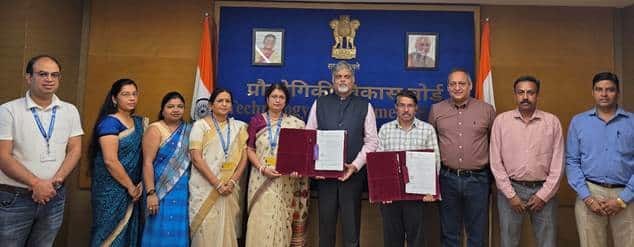
The Technology Development Board (TDB), under the Department of Science and Technology (DST), Government of India, has signed an agreement with Bengaluru-based BigEndian Semiconductors to provide ₹130 crore in financial support for its Project VeerAI under the Research Development and Innovation (RDI) Fund.
The project has a total cost of ₹260 crore and aims to take BigEndian’s technology from Technology Readiness Level (TRL)-5 to TRL-9. The financial support will be provided through Optional Convertible Debt (OCD).
Project VeerAI focuses on developing a camera-focused AI Vision System-on-Chip (SoC) on a sovereign technology platform. The chip is initially targeted at surveillance and CCTV applications, with the broader objective of reducing dependence on externally developed semiconductor technologies and supply chains.
The proposed SoC is designed to combine AI processing, security, privacy, connectivity, and smart features for surveillance applications in India and the Global South. The company plans to extend the platform to other sectors, including defence, automotive, industrial, and medical applications.
Under the project, BigEndian will undertake technology development, validation, integration, testing, and scale-up activities required to progress the technology from TRL-5 to TRL-9 and move it towards commercial deployment.
TDB Secretary Rajesh Kumar Pathak said that application-specific AI chips can play an important role in strengthening India’s semiconductor ecosystem. He added that support through the RDI Fund is intended to help Indian companies move technologies from advanced development stages to commercial deployment.
BigEndian Semiconductors said the funding will help accelerate the development and validation of Project VeerAI and advance its AI Vision SoC towards commercial readiness.
The project also aims to leverage India’s VLSI design talent to develop a scalable, indigenous semiconductor platform focused on application-specific requirements. The company expects the technology to support requirements related to data security, privacy, device-level intelligence, and technology sovereignty across critical applications.