


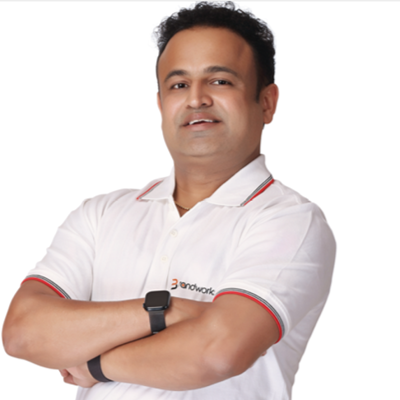

India’s surveillance market is shifting toward secure, design-led innovation. In an exclusive conversation, Ishwar Kumar, CEO of Brandworks Technologies, explains to Electronics For You’s Akanksha Sondhi Gaur and Nikita Kumari how the company is building full-stack, AI-driven solutions through in-house design, GaN technology, and advanced manufacturing aligned with STQC norms and India’s vision for a self-reliant electronics ecosystem.
Q. To begin with, what does Brandworks Technologies do, and what is your core focus today?
A. Ours is a full-stack electronics product company focused on designing and manufacturing advanced surveillance and mobility solutions. Our portfolio includes internet protocol (IP) cameras, closed-circuit television (CCTV) systems, indoor and outdoor surveillance devices, dashcams, and complete vehicle management systems. What differentiates us is our ability to deliver an end-to-end solution from hardware and printed circuit board (PCB) design to firmware, software, and final product assembly. While we operate across multiple electronics segments, surveillance is currently our primary focus, where we are building intelligent, secure, and scalable solutions for both Indian and global markets.
Q. What was the founding vision behind the company, and how has it evolved over time?
A. The company was founded with a clear vision to move India beyond assembly-led manufacturing into design-led product innovation. Historically, most electronics products in India were designed globally and assembled locally. We wanted to change that by owning the design, development, and product lifecycle within India. Over time, this vision has evolved into building full-stack, consumer-centric solutions where every product is designed based on real-world requirements and continuously improved through feedback loops. Today, we are not just building products, we are building an ecosystem of innovation.
Q. Which market segment are you primarily targeting?
A. We focus on the mid and mid-premium segments, where customers value a balance of performance, reliability and cost. This segment aligns well with our design-led and quality-driven approach.
Q. Beyond surveillance, are you exploring other product categories?
A. We operate across multiple electronics categories, including surveillance, mobility solutions such as dashcams and vehicle management systems, plus we continue to expand into other product segments based on market needs.
Q. Can you walk us through your product engineering and design approach?
A. Our design philosophy is iterative and feedback-driven. Every product evolves through multiple versions, incorporating lessons from real-world deployments. We have fully in-house capabilities across mechanical design, industrial design (ID), mold development (MD), PCB design, firmware, and software. This allows us to maintain tight control over performance, cost, and innovation. Importantly, design is not limited to form factor; it includes system-level optimisation, thermal management, power efficiency, and reliability engineering. By keeping design ownership in-house, we ensure both agility and long-term intellectual property creation.
Q. What are the core technical differentiators of your surveillance and dashcam solutions?
A. Our differentiation lies across three layers: hardware, software/firmware and system design. On the hardware side, we focus on optimised architectures that balance performance and cost, while ensuring reliability under varied environmental conditions. On the software side, our in-house firmware stack allows continuous upgrades, feature enhancements, and customisation for different use cases. At the system level, we integrate intelligent features, including artificial intelligence (AI)-based detection and cloud connectivity. Additionally, we pay close attention to industrial design and user experience, tailoring aesthetics and usability specifically for Indian and global markets.
Q. What role does product design play in your differentiation?
A. Design is a key differentiator for us. Beyond hardware and software, we focus heavily on aesthetics and user experience, ensuring our products align with the preferences and expectations of Indian and global consumers.
Q. Are you also developing your own platform or VMS capabilities?
A. Yes, alongside hardware, we are building our own video management system (VMS) platform. This strengthens our full-stack approach, enabling us to offer integrated hardware, software, and cloud-based solutions to our customers.
Q. How are you integrating advanced technologies like AI, ML, and cloud into your products?
A. AI is already a core pillar of our surveillance ecosystem, currently driven by a cloud-based architecture that enables centralised control and scalable deployments. We support over 60 predefined detection capabilities, including fire detection, fault identification, and advanced intelligent monitoring features, all managed server-side for efficiency and flexibility. Looking ahead, our focus is on advancing these capabilities by incorporating edge AI, allowing data processing directly on devices. This shift will enable faster response times, lower latency, and enhanced real-time decision-making, marking a strategic move from a primarily cloud-led model to a more balanced cloud-edge intelligence framework.
Q. What role do next-generation semiconductor technologies like GaN play in your designs?
A. Gallium Nitride (GaN) technology is significantly impacting our product architecture, especially in power management systems. Compared to traditional silicon-based solutions, GaN enables higher efficiency, reduced heat generation, and smaller form factors. This directly contributes to product miniaturisation, one of the biggest trends in electronics today. We are actively integrating GaN into our power designs across products, enhancing performance and aligning with the industry shift toward compact, energy-efficient systems.
Q. How is your design and R&D ecosystem structured geographically?
A. We have a distributed design and innovation ecosystem, with research and development (R&D) in Bengaluru, a design centre in Taiwan, and manufacturing facilities in Mumbai. This allows us to combine global design expertise with strong local manufacturing capabilities.
Q. Can you elaborate on your manufacturing infrastructure and reliability capabilities?
A. We have built a comprehensive manufacturing ecosystem with a strong emphasis on quality and reliability. Our facilities include surface mount technology (SMT) lines, automated assembly systems, automated optical inspection (AOI) and X-ray inspection, and complete end-of-line testing. A key strength is our advanced reliability lab, which houses over 150 testing systems covering thermal, electrical, environmental, and stress testing parameters, including heat, voltage surge, humidity, and temperature cycling. Additionally, we have established a cleanroom facility for camera module assembly, ensuring precision and a contamination-free manufacturing process. This infrastructure enables us to meet global quality standards.
Q. How important is ecosystem collaboration in your growth strategy?
A. Collaboration is central to our philosophy. We strongly believe that no single company can build everything alone, which is why we focus on ecosystem-driven innovation. Through our incubation initiatives, we mentor startups and support them in scaling, while our partnerships with academic institutions enable continuous research and talent development. By co-developing technologies with startups and academia, we not only stay aligned with emerging trends but also contribute meaningfully to the broader innovation landscape.
Q. Have you made any recent infrastructure investments to support growth?
A. Yes, we have recently invested in a dedicated camera manufacturing facility in Mumbai, which includes a cleanroom for camera module assembly and an advanced reliability lab to ensure product quality and performance.
Q. How do you manage supply chain challenges while maintaining innovation?
A. Our approach is a hybrid sourcing strategy. We prioritise domestic sourcing, wherever feasible, to support the Indian ecosystem and improve supply chain resilience. However, for specialised components or advanced technologies not yet available locally, we collaborate with global partners. This balance allows us to maintain both cost efficiency and access to cutting-edge components. At the same time, we are closely aligned with the evolving semiconductor ecosystem in India, which we believe will significantly reduce import dependency in the future.
Q. What challenges do you face in scaling such a technology-driven business?
A. Building technology products from scratch in India comes with inherent challenges, including design complexity, supply chain constraints, and longer go-to-market timelines. However, we see these not as limitations but as opportunities to strengthen our core capabilities. A design-led approach may extend time-to-market, but it ultimately results in more robust, reliable, and high-quality products. Our continued focus on R&D and iterative improvement enables us to navigate these challenges while delivering long-term value.
Q. How do you stay competitive in a price-sensitive market like India?
A. We optimise at multiple levels, especially in hardware design and component selection, to maintain cost efficiency. At the same time, our in-house firmware and software allow us to continuously add value without significantly increasing cost.
Q. How has the government’s surveillance policy and STQC certification impacted the market?
A. The introduction of standardisation testing and quality certification (STQC) has been a game-changer for the industry. It ensures that only secure and compliant products are deployed, which is critical from a national security standpoint. It has also eliminated a large number of low-cost, non-compliant products from the market, creating new opportunities for companies like ours that focus on quality and security. In many ways, this policy is accelerating the shift toward indigenous and trusted surveillance ecosystems.
Q. What exciting innovations or next-gen solutions are you currently working on?
A. One of the most exciting areas for us is building intelligent surveillance ecosystems that go beyond traditional monitoring. This includes deeper AI integration, advanced detection systems, and enhanced vehicle intelligence through our dashcam and mobility solutions. We are also working to improve system-level efficiency through technologies like GaN, enabling smaller, smarter, and more powerful devices. Additionally, our focus on full-stack development allows us to innovate across layers, whether it is hardware optimisation, firmware intelligence or cloud-based analytics. The convergence of these technologies is opening up entirely new possibilities in security and mobility.
Q. What are your expansion plans, both in terms of technology and market reach?
A. From a technology perspective, we are continuously expanding our R&D capabilities, investing in advanced labs, and strengthening our engineering teams. We are also deepening our work in AI, cloud platforms, and next-generation semiconductor integration. On the market side, our focus is on capturing a larger share of the surveillance ecosystem, particularly in the mid and mid-premium segments. We are also expanding partnerships with brands and system integrators to increase market penetration. Globally, we aim to position ourselves as a trusted provider of high-quality surveillance solutions originating from India.
Q. How do you see the Indian semiconductor and electronics ecosystem evolving?
A. India is at a pivotal point in its semiconductor journey. With strong government support through initiatives like India semiconductor mission (ISM), we are already seeing the emergence of design-led companies and early-stage manufacturing capabilities. Over the next decade, we expect a complete ecosystem from chip design to fabrication and product manufacturing to be established within the country. This will not only reduce dependency on imports but also position India as a global electronics hub.
Q. What is your long-term vision?
A. Our long-term vision is to become a leading player in the global surveillance ecosystem while contributing to India’s technological self-reliance. We are advancing India’s smart surveillance with AI, GaN and in-house R&D, moving beyond assembly to secure innovation. Over the next 3-5 years, we aim to capture a significant share of the surveillance market and build advanced products that enhance security infrastructure. More importantly, we want to establish Brandworks as a design-first, innovation-driven company that represents the next generation of Indian electronics manufacturing.

