



As the memory crisis continues to influence, falling smartphone shipments and rising component costs are widening gaps between premium brands and budget-focused manufacturers.
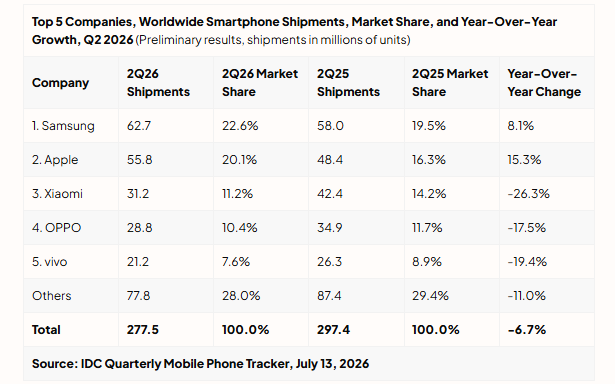
Global smartphone shipments declined 6.7% year-on-year to 277.5 million units in the second quarter of 2026, marking the second consecutive quarterly decline as rising memory prices continue to disrupt the industry, according to preliminary data from International Data Corporation (IDC).
The report said the ongoing memory supply crisis has created a sharp divide between premium smartphone makers and manufacturers focused on lower-priced devices.
Memory prices have increased by almost 300% compared with a year earlier and now account for more than 65% of the bill of materials (BoM) for entry-level smartphones, significantly increasing production costs.
Samsung retained the top position with shipments of 62.7 million units, representing a 22.6% market share and annual growth of 8.1%. Apple ranked second, shipping 55.8 million iPhones to secure a 20.1% market share, while recording the highest growth among the top five vendors at 15.3% year-on-year. IDC attributed Apple’s performance to strong demand for the iPhone 17 and purchases made ahead of anticipated price increases.
By contrast, Chinese manufacturers experienced steeper declines. Xiaomi remained third despite shipments falling 26.3% to 31.2 million units, followed by OPPO with 28.8 million units, down 17.5%, and vivo with 21.2 million units, a decline of 19.4%.
According to IDC, Samsung and Apple increased their market shares by 3.2 and 3.8 percentage points respectively, reflecting their stronger supply chain relationships and greater exposure to premium devices, where memory contributes a smaller proportion of production costs.
Furthermore, manufacturers targeting the sub-US$200 segment are increasingly repackaging older smartphones or offering 4G variants to maintain competitive pricing while managing higher component costs. Xiaomi has deliberately reduced low-end shipments to protect profitability and shift towards higher-priced devices.
Huawei was the exception among major Chinese brands, posting 20.9% year-on-year growth by maintaining stable pricing in China, expanding its product range, running targeted promotions and benefiting from strong domestic brand loyalty.
IDC said the memory crisis is expected to continue favouring manufacturers with scale, premium portfolios and secure component supply chains.

