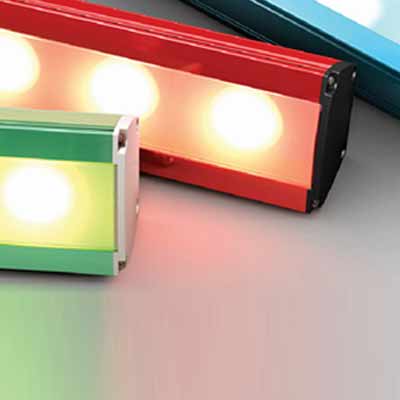

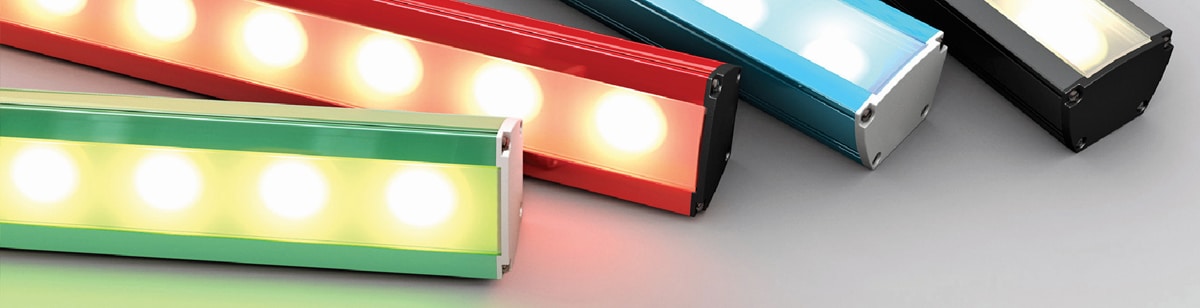
 LED luminaires today are being marketed as the practical solution to a world going green. There is no doubt that high power LEDs are the most efficient and widely considered lighting solutions of the future, yet, they do still produce substantial amounts of waste heat. Therefore, how to efficiently manage excess heat is a crucial challenge that designers are facing at present. So knowing the right solution can place them ahead of the crowd.
By Shruti Mishra
When it comes to high-power general and industrial lighting applications, reliability and efficiency are the two major factors under consideration. Light emitting diodes not only offer the best of these two qualities but are also the more durable, versatile and flexible of lighting solutions.
However, the light output, light quality and the lifetime reliability of LEDs are all temperature-dependent. This makes thermal management very crucial for the overall performance of LEDs. Being a semiconductor based product, LEDs generate substantial amounts of heat during their operation, within a very small area. As a result, it is crucial for LED makers to consider the most appropriate thermal management solutions that can dissipate the highly concentrated waste heat efficiently.
Thermal management in high-powered LEDs
In low-powered LEDs, thermal management solutions can take a back seat as the heat produced in these products can be conducted away via a standard polymer PCB. What escalated the need of thermal management solutions in LEDs is the current miniaturisation of the lights and fixtures, using high powered LEDs. The major challenge that LED designers now face is in how to combine optical and thermal designs within a tight space to get an optimised LED system. Using inappropriate thermal management solutions will result in heat not being dissipated fully, which will drag down the efficiency rating of the product and also harm the surrounding components. Therefore, the need for a properly engineered thermal management solution in an LED fixture is gaining traction these days. This not only increases the heat transfer efficiency of the product but also improves the lumen output of the fixtures, which ultimately contributes to a longer life span.
Advances in thermal dissipation techniques
Heat transfer technology in LEDs relies on both active and passive methods. Active cooling generally involves a fan that is designed to cool the LEDs. Because of their several rotating parts, makers are finding it difficult to use fans in complex or multi-fixture LEDs.
Nowadays, LED light makers have various other thermal management options, though most firms prefer using passive thermal management technologies because of their simple structure and low cost. Apart from heat sinks, there are two other passive cooling methods that designers are embracing these days, in modern LED fixtures, as they simplify designing.
These include the following:
Advanced heat-pipe based assemblies: The reason heat pipe-based thermal solutions are gaining popularity these days is because they successfully overcome the constraints of limited height and the need for reduced power consumption and no noise. This system functions on two phases of heat transfer—through the evaporation and condensation of a working fluid and is capable of dissipating heat more evenly than solid conductors such as aluminium or copper because of their lower total thermal resistance.
In many LED applications, the height over the fixture may not provide enough space for direct cooling. In such cases, heat-pipe assemblies can be the answer. A heat pipe uses the natural convection method, transferring the heat to multiple thin plate fins that are spaced properly, allowing the air to circulate naturally, regardless of the orientation of LEDs.
Above all, any electro-mechanical devices like fans have limited life and need regular maintenance. But the absence of any moving parts reduces the maintenance requirements for heat-pipes.
APG technology: A new alternative amongst solid conductors is annealed pyrolytic graphite (APG) that relies on heat transfer through conduction. APG is an excellent lightweight material with conductivity of 1700 W/m.K which is four times greater than that of copper (~390 W/m.K). Since APG is made up of carbon planes that possess poor mechanical properties, it is always encapsulated within other materials such as aluminium.
APG technology also has no moving parts, which mean that designers do not have to worry about durability and additional maintenance. In addition, APG solutions also allow designers to match the coefficients of thermal expansion (CTE), as needed.
| Recent products introduced into the market |
| Model: Phase change thermal conductive material, Manufacturer: Fischer Elektronik Fischer Elektronik’s new phase change thermal conductive materials provide an alternative to the conventional thermal conductive pastes. They combine the advantages of high 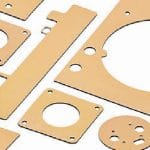 thermal performance with the reliability of phase change materials. It requires just a simple application of this material on the surfaces to be contacted. The FSF 15 P and FSF 20 P thermal conductive materials are solid when delivered, thermal performance with the reliability of phase change materials. It requires just a simple application of this material on the surfaces to be contacted. The FSF 15 P and FSF 20 P thermal conductive materials are solid when delivered,but begin to flow at a phase change temperature between 52 °C and 48 °C. Key features
Contact: www.fischerelektronik.de |
| Model: TPM550, Manufacturer: Electrolube TPM550 is one of Electrolube’s latest high-performance thermal interface material innovations. It is a phase change material that reaches its ‘activation’ temperature at 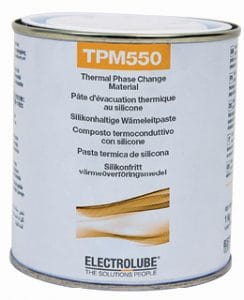 45°C—when it changes state to become a lower viscosity material, minimising the contact thermal resistance and improving the thermal conductivity. 45°C—when it changes state to become a lower viscosity material, minimising the contact thermal resistance and improving the thermal conductivity.Key features
Contact: www.electrolube.com |
| Model: Coolfin Giga, Manufacturer: MechaTronix
The CoolFin is designed for a minimal height of just 20cm, and is targeted at indoor LED top light applications without external sunlight. The first model is a 600 watt ultra- Key features
Contact: www.led-heatsink.com |
| Model: UR5641, Manufacturer: Electrolube The UR5641 is an optically clear flexible polyurethane resin, with the added bonus of  having excellent flame-retardant properties. Due to its exceptional properties, it is suitable for the protection of LED luminaires located in hazardous environments. having excellent flame-retardant properties. Due to its exceptional properties, it is suitable for the protection of LED luminaires located in hazardous environments.Key features
Contact: www.electrolube.com |
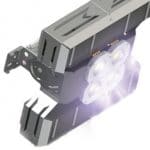 compact lightweight cooler based on advanced heat pipe technology, and is 270° tiltable, allowing users to freely adjust beam angles according to different needs. It is the ideal replacement for the current 1000 watt HID horticulture lamps.