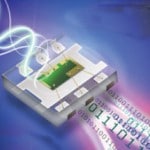
Harnessing the power of light, Germany witnesses a giant leap in supercomputing with the world’s first operational photonic AI processor, developed and claimed by Q.ANT at LRZ.
Germany has achieved a global first in high-performance computing (HPC) as the Leibniz Supercomputing Centre (LRZ) begins live operations with a photonic AI processor, developed by Stuttgart-based tech company Q.ANT.
According to the company, this marks the first time an analogue photonic co-processor has been integrated into a real-world data centre environment.
The initiative, backed by the German Federal Ministry for Research, Technology and Space, is part of a larger push to develop hybrid digital-analogue computing architectures. LRZ will use the new system to test applications in climate modelling, medical imaging, and fusion research.
Q.ANT’s Native Processing Server (NPS), now in operation at LRZ in Garching, enables AI and simulation workloads to be accelerated using light rather than electricity. The result is a large-scale reduction in energy consumption and a boost in processing density.
“This represents a milestone in our efforts to drive sustainable high-performance computing,” said Prof. Dr. Dieter Kranzlmüller, Chairman of LRZ. “The NPS integrates smoothly into our system, allowing us to assess its capabilities without disrupting existing operations.”
Furthermore, Q.ANT’s photonic chip performs complex computations without generating heat, removing the need for energy-intensive cooling systems. Compared to traditional processors, it promises up to 90 times less power use and up to 100 times greater computational density.
The chip delivers 16-bit floating point precision with near-total accuracy and supports widely used AI frameworks like TensorFlow and PyTorch.
Dr. Michael Förtsch, CEO of Q.ANT, called the deployment “a decisive step,” adding: “For the first time in history, we’re operating photonic processors in an HPC under practical workloads.”
German ministers Dorothee Bär and Markus Blume praised the deployment as a triumph of innovation and national collaboration, saying that this positions Germany at the forefront of post-CMOS computing technologies.