
The plant is expected to have an annual production capacity of 96 million semiconductor chips.
Prime Minister Narendra Modi recently inaugurated and unveiled the plaque for ASIP Technologies’ semiconductor manufacturing facility at Tarluvada in Visakhapatnam.
This initiative has a total investment of ₹25 billion. The outsourced semiconductor assembly and test (OSAT) facility is the first semiconductor manufacturing facility in Andhra Pradesh and South India approved under the India semiconductor mission (ISM 1.0).
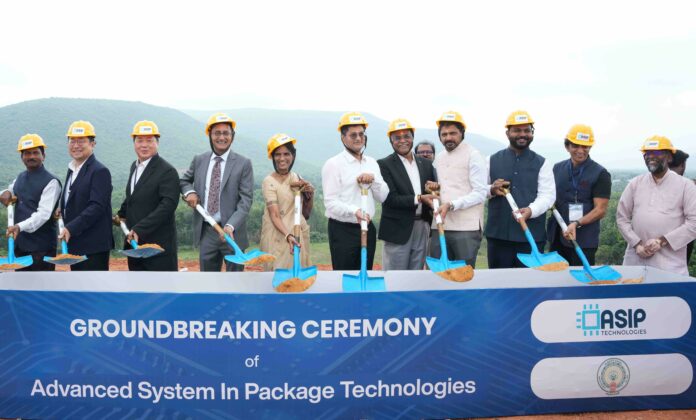
The foundation has been laid in the presence of Andhra Pradesh chief minister N. Chandrababu Naidu, along with senior government officials, industry leaders and global partners. Among those present were India Semiconductor Mission CEO Amitesh Kumar Sinha, Andhra Pradesh IT, Electronics and Communications Secretary Bhaskar Katamneni, and Special Secretary Mallavarapu Surya Teja.
The facility will be set up on a 12140.6sqm (30-acre) site with an initial investment of over ₹460 crore in collaboration with South Korea-based APACT Co. It will serve as the technology partner.
Once operational, the plant is expected to have an annual production capacity of 96 million semiconductor chips.
According to the company, the facility will cater to high-growth applications including artificial intelligence (AI), high-performance computing (HPC), data centres and high-speed communication systems.
ASIP Technologies has also announced plans for a significant expansion of the project, proposing an additional investment of more than ₹20 billion to scale up its advanced semiconductor packaging operations.
The project is expected to create over 1000 direct high-skilled jobs and around 1600 indirect jobs, contributing to the development of a semiconductor ecosystem in the state.
In the initial phase, the facility will begin production using wire-bond and flip-chip ball grid array (FC-BGA) packaging technologies. The company plans to introduce advanced 2.5D and 3D packaging capabilities within the next two to three years, enabling it to address more advanced semiconductor packaging requirements.
The Visakhapatnam OSAT project is expected to strengthen India’s semiconductor supply chain and support the country’s efforts to build domestic capabilities in advanced semiconductor assembly and packaging under the India semiconductor mission.