


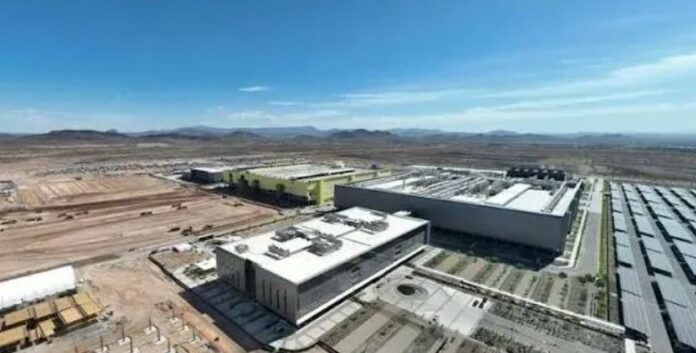

TSMC’s July revenue surged 44.7 per cent year-on-year to a record NT$467.58 billion, underscoring sustained AI demand and accelerating investment in advanced semiconductor manufacturing capacity.
Taiwan Semiconductor Manufacturing Company (TSMC) posted another record monthly revenue in July, with sales climbing 44.7 per cent year-on-year to NT$467.58 billion (about US$14.5 billion). Revenue also increased 5.6 per cent from June, providing another strong indication that demand for advanced computing semiconductors remains resilient.
The July performance extends a powerful run for the world’s largest contract chipmaker. TSMC’s cumulative revenue for January through July reached NT$2.87 trillion, representing a 37 per cent increase from the corresponding period last year. The company has maintained its expectation that 2026 revenue will grow by more than 40 per cent in US-dollar terms, supported principally by continued demand for AI-related computing.
Behind the numbers is a fundamental shift in semiconductor consumption. Artificial intelligence (AI) servers require considerably more sophisticated silicon than conventional computing systems, combining advanced CPUs and accelerators with high-bandwidth memory, networking chips and increasingly complex power-management architectures. TSMC sits at the centre of this supply chain, manufacturing advanced processors and accelerators for major technology companies.
Advanced process technologies are consequently becoming an increasingly important growth engine. TSMC’s leading-edge manufacturing is designed to deliver greater transistor density and improved power and performance characteristics, allowing chip designers to pack more computing capability into increasingly constrained power and thermal envelopes.
Advanced packaging is equally important. Technologies such as chip-on-wafer-on-substrate (CoWoS) allow multiple high-performance components and memory devices to be integrated into sophisticated computing packages. As AI workloads expand, packaging capacity has become a strategic constraint alongside wafer fabrication capacity. TSMC is therefore scaling both manufacturing and packaging capabilities to keep pace with demand.
The revenue trajectory also has implications beyond TSMC. Strong foundry demand supports the broader semiconductor equipment, materials, packaging and testing ecosystem while signalling continued capital expenditure across the chip supply chain.
For the electronics industry, July’s figures suggest that the semiconductor cycle is being reshaped by AI infrastructure rather than simply recovering from a conventional downturn. With advanced-node demand and high-performance computing continuing to drive orders, manufacturing capacity, process technology and packaging innovation are becoming increasingly decisive competitive factors.

